Torres reaches Ternate, part of the Spice …
Years: 1607 - 1607
January
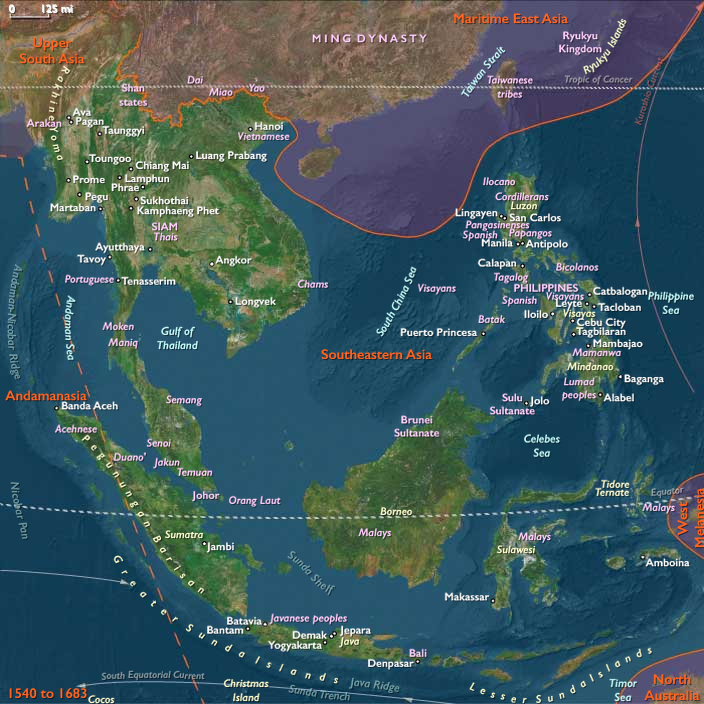
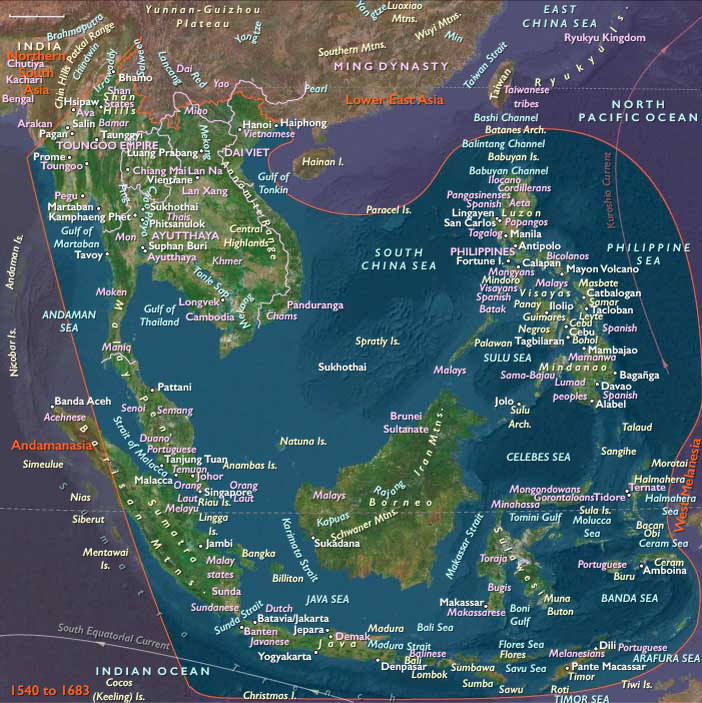
Torres reaches Ternate, part of the Spice Islands, at the beginning of January 1607.
Locations
People
Groups
Topics
Subjects
Regions
Subregions
Related Events
Filter results
Showing 10 events out of 33608 total
Ekatotsarot, whose reign has seen the influx of foreigners into Siam as traders and mercenaries, has established Krom Asas (i.e., volunteer regiments) of foreign soldiers, for example; Krom Asa Mon, Krom Asa Cham, Krom Asa Yipun (Japanese mercenaries), and Krom Asa Maen Puen (Arquebusiers - the Portuguese and Dutch).
Ekatotsarot had a close relations with the Tokugawa shogunate under Tokugawa Ieyasu who has commissioned Red Seal Ships—armed merchant sailing ships bound for Southeast Asian ports with a red-sealed paten—to trade with Siam.
Around this time, the Siamese metallurgists learn the arts of forging mortars from the Westerners and combine these principles with traditional methods, giving rise to the Siamese mortars praised for their high quality of manufacture and design.
Ekatotsarot has two legitimate sons: Prince Sutat and Prince Sri Saowabhak.
Prince Sutat is invested with the title of Uparaja in 1607.
Only four months later, Prince Sutat asks his father to release a prisoner; but instead angers his father, who accused Sutat of rebelling.
The prince commits suicide by poison the same night—much to the grief of Ekatotsarot.
This is one of the most mysterious events of Siamese history, as no one knows who was the prisoner Prince Sutat tried to free, nor why Ekatotsarot was so angry.
Some historians have hypothesized that the prisoner was one of the powerful nobles whose power was a challenge to the monarchy.
The nature of Prince Sutat's death is also disputed, as he may have been poisoned by someone else.
Whatever the facts, the incident lays the ground for future princely struggles that are to plague Ayutthaya throughout the seventeenth century.
Ekatotsarot defies expectatrions by not appointing as Uparaja his second son, Prince Sri Saowabhak.

Most Filipinos had converted to Roman Catholicism by around 1605.
San Agustin Church in Manila, officially completed on January 19, 1607, is currently the oldest church in the Philippines.
Catholic Emperor Rudolf II of Habsburg, responding to the protest of the bishop of Augsburg, had threatened an imperial ban in case of further violation of the rights of the Catholic citizens in Donauwörth.
Similar anti-Catholic incidents of civil disobedience nevertheless take place in 1607, and the participants of the Markus procession are thrown out of town.
Emperor Rudolf now declares an imperial ban on the town and orders Maximilian I, Duke of Bavaria to execute the ban.
Facing his army, the town surrenders.
According to imperial law, the disciplinary measures should not have been executed by the Catholic Duke of Bavaria, but by the Protestant Duke of Württemberg—which, like Donauwörth, is a member of the Swabian Imperial Circle.
Maximilian de facto absorbs the former Free Imperial City, which is a violation of imperial law as well.
Pedro Páez’s caution benefits his cause: Susenyos invites him to his court, where the two become friends.
Susenyos' reign is perhaps best known as the brief period in Ethiopian history when Roman Catholic Christianity became the official religion.
The Emperor became interested in Catholicism, in part due to Páez' persuasion, but also hoping for military help from Portugal and Spain.
Susenyos hopes to receive a new contingent of well-armed European soldiers, this time against the Oromo, who are ravaging his kingdom, and to help with the constant rebellions.
Two letters of this diplomatic effort survive, which he entrusts to Páez to send to Europe: the one to the King of Portugal is dated December 10, 1607, while the other is to the Pope and dated October 14 of the same year; neither mention his conversion, but both ask for soldiers.
He shows the Jesuit missionaries his favor by a number of land grants, most importantly those at Gorgora, located on a peninsula on the northern shore of Lake Tana.
The newly founded bank provides a new source of income for the Archhospital of Santo Spirito (founded 1201), whose financial difficulties had been increasing throughout the sixteenth century, and in 1607 the bank begins supervising the finances of the hospital, which owns the bank.
Caravaggio's Death of the Virgin, commissioned in 1601 by a wealthy jurist for his private chapel in the new Carmelite church of Santa Maria della Scala, had been rejected by the Carmelites in 1606.
Caravaggio's contemporary Giulio Mancini records that it was rejected because Caravaggio had used a well-known prostitute as his model for the Virgin; Giovanni Baglione, another contemporary, tells us it was due to Mary's bare legs—a matter of decorum in either case.
Caravaggio scholar John Gash suggests that the problem for the Carmelites may have been theological rather than aesthetic, in that Caravaggio's version fails to assert the doctrine of the Assumption of Mary, the idea that the Mother of God did not die in any ordinary sense but was assumed into Heaven.
Caravaggio, who leads a tumultuous life, is notorious for brawling, even in a time and place when such behavior is commonplace, and the transcripts of his police records and trial proceedings fill several pages.
He had killed, possibly unintentionally, a young man named Ranuccio Tomassoni on May 29, 1606.
Previously his high-placed patrons had protected him from the consequences of his escapades, but this time they could do nothing.
Caravaggio, outlawed, had fled to Naples.
Here, outside the jurisdiction of the Roman authorities and protected by the Colonna family, the most famous painter in Rome becomes the most famous in Naples.
His connections with the Colonnas lead to a stream of important church commissions, including the Madonna of the Rosary, and The Seven Works of Mercy.
Both sides in the Dutch Revolt now embark on an intensification of the fortress-building spree that had begun in the mid-1590s, enveloping the Republic in a double belt of fortresses on its outer borders (an outer Spanish and an inner Dutch belt).
This belt runs from Emden in the northeast via Bourtange, ...
...Coevorden, ...
...Zwolle, ...
...the line of the IJssel, with Deventer and ...