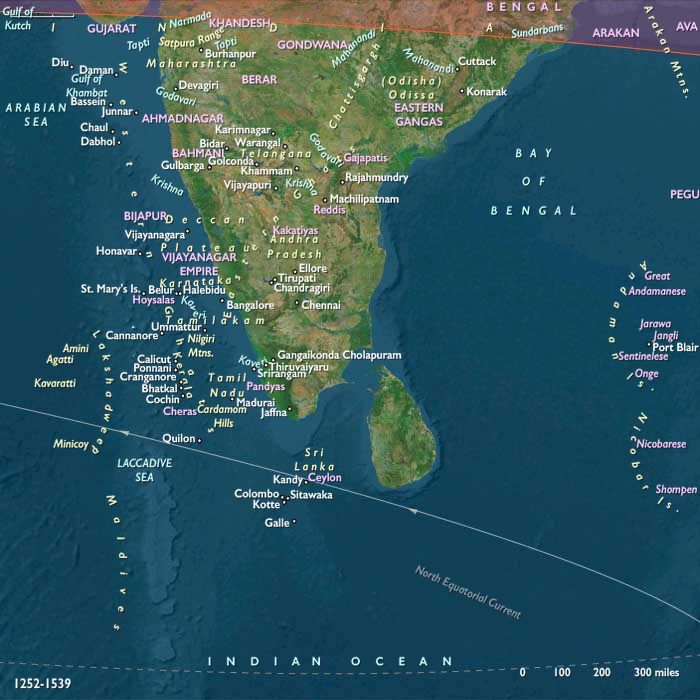
…Tirupati, a pilgrimage city located in the …
Years: 1524 - 1524
…Tirupati, a pilgrimage city located in the vicinity of the Tirupati Temple.
Refusing to take any support from his former King, he will die a pauper.
Locations
People
Groups
Topics
Commodoties
Subjects
Regions
Subregions
Related Events
Filter results
Showing 10 events out of 38519 total
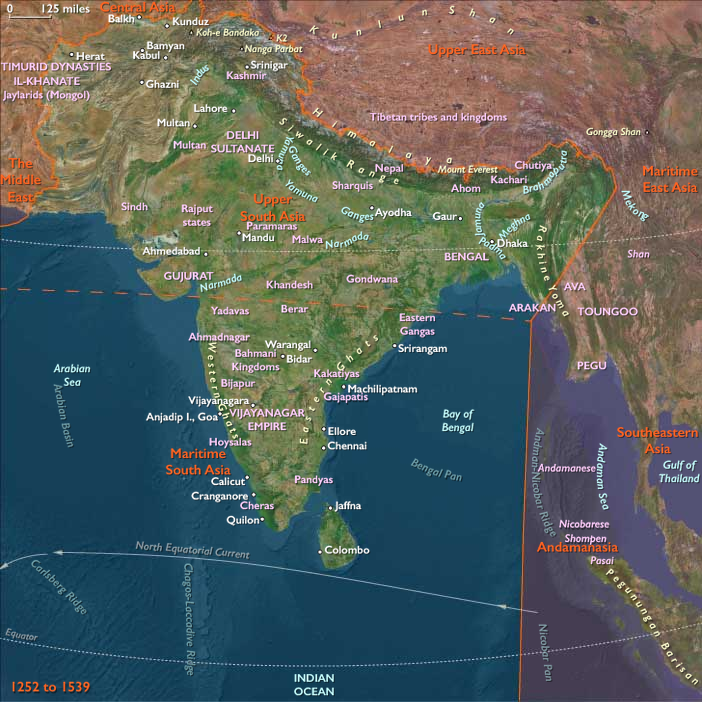
The Burmese kingdom of Ava had fought wars of unification from 1385 to 1424) but had never quite reassembled its lost empire.
The Mon kingdom of Hanthawaddy, having held off Ava, had entered its golden age, and Arakan had gone on to become a power in its own right.
In contrast, constant warfare had left Ava greatly weakened, and it has slowly disintegrated from 1481 onward.
The Shans of Mohnyin, invading Ava, which has failed to either appease the Shans or gain support from the Burmese kingdom of Toungoo to the south, have by 1524 seized Ava’s border garrisons and gained control of the upper Irrawaddy River, on the left bank of which, at the Myitnge confluence, lies Ava.
Magdeburg, which had become a member of the Hanseatic League, in the thirteenth century, is one of the largest cities in the Holy Roman Empire, with more than twenty thousand inhabitants.
The town has an active maritime commerce on the west (towards Flanders), with the countries of the North Sea, and maintains traffic and communication with the interior (for example Brunswick).
The citizens constantly struggle against the archbishop, becoming nearly independent from him by the end of the fifteenth century.
In about Easter 1497, the then twelve-year-old Martin Luther had attended school in Magdeburg, where he was exposed to the teachings of the Brethren of the Common Life.
In 1524, he was called to Magdeburg, where he preaches and causes the city's defection from Catholicism.
The earliest Lutheran chorale collections, the Achtliederbuch, comprising eight poems and four melodies, and the Enchiridion, containing about three times as much material, are published in 1524.
Both volumes are intended for congregational singing.
In the same year, Johann Walter, a twenty-eight-year-old colleague of Martin Luther, publishes the first collection of polyphonic chorale settings, which, because of their greater complexity, are clearly designed for choirs.
Walter was born in Kahla, in present-day Thuringia in 1496.
According to a document filed with his will, he was born with the surname of Blanckenmüller, but adopted out of poverty by a citizen of Kahla, and given an education at Kahla and Rochlitz under his new name, Johann Walter.
He had begun his career as a composer and bass cantor in the chapel of Frederick the Wise at the age of twenty-one.
It is a position he will hold until Frederick’s death in 1525.
By this time, he is the director of the chapel and has become an outspoken musical spokesman for Lutherans.
Walter edits the first Protestant hymnal for choir, Eyn geystlich Gesangk Buchleyn, in Wittenberg in 1524, with a foreword by Martin Luther himself.
Ismail dies on May 23, 1524, at the relatively young age of thirty-six.
He is buried in Ardabil, and is succeeded by his son Tahmasp.
Only ten years old and thus too young to rule in his own right, Tahmasp comes under the control of the Qizilbash.
The tribal rivalries between the Qizilbāsh, which had temporarily ceased before the defeat at Chaldiran, resurface in intense form immediately after the death of Ismāil.
Some of the tribes recognize a Qizilbash leader, Div Sultan Rumlu, as regent (atabeg) to the shah, but others dissent.
Babur’s aim has only been to expand his rule to Punjab, mainly to fulfill his ancestor Timur's legacy, since it used to be part of his empire.
At this time parts of north India are under the rule of Ibrahim Lodi of the Lodi dynasty, but the empire is crumbling and there are many defectors.
Receiving invitations from Daulat Khan Lodi, Governor of Punjab and Ala-ud-Din, uncle of Ibrahim, he sends an ambassador to Ibrahim, claiming himself the rightful heir to the throne of the country: however,the ambassador is detained at Lahore and released months later.
Babur starts for Lahore, Punjab, in 1524 but finds that Daulat Khan Lodi had been driven out by forces sent by Ibrahim Lodi.
When Babur arrives at Lahore, the Lodi army marches out and his army is routed.
In response, Babur burns Lahore for two days, then…
…marches to Dipalpur, placing Alam Khan, another rebel uncle of Lodi's, as governor.
Alam Khan is quickly overthrown and flees to Kabul.
In response, Babur supplies Alam Khan with troops who later join up with Daulat Khan Lodi and, together with about thirty thousand troops, besiege Ibrahim Lodi at Delhi.
He easily defeats and drives off Alam's army and Babur realizes Lodi will not allow him to occupy the Punjab.
Saluva Timmarusu or simply Timmarasa, who had served as the prime minister of Krishna Deva Raya, had also served as prime minister under Viranarasimha Raya.
He belongs to a Niyogi Telugu Brahmin family.
The later writings of Portuguese traveler Fernão Nunez suggest that Vira Narasimha, while on his death bed in 1509, had ordered Timmarasa to blind his half brother Krishna Deva Rraya to ensure that his own minor son of eight years would become king of the empire.
Timmarasa had instead presented the king with a pair of she-goat eyes in order to satisfy the wish of the dying king.
This way Timmarasa ensured that Krishnadevaraya became the successor.
However, there is no record to suggest anything but a friendly relationship between the two half brothers and that the coronation of Krishna Deva Raya had been a smooth one.
In 1524, Krishnadevaraya crowns his minor son Yuvaraja.
A few months later the prince falls ill and dies of poisoning.
Accusing Timmarusu for this crime, Krishnadevaraya has the entire family of the minister blinded.
It is said the King later released Timmarusu, on knowing that the conspiracy to kill his own son was hatched by the Gajapathis of Orissa, who belong to the great Solar Dynasty or Surya Vamsi clan of Orissa and did not want their princess Jaganmohini to wed Krishadevaraya, as they believed he was not of pure blue blood.
The Gajapathis had had to agree to this marriage, however, owing to Krishnadevaraya's victory over them.
Krishanadevaraya's parents, Narasa Nayaka, a chieftain from Dakshina Kannada and Nagaladevi, a chieftain's daughter from Uttara Kannada, are not from the royal family of Vijayanagara, the Sangama Dynasty).
The king later deplores and relents of his own actions with Timmarusu, who, on being released, will spend the rest of his life begging in …

Hain Ahmed Pasha, appointed as the Ottoman governor of Egypt in 1523, and disappointed that he had not been made grand vizier and his rival Pargalı Ibrahim Pasha had been made in his place, declares himself the Sultan of Egypt and Egypt independent from the Ottoman Empire.
He strikes coins with his own face and name in January 1524 in order to legitimize his power and captures Cairo Citadel and the local Ottoman garrisons.
After surviving an assassination attempt in his bath by two emirs that he had previously sacked, however, he flees Cairo and is finally captured by the Ottoman Empire and executed by decapitation.
His rebellion created a short period of instability in the nascent Egypt Eyalet.
Evidence of the effect of the Reformation is seen in early 1524.
Candlemas is not celebrated, processions of robed clergy cease, worshipers do not go with palms or relics on Palm Sunday to the Lindenhof, and triptychs remain covered and closed after Lent.
Opposition to the changes come from Konrad Hofmann and his followers, but the council decides in favor of keeping the government mandates.
When Hofmann leaves the city, opposition from pastors hostile to the Reformation breaks down.
The bishop of Constance tries to intervene in defending the mass and the veneration of images.
Zwingli writes an official response for the council and the result is the severance of all ties between the city and the diocese.
Shortly after the second Zurich disputation, many in the radical wing of the Reformation had become convinced that Zwingli was making too many concessions to the Zurich council.
They reject the role of civil government and demand the immediate establishment of a congregation of the faithful.
Conrad Grebel, the leader of the radicals and the emerging Anabaptist movement, speaks disparagingly of Zwingli in private.
The council on August 15, 1524, insists on the obligation to baptize all newborn infants.
Zwingli secretly confers with Grebel's group and late in 1524, the council calls for official discussions.
When talks are broken off, Zwingli publishes Wer Ursache gebe zu Aufruhr (Whoever Causes Unrest) clarifying the opposing points-of-view.
Genoa had been recaptured by the French, and in 1522 by the Imperialists, while Andrea Doria had been scouring the Mediterranean in command of the Genoese fleet, waging war on the Turks and the Barbary pirates, but Doria has now joined the French, or popular, faction, and has entered the service of King Francis, who has made him captain-general.
He relieves Marseille, besieged by the Imperial forces in 1524, and helps to place his native city once more under French domination.