…Timotheus ejects a Persian garrison he finds …
Years: 366BCE - 366BCE
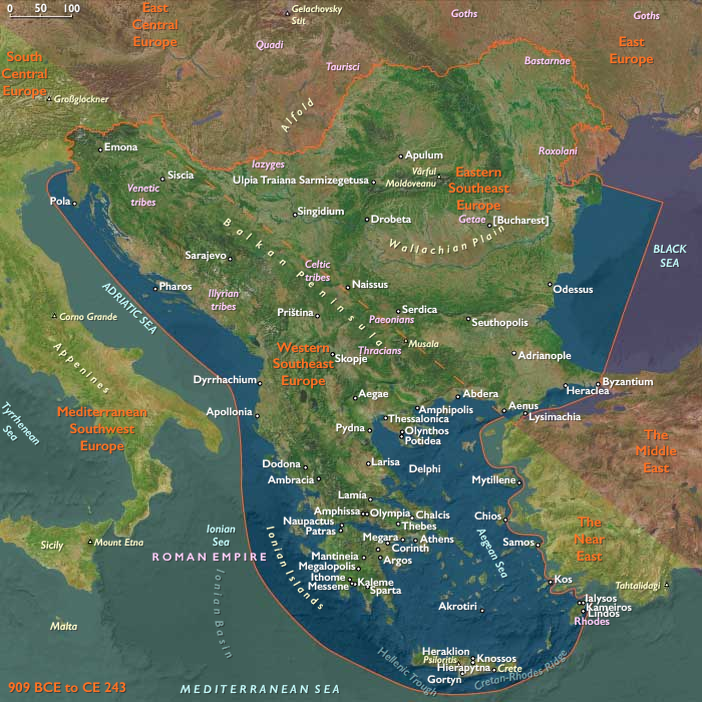
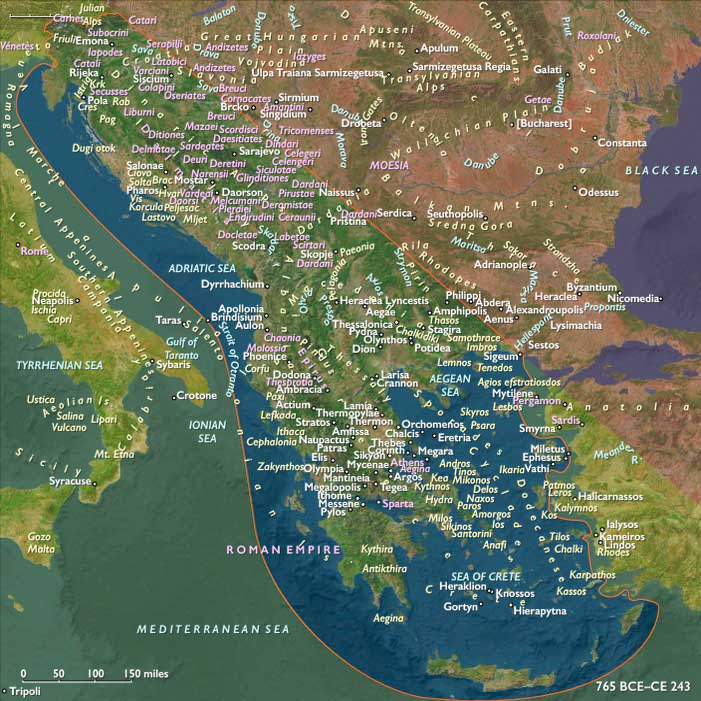
…Timotheus ejects a Persian garrison he finds installed on Samos, a violation of Persia's side of the original King's Peace.
It is surprising that Athens should act against Persia so soon if the peace of 366 is really a King's Peace, but the risk of reprisals at this time is slight.
In any case, Timotheus' somewhat contradictory instructions are to keep to the King's Peace while also helping Ariobarzanes.
Locations
People
Groups
- Thebes, City-State of
- Greece, classical
- Persian people
- Sparta, Kingdom of
- Peloponnesian League (Spartan Alliance)
- Boeotian League
- Achaemenid, or First Persian, Empire
- Athens, City-State of
- Athenian Empire or Confederacy, Second
Topics
Commodoties
Subjects
Regions
Subregions
Related Events
Filter results
Showing 10 events out of 44 total
Red Cloud's War ends with victory for the Lakota Sioux.
The Treaty of Fort Laramie (1868) with the United States confirms the Lakota control over all the high plains from the Black Hills of the Dakotas westward across the Powder River Basin to the crest of the Big Horn Mountains.
Hereafter bands of Lakota Sioux led by Sitting Bull, Crazy Horse, Gall and others, along with their Northern Cheyenne allies, will hunt and raided throughout the length and breadth of eastern Montana and northeastern Wyoming, which had been for a time ancestral Crow territory.
The Crows are killed to either last or last but one man.
The Sioux lose fourteen warriors.
Sioux chief Sitting Bull takes part in this battle.
Later, mourning Crows with "their hair cut off, their fingers and faces cut" bring the dead bodies back to camp.
The drawing from the Sioux winter count of Lone Dog shows the Crows in the circle (the breastwork), while the Sioux close in on them.
The many lines indicates flying bullets.
Crow chief Blackfoot objects to this incursion and calls for resolute U.S. military actions against the trespassers.
Due to Sioux attacks on both civilians and soldiers north of the Yellowstone in newly established U.S. territory (Battle of Pease Bottom, Battle of Honsinger Bluff), the Commissioner of Indian Affairs advocates the use of troops to force the Sioux back to South Dakota in his 1873 report.
No action is taken.
George Bird Grinnell, a member of the exploring party in the Yellowstone National Park this year, sees the bringing in of the dead chief.
A mule carries the body, which is wrapped in a green blanket.
The chief is placed in a tipi "not far from the Crow camp, reclining on his bed covered with robes, his face handsomely painted".
Crow woman Pretty Shield remembers the sadness in camp. "We fasted, nearly starved in our sorrow for the loss of Long-Horse."
The Black Hills are sacred to the Lakota nation.
The rapid influx of prospectors to the region, a part of the Powder River territory not ceded by the Native Americans to the United States, and the attendant friction causes war to begin in earnest in 1876, the year that a combined force of Northern Cheyenne, Lakota, and Arapaho under Sitting Bull and Crazy Horse annihilate Colonel George Custer and most of the US Seventh Cavalry.
The Fort Laramie Treaty of 1868, signed with the United States by Lakota and Northern Cheyenne leaders following Red Cloud's War, had set aside a portion of the Lakota territory as the Great Sioux Reservation.
This includes the Black Hills region for their exclusive use.
It also provided for unceded territory for Cheyenne and Lakota hunting grounds.
The growing number of miners and settlers encroaching in the Dakota Territory, however, has rapidly nullified the protections.
The US government could not keep settlers out.
By 1872, territorial officials were considering harvesting the rich timber resources of the Black Hills, to be floated down the Cheyenne River to the Missouri, where new plains settlements need lumber.
The geographic uplift area suggested the potential for mineral resources.
When a commission approached the Red Cloud Agency about the possibility of the Lakota's signing away the Black Hills, Colonel John E. Smith noted that this was "the only portion [of their reservation] worth anything to them".
He concluded that "nothing short of their annihilation will get it from them". (Smith to Gen. Ord, June 27, 1873, Department of the Platte, Letters Received, National Archives. Colonel (brevet Brigadier General) Smith was commander of the 14th Infantry, headquartered at Fort Laramie, who had extensive experience with the Lakota.)
The government had dispatched the Custer Expedition in 1874 to examine the Black Hills, alarming the Lakota.
Before Custer's column had returned to Fort Abraham Lincoln, news of their discovery of gold had been telegraphed nationally.
The presence of valuable mineral resources had been confirmed the following year by the Newton-Jenney Geological Expedition.
Prospectors, motivated by the economic panic of 1873, had soon begun to trickle into the Black Hills in violation of the Fort Laramie Treaty.
This trickle has turned into a flood as thousands of miners invaded the Hills, with organized groups coming from states as far away as New York, Pennsylvania, and Virginia.
The United States Army had struggled initially to keep miners out of the region.
In December 1874, for example, a group of miners led by John Gordon from Sioux City, Iowa, had managed to evade Army patrols and reached the Black Hills, but the Army ejected them three months later.
Such evictions, however, have increased political pressure on the Grant Administration to secure the Black Hills from the Lakota.
Sioux delegations headed by Spotted Tail, Red Cloud, and Lone Horn had traveled to Washington, D.C., in May 1875 in an eleventh-hour attempt to persuade President Ulysses S. Grant to honor existing treaties and stem the flow of miners into their territories.
They had met with Grant, Secretary of the Interior Columbus Delano, and Commissioner of Indian Affairs Edward Smith.
The US leaders had said that the Congress wanted to pay the tribes twenty-five thousand for the land and have them relocate to Indian Territory (in present-day Oklahoma).
The delegates had refused to sign a new treaty with these stipulations.
Spotted Tail said, "You speak of another country, but it is not my country; it does not concern me, and I want nothing to do with it. I was not born there ... If it is such a good country, you ought to send the white men now in our country there and let us alone."
Although the chiefs had been unsuccessful in finding a peaceful solution, they will not join Crazy Horse and Sitting Bull in the warfare that is to come.
A US commission had been sent in autumn 1875 to each of the Indian agencies to hold councils with the Lakota in hopes of gaining the people's approval and thereby bringing pressure on the Lakota leaders to sign a new treaty, but the government fails in its attempt to secure the Black Hills.
While the Black Hills are at the center of the growing crisis, Lakota resentment is growing over expanding US interests in other portions of Lakota territory.
For instance, the government had proposed that the route of the Northern Pacific Railway cross through the last of the great buffalo hunting grounds.
In addition, the US Army had carried out several devastating attacks on Cheyenne camps before 1876.

The Great Sioux War of 1876–77 begins on February 8, when Major General Philip Sheridan, commander of the Division of the Missouri, telegraphs Brigadier Generals George Crook, commander of the Department of the Platte, and Alfred Terry, commander of the Dakota Territory, ordering them to commence their winter campaigns against the "hostiles".
The non-treaty bands of Lakota and Northern Cheyenne, who had refused to come to the Indian agencies for council, have refused the offer of twenty-five thousand dollars from the United States to relocate from the Black Hills region to Indian Territory (present Oklahoma).
Sheridan and Crook had been called to Washington, D.C. in early November 1875 to meet with President Grant and several members of his cabinet to discuss the Black Hills issue.
They had agreed that the Army should stop evicting trespassers from the reservation, thus opening the way for the Black Hills Gold Rush.
The government had instructed Indian agents in the region to notify the various non-treaty bands to return to the reservation by January 31, 1876, or face potential military action.
The United States agent at Standing Rock Agency expresses concern that this is insufficient time for the Lakota to respond, as deep winter restricts travel.
His request to extend the deadline is denied.
Lakota leaders in the council lodges of the non-treaty bands meanwhile seriously discuss the notification for return.
Short Bull, a member of the Soreback Band of the Oglala, later recalls that many of the bands had gathered on the Tongue River.
"About one hundred men went out from the agency to coax the hostiles to come in under pretense that the trouble about the Black Hills was to be settled," he said.
"...All the hostiles agreed that since it was late [in the season] and they had to shoot for tipis [i.e., hunt buffalo] they would come in to the agency the following spring." (Grant Short Bull Interview, July 13, 1930, in Eleanor H. Hinman (ed.) "Oglala Sources on the Life of Crazy Horse", Nebraska History v. 57 no. 1 (Spring 1976) p. 34.
As the deadline of January 31 passes, the new Commissioner of Indian Affairs, John Q. Smith, writes that "without the receipt of any news of Sitting Bull's submission, I see no reason why, in the discretion of the Hon. the Secretary of War, military operations against him should not commence at once."
His superior, Secretary of the Interior Zachariah Chandler, agrees, adding that "the said Indians are hereby turned over to the War Department for such action on the part of the Army as you may deem proper under the circumstances."
General Crook immediately launches the first strike while General Terry stalls.
He dispatches Colonel Joseph J. Reynolds with six companies of cavalry, who locate a village of about sixty-five lodges and attack on the morning of March 17, 1876.
Crook accompanies the column but does not play any command role.
His troops initially take control of and burn the village, but they quickly retreat under enemy fire.
The U.S. troops leave several soldiers on the battlefield, an action which leads to Colonel Reynolds' court martial.
The U.S. army had captured the band's pony herd, but the following day, the Lakota recover many of their horses in a raid.
The Army believes they have attacked Crazy Horse; however, it was actually a village of Northern Cheyenne (led by Old Bear, Two Moons and White Bull) with a few Oglala.
The Montana Column, commanded by Colonel John Gibbon, departs Fort Ellis.
General Crook commands a third column that departs Fort Fetterman to head north.
The plan is for all three columns to converge simultaneously on the Lakota hunting grounds and pin down the Indians between the approaching troops.
Years: 366BCE - 366BCE
Locations
People
Groups
- Thebes, City-State of
- Greece, classical
- Persian people
- Sparta, Kingdom of
- Peloponnesian League (Spartan Alliance)
- Boeotian League
- Achaemenid, or First Persian, Empire
- Athens, City-State of
- Athenian Empire or Confederacy, Second