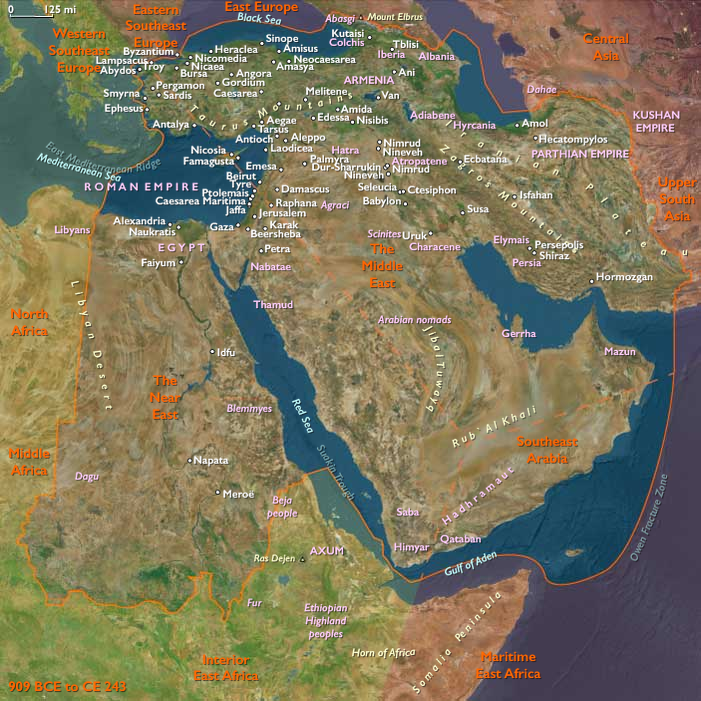
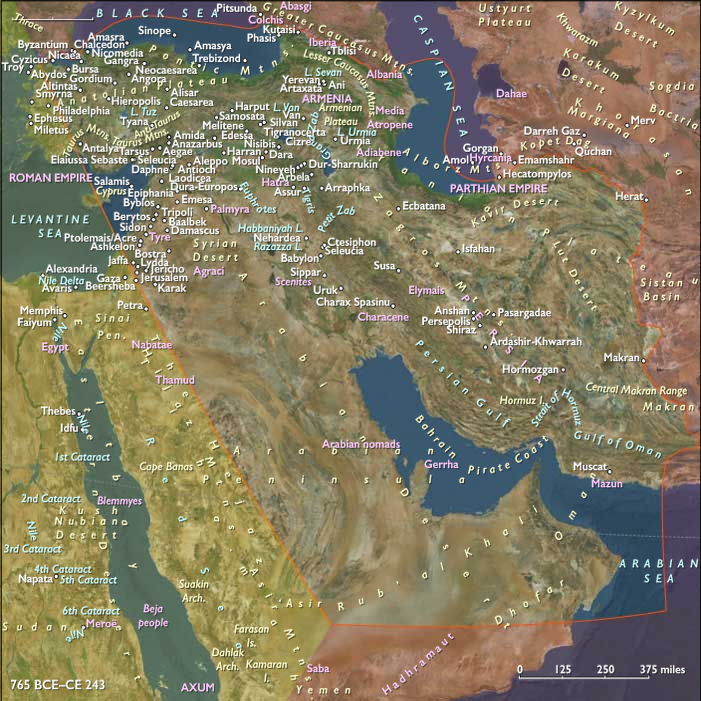
…Tigranes retires to the northern regions of …
Years: 69BCE - 69BCE
…Tigranes retires to the northern regions of his kingdom to gather another army and defend his hereditary capital of Artaxata, while …
Locations
People
Groups
- Iranian peoples
- Armenian people
- Roman Republic
- Greeks, Hellenistic
- Pontus, Kingdom of
- Parthian Empire
- Seleucid Empire
- Armenia, Empire of
Topics
- Classical antiquity
- Roman Republic, Crisis of the
- Mithridatic War, Third
- Roman-Armenian War of 72-66 BCE
Commodoties
Subjects
Regions
Subregions
Related Events
Filter results
Showing 10 events out of 26 total
The Old Book of Tang describes Guangzhou as important port in the south of China.
Direct routes connect the Near East and China in this period: a Chinese prisoner, who had been captured in 751 in the Battle of Talas and had stayed in Iraq for twelve years, returns to China by ship on a direct route from Iraq to Guangzhou.
Sacked by Arab and Persian raiders during the turmoil of the An Shi Rebellion, tThe port will remain shut down for the next five decades while foreign vessels dock at Hanoi instead, yet Guangzhou will thrive again once it is reopened to foreign trade in the early ninth century.
Wang Duo had by this point volunteered to oversee the operations against Huang, and Wang is thus made the overall commander of the operations as well as the military governor of Jingnan Circuit (headquartered in modern Jingzhou, Hubei).
In reaction to Huang's movement, he commissions Li Xi to be his deputy commander, as well as the governor of Hunan Circuit (headquartered in modern Changsha, Hunan), in order to block a potential northerly return route for Huang.
Meanwhile, Huang writes Cui Qiu, the governor of Zhedong Circuit and Li Tiao, the military governor of Lingnan East Circuit (headquartered in modern Guangzhou, Guangdong), to ask them to intercede for him, offering to submit to Tang imperial authority if he were made the military governor of Tianping.
Cui and Li Tiao relay his request, but Emperor Xizong refuses.
Huang then makes a direct offer to Emperor Xizong, requesting to be the military governor of Lingnan East.
Under the opposition of the senior official Yu Cong, however, Emperor Xizong also refuses, instead, at the chancellors' advice, offering to make Huang an imperial guard general.
Huang, receiving the offer, is incensed by what he perceives to be an insult.
He attacks Lingnan East's capital Guang Prefecture in fall 879, capturing it after a one-day siege and taking Li Tiao captive.
He orders Li Tiao to submit a petition to Emperor Xizong on his behalf again, but this time, Li Tiao refuses, so he executes Li Tiao.
The Arab historian Abu Zayd Hasan of Siraf reports that when Huang Chao captured Guang Prefecture, his army killed a large number of foreign merchants resident there: Muslims, Jews, Christians, and Parsees.
The ethnicity of the killed were reported to be Persians, Arabs, and Jews.
However Chinese sources do not mention the alleged massacre, stating only that mulberry groves were ruined by his army.
However, Huang Chao's army in the Lingnan region is stricken by illnesses, and some 30-40% die.
His chief subordinates suggest that he march back north, and he agrees.
Liu Yin had been named regional governor and military officer by the Tang court in 905.
Though the Tang had fallen two years later, Liu had not declared himself the founder of a new kingdom as other southern leaders had done, but merely inherited the title of Prince of Nanping in 909.
It is not until Liu Yin’s death in 917 that his brother, Liu Yan, declares the founding of a new kingdom, which he initially calls "Great Yue,” but he will change the name to Great Han in 918, because his surname Liu is the imperial surname of the Han dynasty and he claims to be a descendant of that famous dynasty.
The kingdom, in Panyu (modern-day Guangdong) and Guangxi, is often referred as the Southern Han Dynasty throughout China's history.
Zhang Hongfan of the Yuan, reinforced by Li Heng, who previously had captured Guangzhou, attacks the Song navy in Yamen in 1279.
Some within the Song forces suggest that the navy should first claim the mouth of the bay, to secure their line of retreat to the west.
Zhang Shijie turns down this suggestion in order to prevent his soldiers from fleeing the battle.
He then orders the burning of all palaces, houses and forts on land for the same reason.
Zhang Shijie orders about one thousand warships to be chained together, forming a long string within the bay, and places Emperor Huaizong's boat in the center of his fleet.
This is done to prevent individual Song ships from fleeing the battle.
The Yuan forces steer fire ships into the Song formation, but the Song ships are prepared for such an attack: all Song ships have been painted with fire-resistant mud.
The Yuan navy then blockades the bay, while the Yuan army cuts off Song's fresh water and wood sources on land.
The Song side, with many noncombatants, soon runs out of supplies.
The Song soldiers are forced to eat dry foods and drink sea water, causing nausea and vomiting.
Zhang Hongfan even kidnaps Zhang Shijie's nephew, asking Zhang Shijie to surrender on three occasions, to no avail.
Zhang Hongfan prepares for a massive assault in the afternoon of March 18.
The employment of cannons is rejected because Hongfan feels that cannons could break the chains of the formation too effectively, making it easy for the Song ships to retreat.
The next day Zhang Hongfan splits his naval forces into four parts: one each of the Song's east, north, and south sides, while Hongfan leads the remaining faction to about a li away from the Song forces.
First, the north flank engages the Song forces but are repulsed.
The Yuan then begin playing festive music, leading the Song to think that the Yuan forces are having a banquet and lowering their guard.
At noon, Zhang Hongfan attacks from the front, hiding additional soldiers under large pieces of cloth.
Once Zhang Hongfan's boats near the Song fleet, the Yuan sounds the horn of battle, revealing the soldiers under the fabric.
The Song troops are prepared for a small skirmish, not a large assault.
Waves of arrows hit the Song ships.
Caught off guard, the Song fleet immediately loses seven ships, along with a great number of troops in the process.
The ill and weakened Song soldiers are no match for the Yuan troops in close combat, and the chaotic environment makes battle command impossible.
The chained Song ships can neither support the middle or retreat.
After the Song troops are killed, the bloody slaughter of the Song court begins.
Seeing that the battle is lost, Zhang Shijie picks out his finest soldiers and cuts about a dozen ships from the formation in an attempted breakout to save the emperor.
The Yuan forces quickly advanced to the center and to Emperor Huaizong, killing everyone in their way.
Here, Left Prime Minister Lu Xiufu sees no hope of breaking free and, taking the boy emperor with him, jumps into the sea, where both drown.
Many officials and concubines follow suit.
The History of Song records that, seven days after the battle, hundreds of thousands of corpses floated to the surface of the sea.
Reportedly, the body of the boy emperor was found near today's Shekou in Shenzhen, though his actual grave has yet to be found.
Zhang Shijie, having escaped the battle, hoped to have Dowager Yang appoint the next Song emperor, and from there continue to resist the Yuan dynasty.
However, after hearing of Emperor Huaizong's death, Dowager Yang also commits suicide at sea.
Zhang Shijie buries her at the shore.
He and his remaining soldiers are assumed to have drowned at sea, as a tropical storm whipped up soon afterwards.
The death of Emperor Huaizong of Song effectively ends the Song dynasty, thus leading the House of Zhao, for the first time, to lose control over China after three hundred and nineteen years.
The Yuan dynasty, under Kublai Khan, now has all of China under its control.
He and and his descendants and followers will rule China for ninety-seven years until the rise of the native Ming dynasty under the Hongwu Emperor of the House of Zhu.

The Franciscan missionary Odoric of Pordenone had sailed from India in a junk to Sumatra, visiting various ports on the northern coast of that island, and thence to Java, to the coast (it would seem) of Borneo, to Champa (Indochina), and to Guangzhou (Canton), at this time known as Chin-Kalan or Great China (Mahachin).
From Guangzhou, …
The first signs of the White Lotus Society had come during the late thirteenth century.
Mongol rule over China, known also by its dynastic name, the Yuan dynasty,had prompted small, yet popular demonstrations against foreign rule.
The White Lotus Society had taken part in some of these protests as they grew into widespread dissent.
The Mongols considered the White Lotus society a heterodox religious sect and banned it, forcing its members to go underground.
Now a secret society, the White Lotus became an instrument of quasi-national resistance and religious organization.
A revolution, inspired by the White Lotus society, takes shape in 1352 around Guangzhou.
A Buddhist monk and former boy-beggar, Zhu Yuanzhang, throws off his vestments and joins the rebellion.
His exceptional intelligence takes him to the head of a rebel army; he wins people to his side by forbidding his soldiers to pillage, in observance of White Lotus religious beliefs.
Contacts between Asia and the west already dated back hundreds of years, especially between the Papacy and the Mongol Empire in the thirteenth century.
There were also numerous traders that traveled between the continents, the most famous of which is Marco Polo.
Christianity is not new to the Mongols, as many have been practicing Nestorian Christianity since the seventh century.
However, the overthrow of the Mongol Yuan Dynasty by the Ming in 1368 resulted in a strong assimilatory pressure on China's Muslim, Jewish, and Christian communities, and outside influences were forced out of China.
By the sixteenth century, there is no reliable information about any practicing Christians remaining in China.
Syphilis seemed to have reached Guangzhou in 1505.
The first Portuguese explorer credited with reaching China is Jorge Álvares, who arrives at Guangzhou via the Pearl River Delta in 1513.
The Portuguese have not only monopolized the European spice trade after the conquest of Malacca in 1511 but also meet and trade avidly with Chinese merchants.
When Portuguese under Diogo Lopes de Sequeira had earlier arrived in Malacca in 1509 to open trade relations, he had been supported by the local Chinese merchants there (along with Javanese and Tamil merchants).
Alfonso D'Albuquerque had sent Jorge Álvares to explore northward; his expedition had sailed along the coast of Guangdong in 1513 and hoisted a flag on "Tuen Mun island".
Jorge Álvares had been the first to land on Lintin Island in the Pearl River Delta in May 1513, but it is Rafael Perestrello—a cousin, by marriage, of the famed Christopher Columbus—who becomes the first European explorer to land on the southern coast of mainland China and trade in Guangzhou in 1516, commanding a Portuguese vessel with a crew from a Malaysian junk that had sailed from Malacca.
He provides an enticing report to other Portuguese on the lucrative trade in China.
This prompts Fernão Pires de Andrade to speed up the course of his mission while stalled in Malacca and debate with his crew on whether to go to China or Bengal.
The Portuguese send a large subsequent expedition in 1517 to enter port at Guangzhou to trade with the Chinese merchants here.
During this expedition the Portuguese attempt to send an inland delegation in the name of Manuel I of Portugal to the court of the Zhengde Emperor.
Massive epidemics had broken out in northern and central China in 1640 and raced south down along the Grand Canal of China and the densely populated settlements there, from the northern terminus at Beijing, to the fertile Jiangnan region.
The epidemic wipes out ninety percent of the local populace in some areas and towns.
A devastating epidemic in 1640 affects most of China’s densely settled areas, sparing only the provinces of Guangdong and ...
Years: 69BCE - 69BCE
Locations
People
Groups
- Iranian peoples
- Armenian people
- Roman Republic
- Greeks, Hellenistic
- Pontus, Kingdom of
- Parthian Empire
- Seleucid Empire
- Armenia, Empire of
Topics
- Classical antiquity
- Roman Republic, Crisis of the
- Mithridatic War, Third
- Roman-Armenian War of 72-66 BCE