Tigranes marries Cleopatra, the daughter of Mithridates …
Years: 94BCE - 94BCE
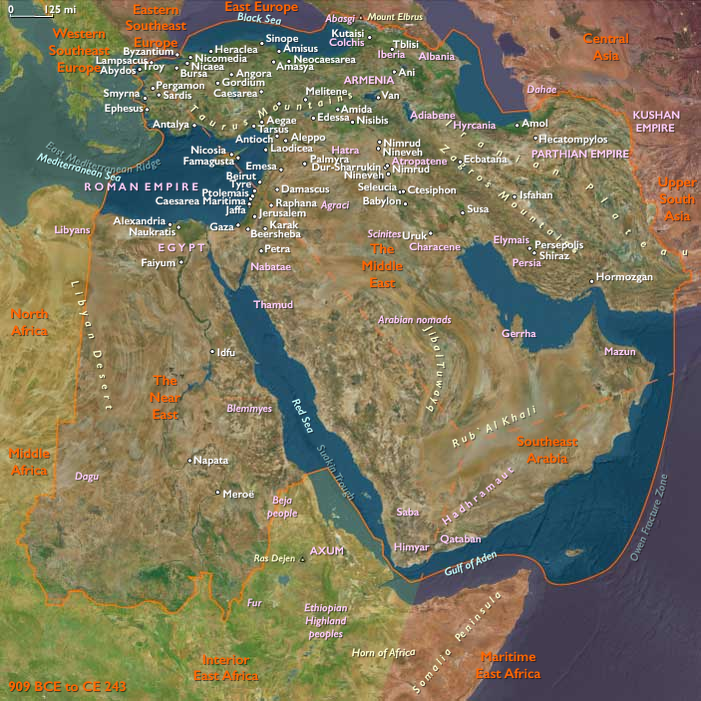
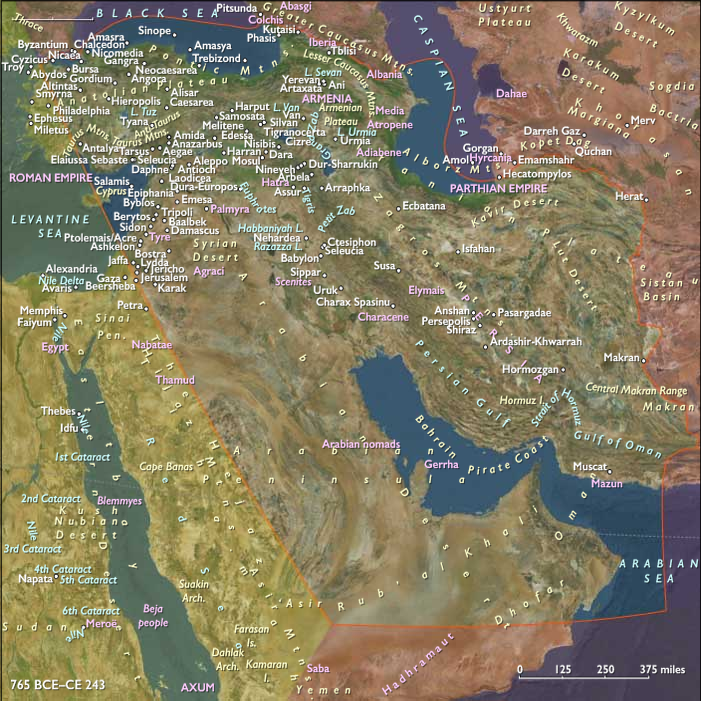
Tigranes marries Cleopatra, the daughter of Mithridates VI Eupator of Pontus, in 94, and forms an alliance with that kingdom.
At the time, Tigranes is forty-six years old while she is only sixteen.
She is to play a decisive role in the life of Tigranes and all of Armenia.
Cleopatra will bear Tigranes three sons: Zariadres, Artavasdes II of Armenia, Tigranes and a daughter who will marry King Pacorus I of Parthia.
Locations
People
Groups
Topics
Subjects
Regions
Subregions
Related Events
Filter results
Showing 10 events out of 62857 total
The foundation upon which Tigranes is to build his Empire is already in place when he comes to power, a legacy of the founder of the Artaxiad Dynasty, Artaxias I, and subsequent kings.
The mountains of Armenia, however, form natural borders between the different regions of the country and as a result, the feudalistic nakharars have significant influence over the regions or provinces in which they are based.
This does not suit Tigranes, who wants to create a centralist empire.
He thus proceeds by consolidating his power within Armenia before embarking on his campaign.
He begins in 94 BCE by deposing Artanes, the last king of Armenian Sophene (east of the Euphrates River) and a descendant of Zariadres.
Dissatisfaction in the Roman province of Asia has given new hope to Mithridates VI of Pontus.
Ineffectively organized after annexation and corrupt in its cities' internal administration, it had soon been overrun with Italian businessmen and Roman tax collectors.
When the Senate realizes the danger, it sends its most distinguished jurist, Quintus Mucius Scaevola, who has just completed his consulate, on an unprecedented mission in 94 to reorganize Asia.
He takes with him as his senior officer.
Publius Rutilius Rufus—jurist, stoic philosopher, and former consul —whose consular main achievements concerned the discipline of the army and the introduction of an improved system of drill.
Mediterranean Southwest Europe (93–82 BCE): Social War and Civil Conflict
The era 93–82 BCE witnesses a turbulent period within the Roman Republic, characterized by internal conflicts, profound social upheaval, and significant constitutional crises, leading to the destructive Social War and subsequent civil wars between rival political factions.
The Social War: Allies Rebel (90–88 BCE)
The Social War (also known as the Italian War or Marsic War) erupts in 90 BCE, fueled by longstanding grievances of Rome’s Italian allies (socii) over citizenship and political rights. The Italian allies, including the Marsi, Samnites, and other central and southern Italian peoples, form a federation and revolt against Roman domination, presenting one of the most severe internal threats Rome has faced.
Rome initially suffers severe defeats as the well-trained and highly motivated Italian forces challenge Roman supremacy, threatening the cohesion of the Republic itself. In response, Rome hastily grants citizenship to loyal communities, undermining rebel unity. By 88 BCE, Roman forces, under commanders such as Lucius Cornelius Sulla and Gnaeus Pompeius Strabo, successfully suppress the rebellion. Although militarily victorious, Rome is forced to concede citizenship to nearly all Italian allies, fundamentally transforming Roman society and politics.
Sulla's First Civil War (88–87 BCE)
In the immediate aftermath of the Social War, Rome plunges into further conflict. The political rivalry between Gaius Marius, the champion of popular causes and military reform, and Lucius Cornelius Sulla, representing conservative senatorial interests, escalates dramatically. When Sulla is granted command of the lucrative and prestigious war against Mithridates VI of Pontus, Marius successfully manipulates political channels to transfer this command to himself.
Refusing to relinquish power, Sulla responds by an unprecedented march on Rome in 88 BCE, capturing the city and purging his opponents. This dramatic action triggers Sulla's first civil war against Marius and his supporters. After consolidating control, Sulla departs for the East to engage Mithridates, allowing Marius and his ally Lucius Cornelius Cinna to retake Rome and instigate brutal reprisals against Sullan supporters.
Sulla's Second Civil War (83–82 BCE)
Upon concluding his campaign in the East, Sulla returns to Italy in 83 BCE, initiating the second civil war. Fierce battles unfold throughout Italy, Sicily, and parts of Africa as Sulla confronts Marius’s faction, now led by Gaius Marius the Younger following his father's death. The decisive conflict occurs at the Battle of the Colline Gate in 82 BCE, where Sulla achieves a bloody victory, securing absolute control over Rome.
Sulla's Dictatorship and Constitutional Reforms
With victory secured, Sulla assumes the extraordinary office of dictator without term limits, initiating a series of conservative constitutional reforms aimed at strengthening the Senate and curbing popular power. He institutes proscriptions—a policy of legalized mass executions and property confiscations—to eliminate political enemies and replenish depleted state funds.
Cultural Developments: The Second Style of Roman Wall Painting
Parallel to the political upheavals, Roman art flourishes, exemplified by advancements in wall painting. Early in the first century BCE, Roman artists perfect the Second Style, also known as the architectural style, characterized by sophisticated painted illusions of marble paneling, columns, and expansive landscapes or cityscapes, often integrating mythological narratives.
Legacy and Implications
The era 93–82 BCE profoundly reshapes the Roman Republic, with the Social War permanently altering the relationship between Rome and its Italian allies, extending citizenship and altering political dynamics. The civil wars, driven by the rivalry between Marius and Sulla, demonstrate the Republic’s susceptibility to charismatic military leaders wielding personal armies, further undermining the traditional republican system and setting a dangerous precedent toward autocratic governance.

The small states of the Malay Peninsula, greatly influenced by Indian culture, establish trade relations with China and India in the first century BCE.
Emperor Wu of Han dies in 87 BCE after an illustrious reign spanning more than five decades.
His throne passes to a minor under a regency council.
The Emperors official court historian, Sima Qian, dies the following year, leaving his Shi Ji (“Records of the Historian”), the first general history of China from its earliest times.
Writing in a lively but terse voice, Sima Qian recounts two thousand years of complex history in an orderly chronological style in one hundred and thirty chapters, one hundred of which are biographical and deal with various famous individuals.
The Middle East: 93–82 BCE
Roman-Parthian Diplomatic Contact and Mithridatic Conflicts
The era from 93 to 82 BCE marks significant diplomatic and military developments between the emerging Roman Republic and the Parthian Empire. In 92 BCE, Lucius Cornelius Sulla initiates the first formal diplomatic engagement between Rome and Parthia, leading to the mutual recognition of the Euphrates River as the boundary between their respective spheres of influence.
During this period, Roman forces also confront threats from the Armenian kingdom under Tigranes, who had expanded into Cappadocia. Roman general Lucullus invades Armenia in 92 BCE, beginning a protracted period of conflicts between the Greco-Roman states and successive Iranian empires, specifically the Parthian and later the Sassanid Empires.
Meanwhile, Mithridates VI of Pontus significantly challenges Roman dominance in Asia Minor. His kingdom absorbs several neighboring territories in northern Anatolia, setting the stage for the First Mithridatic War (89–85 BCE). This conflict sees Mithridates lead a coalition, including many rebellious Greek cities, against the Roman Republic and its ally, the Kingdom of Bithynia. After five years of warfare, Rome emerges victorious, forcing Mithridates to relinquish his conquered territories and retreat to Pontus. Nevertheless, tensions persist, leading to the Second Mithridatic War, triggered by Sulla’s legate in Asia Minor, Lucius Licinius Murena. Murena's unauthorized invasion of Pontus, justified by claims that Mithridates is rearming, results in several skirmishes. Mithridates ultimately forces Murena to withdraw, underscoring his resilience and signaling continued Roman-Parthian tension in the coming decades.
Thus, the period from 93 to 82 BCE witnesses critical diplomatic foundations between Rome and Parthia, alongside intense military confrontations that significantly influence geopolitical dynamics in the eastern Mediterranean and Near Eastern regions.
Sulla repulses Tigranes of Armenia from Cappadocia and Lucullus invades Armenia in 92 BCE, initiating a series of conflicts between states of the Greco-Roman world and two successive Iranian empires: the Parthian and the Sassanid.
The Pontic kingdom, under the energetic leadership of Mithridates VI “The Great”, expands to absorb several of its small neighbors in northern Anatolia and contests Rome's hegemony in Asia Minor.
The First Mithridatic War (89–85 BCE) is a war challenging Rome's expanding Empire and rule over the Greek world.
The Kingdom of Pontus and many Greek cities rebelling against Rome are led in this conflict by Mithridates VI against the Roman Republic and the Kingdom of Bithynia.
The war lasts five years and ends in a Roman victory, which forces Mithridates to abandon all his conquests and return to Pontus.
The conflict with Mithridates VI will continue in two further Mithridatic Wars.
The second Mithridatic war is fought between Mithridates VI and Sulla’s legate in Asia Minor, Lucius Licinius Murena, who invades Pontus on his own authority, claiming that Mithridates is re-arming and poses a direct threat to Roman Asia Minor.
Mithridates, after several inconclusive skirmishes, inflicts a minor defeat on Murena and forced his withdrawal from Pontus.
Lucius Cornelius Sulla meets with a Parthian envoy in the first diplomatic contact between Rome and Parthia, resulting in the parties recognizing the Euphrates as a common frontier.
The Sakas, diverted by their Parthian cousins from Iran, move into Gandhara and other parts of Pakistan and western India around 85 BCE.
The most famous king of the Sakas, Maues, establishes himself in Gandhara.
Maues has his capital in Sirkap and mints most of his coins in …