Tiberius consolidates Roman control of the western …
Years: 14 - 14
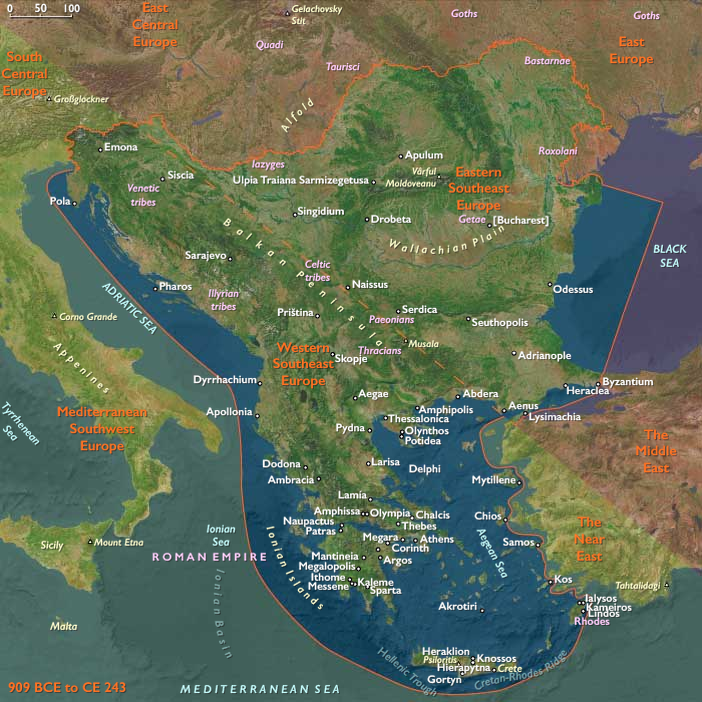
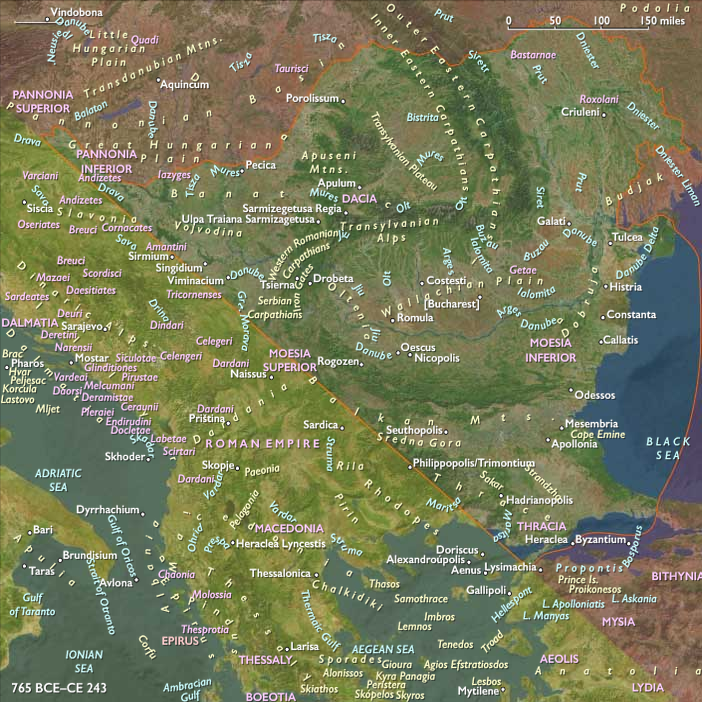
Tiberius consolidates Roman control of the western Balkan peninsula; by the time of his accession in 14, Rome has subjugated the Celts in what is now Serbia, their conquest of Pannonia complete with the capture in this year of Sirmium (Sremska Mitrovica, Vojvodina, Yugoslavia), the key town of the Sava Valley.
After the revolt is put down, Pannonia is organized as a separate province and garrisoned with three legions.
The Pannonians are mainly Illyrians, but there are some Celts in the western part of the province.
Locations
Groups
Topics
Commodoties
Subjects
Regions
Subregions
Related Events
Filter results
Showing 10 events out of 61998 total
There is a temporary détente in 14, when Xian returns Xin defectors Chen Liang and Zhong Dai who, as junior army officers in Xiyu, had killed their superiors and surrendered to the Xiongnu (perhaps seeking to have the Xiongnu help them reestablish Han rule) so that Wang could execute them.
In reciprocation, Wang recalls the forces to the northern regions that had been intended to attack Xiongnu (but have never received the full support that Wang had envisioned).
However, after Chanyu Xian discovers, late in 14, that Deng had been executed, he resumes raids against the border regions but maintains a façade of peaceful intention.
Emona or Aemona, short for Colonia Iulia (A)emona, is a Roman castrum founded in 14/15 CE, possibly by the XV Legio Apollinaris (theory proposed by the noted historian and epigraphy expert Balduin Saria), on a territory already populated by ancient settlers of uncertain origin.
Situated on the Ljubljanica River near its junction with the Sava, its location overlaps with the southwestern part of the old nucleus of the modern city of Ljubljana, capital of Slovenia, where numerous remains of Emona can still be seen today (substantial parts of the ancient city walls, several mosaics, parts of the paleochristian baptistry, residential houses, statues, tombstones etc.).
(A)emona is, along with Nauportus, Celeia and Poetovio, one of the main cities on the eastern coast of the Adriatic.
Formerly, it was assumed to have been a part of the Roman province of Pannonia.
However, recent research seems to indicate that Aemona was actually the easternmost city of the Roman empire proper.
Augustus had in 19 BCE declared the conquest of the Iberian peninsula complete with the Roman victory in the Cantabrian Wars, .
The northeast of the peninsula had been the first region to fall under Roman control, and served as a base for further conquests.
While the Romans during this period had settled the former Carthaginan town occupying present Barcelona, it is considerably less important than the major centers of Tarraco and Caesar Augusta, known today as Zaragoza.
The name Barcino, believed to have been derived from the Punic family of Barca, is formalized around the end of the reign of Augustus (CE 14), is a shortened version of the name which had been official up until this point, Colonia Faventia Julia Augusta Pia Barcino (also Colonia Julia Augusta Faventia Paterna Barcino and Colonia Faventia).
As a colonia, it had been established to distribute land among retired soldiers.
The Roman geographer Pomponius Mela refers to Barcino as one of a number of small settlements under the control of Tarraco.
However its strategic position on a branch of the Via Augusta allows the development of its commercial and economic development, and it enjoys immunity from imperial taxation.
Tiberius is due to leave for Illyricum in 14 but is recalled by the news that Augustus is gravely ill, and on August 19, Augustus dies while visiting the place of his birth father's death at Nola.
Both Tacitus and Cassius Dio wrote that Livia brought about Augustus' death by poisoning fresh figs, though this allegation remains unproven.
Tiberius, who is present alongside Livia at Augustus' deathbed, is named his heir.
Augustus' famous last words are, "Have I played the part well?
Then applaud as I exit"—referring to the play-acting and regal authority that he had put on as emperor.
Publicly, though, his last words were, "Behold, I found Rome of clay, and leave her to you of marble."
An enormous funerary procession of mourners travels with Augustus' body from Nola to Rome.
All public and private businesses close for the day of Augustus’ burial.
Tiberius and his son Drusus deliver the eulogy while standing atop two rostra.
Coffin-bound, Augustus' body is cremated on a pyre close to his mausoleum.
It is proclaimed that Augustus joined the company of the gods as a member of the Roman pantheon.
Although no automatic system of succession exists under the principate, Livia, the late emperor’s wife and esteemed counselor, uses her influence to ensure the succession of Tiberius, already in possession of the chief military command, is now supreme.
The formalities involved in the succession prove embarrassing both to himself and to the Senate because the “principate” of Augustus had not, constitutionally speaking, been heritable or continuous.
He plays politics with the Senate and does not allow it to name him emperor for almost a month.
The Senate convenes on September 18 to validate Tiberius's position as Princeps and, as it had done with Augustus before, extend the powers of the position to him.
These proceedings are fully accounted by Tacitus.
Tiberius already has the administrative and political powers of the Princeps; all he lacks are the titles—Augustus, Pater Patriae, and the Civic Crown (a crown made from laurel and oak, in honor of Augustus having saved the lives of Roman citizens).
Tiberius, however, attempts to play the same role as Augustus: that of the reluctant public servant who wants nothing more than to serve the state.
This ends up throwing the entire affair into confusion, and rather than humble, he comes across as derisive; rather than seeming to want to serve the state, he seems obstructive.
He cites his age (56) as a reason why he cannot act as Princeps, states he does not wish the position, and then proceeds to ask for only a section of the state.
Tiberius finally relents and accepts the powers voted to him, though according to Tacitus and Suetonius he refuses to bear the titles Pater Patriae, Imperator, and Augustus, and declines the most solid emblem of the Princeps, the Civic Crown and laurels.
Problems arise quickly for the new Princeps.
The legions posted in Pannonia and in Germania have not been paid the bonuses promised them by Augustus, and after a short period of time, when it is clear that a response from Tiberius is not forthcoming, mutiny.
Germanicus and Drusus are dispatched with a small force to quell the uprising and bring the legions back in line.

Augustus had died without having removed Postumus from Planasia and without including him in his will, regardless of the emperor's supposed visit the previous year.
Postumus is executed by his guards around the time of Augustus' death, with some accounts contradicting whether it happened before or after Augustus’ demise.
Accounts are also inconsistent on who ordered the death and these exist almost from the start, when Tiberius immediately and publicly disavows the act upon being notified of it (Tacitus, Ann. 1.5).
Some suggested that Augustus may have ordered the execution, while others place the blame on either Tiberius or Livia (with or possibly without Tiberius's knowledge) (Suetonius, Lives, Tiberius 22), taking advantage of the confusing initial political situation upon Augustus' death.
The Senate had appointed Germanicus commander of the forces in Germania after the death of Augustus in 14.
The legions a short time after had rioted on the news that their recruitment terms would not be marked back down to sixteen years from the then standard twenty.
Refusing to accept this, the rebel soldiers had cried for Germanicus as emperor.
Germanicus, preferring to continue only as a general, puts down this rebellion himself.
In a bid to secure the loyalty of his troops and his own popularity with them and with the Roman people, he leads them on a spectacular but brutal raid against the Marsi, a German tribe on the upper Ruhr river, in which he massacres much of the tribe.
Tacitus mentions the Marsi repeatedly, in particular in the context of the wars of Germanicus.
They had been part of the tribal coalition of the Cheruscian war leader Arminius that in 9 CE had annihilated the three Roman legions under Varus in the Battle of Teutoburg Forest.
Germanicus, seeking revenge for this defeat, invades the lands of the Marsi in 14 CE with twelve thousand legionnaires, twenty-six cohorts of auxiliaries and eight cavalry squadrons.
The Marsi, celebrating the feast of their goddess Tanfana, are too drunk to respond effectively to the Roman surprise attack and are massacred.
According to Tacitus (Annals 1, 51), an area of fifty Roman miles is laid to waste with fire and sword: "No sex, no age found pity."
A Legion eagle from Varus’s Defeat, either from the XVII or XVIII, is recovered.
Several town names today remain as reminders of the ancient Marsi—e.g., Marsberg and Obermarsberg in eastern North Rhine-Westphalia and Volkmarsen in northern Hesse.
A major problem plaguing Wang Mang's administration, in addition to the internal wars waged by the Xin dynasty, is his strong commitment in determining the ancient governmental structure, believing that once things were restored to Zhou Dynasty standards, the government would be efficient.
He and his officials have thus spent inordinate amounts of time carrying out research of ancient legends, leaving important affairs of the state undecided.
For years, a large number of counties have lacked magistrates.
The local officials, without supervision, have become highly corrupt and oppressive of the populace.
Because of the way Wang had come to power, he has become suspicious of allowing his subordinates to accrue too much power.
Wang therefore makes all important decisions by himself and does not delegate, leaving him highly fatigued and many decisions unmade.
Further, he has entrusted eunuchs to screen the reports from local governments for him, but those eunuchs decide to relay or not relay those reports based on their own personal likes and dislikes, and many important petitions go unanswered.
An even more serious problem is that the officials lack salaries.
The Han dynasty had a well-defined system of official salaries, but when Wang became emperor, he had ordered that the salary system be overhauled and recalibrated; however because the creation of a new system has taken years, the officials have in the meantime gone without salaries.
In response, they have become corrupt in demanding bribes from the people, causing the people great distress.
Augustus' reign has laid the foundations of a regime that is to last for nearly fifteen hundred years through the ultimate decline of the Western Roman Empire and until the Fall of Constantinople in 1453.
Both his adoptive surname, Caesar, and his title Augustus will become the permanent titles of the rulers of the Roman Empire for fourteen centuries after his death, in use both at Old Rome and at New Rome (Constantinople).
In many languages, Caesar becomes the word for Emperor, as in the German Kaiser and in the Bulgarian and subsequently Russian Tsar.
The cult of Divus Augustus will continue until the state religion of the Empire is changed to Christianity in 391 by Theodosius I. Consequently, there are many excellent statues and busts of the first emperor.
He had composed an account of his achievements, the Res Gestae Divi Augusti, to be inscribed in bronze in front of his mausoleum.
Copies of the text are inscribed throughout the Empire upon his death.
The inscriptions in Latin feature translations in Greek beside it, and are inscribed on many public edifices, such as the temple in Ankara dubbed the Monumentum Ancyranum, called the "queen of inscriptions" by historian Theodor Mommsen.
There are a few known written works by Augustus that have survived, including his poems Sicily, Epiphanus, and Ajax, an autobiography of 13 books, a philosophical treatise, and his written rebuttal to Brutus' Eulogy of Cato.
However, historians are able to analyze existing letters penned by Augustus to others for additional facts or clues about his personal life.
Germanicus’ major success is the capture of Arminius' wife Thusnelda in May 15.
He lets Thusnelda sleep in his quarters during the whole of the time she is a prisoner.
He is able to devastate large areas and eliminate any form of active resistance, but at the sight of the Roman army the majority of the Germans flee into remote forests.
The raids are considered a success since the major goal of destroying any rebel alliance networks is completed.
Germanicus visits the site of the disastrous Battle of the Teutoburg Forest and buries the remains of the slaughtered Roman troops, then launches a massive assault on the heartland of Arminius' tribe, the Cherusci.
Arminius initially lures Germanicus' cavalry into a trap and inflicts minor casualties, until successful fighting by the Roman infantry causes the Germans to break and flee into the forest.
This victory, combined with the fact that winter is fast approaching, means Germanicus's next step is to lead his army back to its winter quarters on the Rhine.