
Thuringia, named after the Thuringian people who …
Years: 1254 - 1254
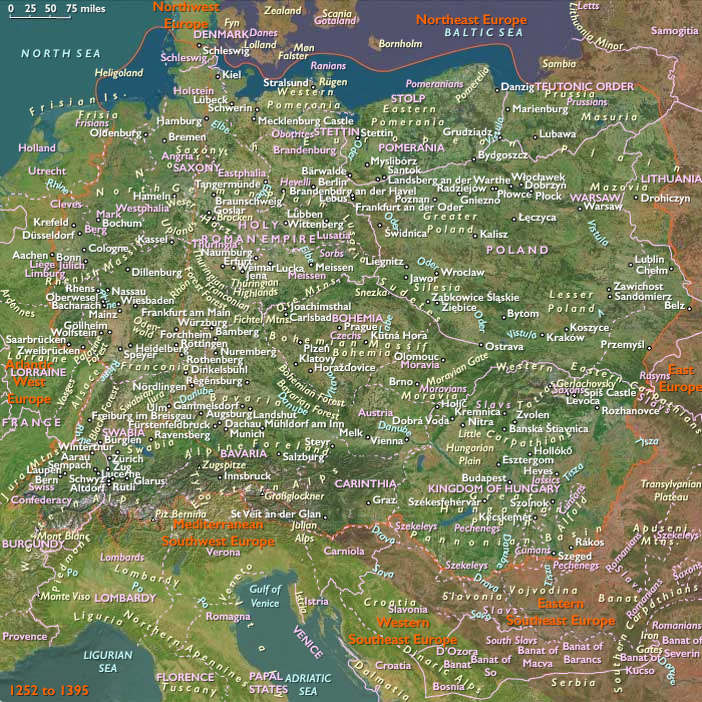
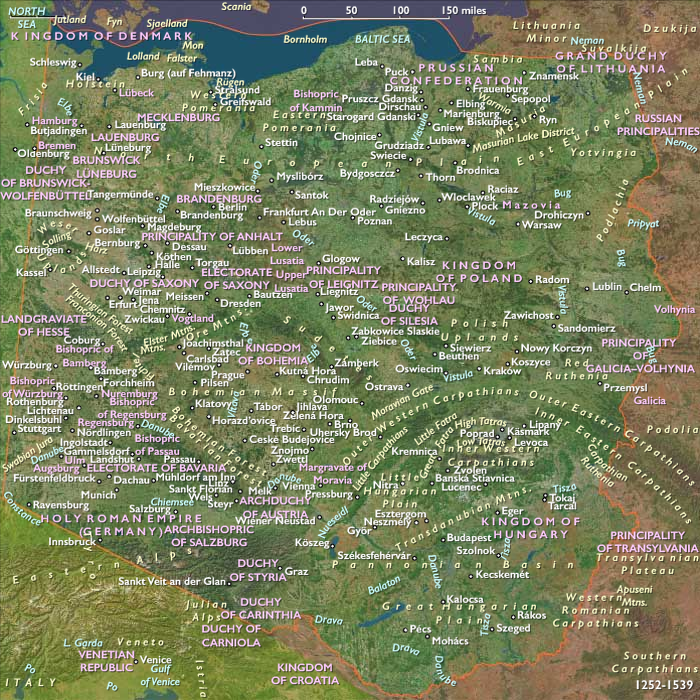
Thuringia, named after the Thuringian people who occupied it around 300, had come under Frankish domination in the sixth century, forming a part (from 1130 a landgravate) of the subsequent Holy Roman Empire.
The death of Landgrave Ludwig IV and consequent extinction of the reigning Ludowingian line of counts in 1247 had sparked the seventeen-year War of the Thuringian Succession, in which Ludwig’s daughter Sophia (1224-84), who had married Henry II, Duke of Brabant, wins the western half of the langravate for her son Henry I, called the Child.
At war’s end in 1264, this portion will become independent under the name of Hesse, never to become a part of Thuringia again.
Most of the remaining Thuringian lands will come under the rule of the Wettin dynasty of the nearby Margravate of Meißen, the nucleus of the later duchy and kingdom of Saxony.
The oldest record of Weimar, located on the Ilm River in Thuringia, dates from the year 899.
Ruled by the counts of Weimar-Orlamünde from 1247, it is declared a town in 1254.
(The future capital of the Duchy—after 1815 the Grand Duchy—of Saxe-Weimar, the city will also give its name to the Weimar Republic, the German state between the World Wars of the twentieth century).
Locations
People
Groups
Topics
Commodoties
Subjects
Regions
Subregions
Years: 1254 - 1254
Locations
People
Groups
Topics
Commodoties
Subjects
Regions
Subregions