Throughout the summer of 1947, as communal …
Years: 1947 - 1947
Throughout the summer of 1947, as communal violence mounts, preparations for Partition proceed in Delhi.
Assets are divided, boundary commissions are set up to demarcate frontiers, and British troops are evacuated.
The military is restructured into two forces.
Law and order breaks down in different parts of the country.
Civil servants are given the choice of joining either country; British officers can retire with compensation if not invited to stay on.
Jinnah and Nehru attempt unsuccessfully to quell the passions of communal fury that neither fully understands.
On August 14, 1947, Pakistan and India achieve independence as dominions within the Commonwealth.
The partition and the movement of refugees are accompanied by terrible massacres for which both communities are responsible.
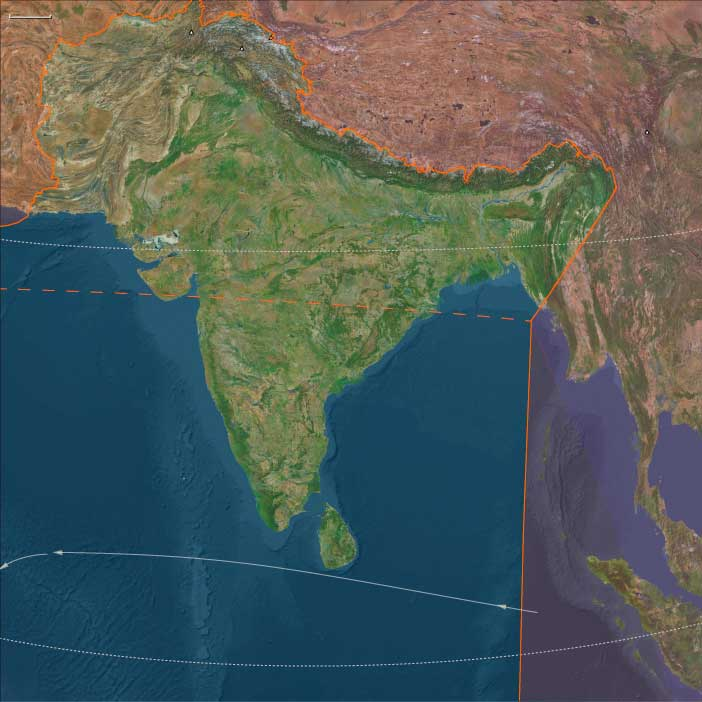
The territory of Pakistan is divided into two parts at independence, separated by about 1,000 miles (1,600 kilometers) of Indian territory.
The leaders of the new Pakistan are mainly lawyers with a strong commitment to parliamentary government.
They had supported Jinnah in his struggle against the Congress not so much because they desired an Islamic state but because they had come to regard the Congress as synonymous with Hindu domination.
They have various degrees of personal commitment to Islam.
To some it represents an ethic that might (or might not) be the basis of personal behavior within a modern, democratic state.
To others, it represents a tradition, the framework within which their ancestors had ruled India.
However, some groups subscribe to Islam as a total way of life, and these people are said to wish to establish Pakistan as a theocracy (a term they repudiate).
The members of the old Constituent Assembly, elected at the end of 1945, assemble at Karachi, the new capital.
Jinnah becomes the first governor-general of the Dominion of Pakistan and Liaquat Ali Khan the first prime minister (the Quaid-i-Millet, or Leader of the Nation).
The supreme authority at independence, Jinnah's followers hail him as the Quaid-i-Azam (Great Leader).
As governor-general, he assumes the ceremonial functions of head of state while taking on effective power as head of government, dominating his prime minister.
To these roles, he adds the leadership of the Muslim League and the office of president of the Constituent Assembly.
While India inherits most of the British administrative machinery, Pakistan has to start with practically nothing; records and Muslim administrators are transferred from New Delhi to a chaotic, makeshift capital at Karachi.
Pakistan lacks the machinery, personnel, and equipment for a new government.
Even its capital, Karachi, is a second choice-Lahore was rejected because it is too close to the Indian border.
With the major portion of the wealth and resources of the British heritage passing to India, Pakistan's survival seems uncertain.
Of all the well-organized provinces of British India, only the comparatively backward areas of Sindh, Balochistan, and the North-West Frontier come to Pakistan intact.
The Punjab and Bengal are divided, and Kashmir becomes disputed territory.
Economically, the situation seems almost hopeless; the new frontier cuts off Pakistani raw materials from the Indian factories, disrupting industry, commerce, and agriculture.
Further, much of Punjab's electricity is imported from Indian power stations.
India, the major market for Pakistan's commodities, remains openly unfriendly, expressing its economic advantage in a virtual blockade.
The dispute over Kashmir brings the two countries to the verge of war; and India's command of the headworks controlling the water supplies to Pakistan's eastern canal colonies gives it an additional economic weapon.
The resulting friction, by obstructing the process of sharing the assets inherited from the British raj (according to plans previously agreed), further handicaps Pakistan.
Above all other concerns are the violence and the refugee problem: Muslims are fleeing India; Hindus and Sikhs are fleeing Pakistan.
Among the long-term concerns faced by Pakistan is the role of Islam in the new nation.
Is Pakistan to be a secular state serving as a homeland for Muslims of the subcontinent, or is it to be an Islamic state governed by the sharia, in which non-Muslims are second-class citizens?
Although Jinnah had led the movement for Pakistan as a separate Muslim nation, he is appalled by the communal riots and urges equal rights for all citizens irrespective of religion.
Jinnah's plea to regard religion as a personal matter, not a state matter, is ignored.
Another major concern is the distribution of power between the central and provincial governments.
Pakistani society is polarized from its inception.
One major faction is that of the traditional rural people already inhabiting Pakistan (whose support for the concept of Pakistan is not immediate).
At the other end of the spectrum are the newly arrived displaced urbanites from Muslim-minority provinces, whose goals for the new state to which they had fled are often incompatible with those held by the former.