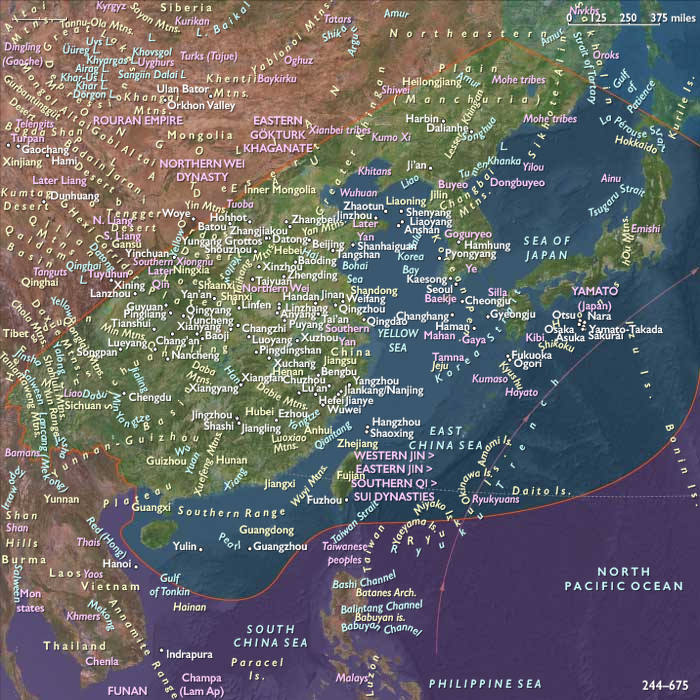
Taizong issues an official declaration protecting the …
Years: 638 - 638
Taizong issues an official declaration protecting the Nestorian church three years after Alopen’s arrival to Chang'an.
He erects China's first Christian church and recognizes twenty-one priests, likely all Persians, to administer it.
Locations
People
Groups
- Persian people
- Confucianists
- Christians, Eastern (Diophysite, or “Nestorian”) (Church of the East)
- Chinese Empire, Tang Dynasty
Topics
Subjects
Regions
Subregions
Related Events
Filter results
Showing 10 events out of 56605 total
Tibetan forces, apparently commanded by Songtsän Gampo himself, raid the Tang frontier city of Songzhou (modern Songpan County in Sichuan) in the fall of 638, but meanwhile send emissaries to the Tang capital Chang'an, again offering tributes and declaring that they are intending to welcome a princess.
The size of Songtsän Gampo’s army is given as one hundred thousand by Tibetan sources and over two hundred thousand by Chinese sources.
They defeat a force sent against them by the Songzhou governor Han Wei.
According to the Chinese annals, Taizong respondd by commissioning the general Hou Junji to command an army, assisted by the generals Zhishi Sili, Niu Jinda and Liu Jian.
Led by Niu, the Tang army inflicts heavy casualties on the Tibetans in a surprise night attack.
Alarmed, Songtsän Gampo withdraws, sent emissaries and tributes to Chang'an to apologize and to again request marriage.
Emperor Taizong agrees this time.
However, no further action will be taken to carry out the marriage for about two years.
A basket of Buddhist scriptures had arrived in Tibet from India in the fifth century during the reign of Thothori Nyantsen, the twenty-eighth king of Tibet according to the Tibetan legendary tradition.
Written in Sanskrit, they are not translated into Tibetan until the reign of king Songtsän Gampo.
While there is doubt about the level of Songtsän Gampo's interest in Buddhism, it is known that he married a Chinese Tang Dynasty Buddhist princess, Wencheng, who had come to Tibet with a statue of Shakyamuni Buddha.
It is clear from Tibetan sources however that some of his successors became ardent Buddhists.
The records show that Chinese Buddhists are actively involved in missionary activity in Tibet, they do not have the same level of imperial support as Indian Buddhists, with tantric lineages from Bihar and Bengal.
Songtsän Gampo according to a Tibetan legendary tradition also married a Nepalese Buddhist princess, Bhrikuti.
He will already be regarded by the second half of the eighth century as an embodiment of the Bodhisattva Avalokiteśvara.
Emperor Taizong of Tang had meanwhile sent the general Li Jing against Tuyuhun in late 634 and, in a major campaign, had overpowered Tuyuhun's Busabo Khan Murong Fuyun, who was killed in flight.
Tang thereafter appointed Murong Fuyun's son Murong Shun as Tuyuhun's khan and, after Murong Shun was assassinated late in 635, supported Murong Shun's son Murong Nuohebo as khan.
Feng Dexia appeared to have gotten to Tibet around the same time.
By this time, Songtsän Gampo is aware that, in the past, the khans of the Eastern Turkic Khaganate and Tuyuhun had arranged marriages of state with China and therefore sends an emissary to accompany Feng back to Tang with further tribute to request to marry a Tang princess.
Emperor Taizong had received the emissary with elaborate courtesy; he reciprocates four years later by dispatching a group of high officials to visit the Tibetan monarch.
When the Tibetan emissary returns to Tibet, he informs Songtsän Gampo, falsely according to Tibetan historical sources, that Taizong was disposed to approve a dynastic marriage but changed his mind after hearing the Tibetans slandered by the Tuyuhun.
It was said that Murong Nuohebo had visited Tang and was interfering, leading to Taizong's refusal.
Songtsän Gampo, believing the report, attacks Tuyuhun in late 637 and early 638, capturing some of them and forcing the rest to flee north of Qinghai Lake.

Roman emperors have endeavored to preserve uniform theological belief since their adoption of Christianity in the fourth century, and have persecuted those with differing Christological views, notably in Egypt, Syria, and Armenia.
Religious controversy has weakened the loyalties that Syrians and Egyptians render to Constantinople, and Heraclius seeks in 638 to placate Monophysite sentiment in these two provinces by promulgating the doctrine of Monothelitism, holding that Christ, although of two natures, had but one will, setting it forth as the official doctrine of the Eastern Orthodox Church.
Heraclius’ Ekthesis is vigorously opposed, notably by Maximus the Confessor, an influential unofficial political advisor and spiritual head in North Africa.
Neither in the East nor in the West will this compromise prove successful.
Heraclius’s son Heraklonas was probably born at Lazica while his father was on campaign against Khosrau II of the Sassanid Empire.
He was probably the fourth son of Martina and Heraclius, but the first one born free of physical deformity and eligible for the throne.
Heraklonas obtains through his mother’s influence the title of Augustus on July 4, 638.
Pyrrhus I becomes patriarch of Constantinople after the death of Sergius I.
He has been an advocate of Monothelitism and a close friend of Heraclius.
Islamic Arab forces under Abu Musa al-Asha'ari in the lower Zagros Mountains capture capture and destroy the flourishing Sassanian trade center of Susa in 638.
The Empire's field armies are withdrawn at some point in the mid-seventh century, probably in the late 630s, to Anatolia, the last major contiguous territory remaining to the Empire, and assigned to the districts that will become known as the themes.
Heraclius creates a buffer zone or no man's land in the heartland of Asia Minor.
In the mountainous terrain of Anatolia, the imperial forces develop a system of defensive guerrilla warfare.
The strategy is known as ‘shadowing warfare’, as it avoids battle with major Muslim invasions and instead attacks raiding parties on their return when they are laden with booty, captured livestock or prisoners.
Umar I dismisses Khalid ibn al-Walid after the conquest of Syria, owing to his ever-growing fame and influence.
He wants the Muslims to know that victory comes from God, not his general.
The invading Rashidun army under Khalid ibn al-Walid moves into eastern Anatolia, conquering without strong imperial resistance, capturing Malatya, which becomes a base for their raids further into Anatolia.
Arab forces march into Armenia, where they capture the cities Edessa and …
…Amida, up to the Ararat plain.
Acre comes under the rule of the Rashidun Caliphate beginning in 638, following the defeat of the imperial army of Heraclius by the Muslim army of Khalid ibn al-Walid in the Battle of Yarmouk, and the capitulation of the Christian city of Jerusalem to the Caliph Umar,
The actual conquest of Acre According to the early Muslim chronicler al-Baladhuri was led by Shurahbil ibn Hasana, one of the main field commanders during the Muslim conquest of Syria, and the city likely surrendered without resistance.
Years: 638 - 638
Locations
People
Groups
- Persian people
- Confucianists
- Christians, Eastern (Diophysite, or “Nestorian”) (Church of the East)
- Chinese Empire, Tang Dynasty