
Filters:
Attempts to cross the Blue Mountains had …
Years: 1820 - 1820
Attempts to cross the Blue Mountains had been made from 1790 onward with convicts seeking a way to escape and adventurers eager to explore the region.
However, all of these attempts had failed and it was to be over twenty years before a way across was found.
In May 1813, Gregory Blaxland, William Lawson and William Charles Wentworth had set out with a plan to find a passage through the impenetrable Blue Mountains.
After twenty-one days of traveling through fifty miles (eighty kilometers) of rugged terrain, the party reached Mount Blaxland.
From here they saw a vast expanse of forest and grass.
This was in fact the land of the Wiradjuri people, one of the largest language groups in Australia.
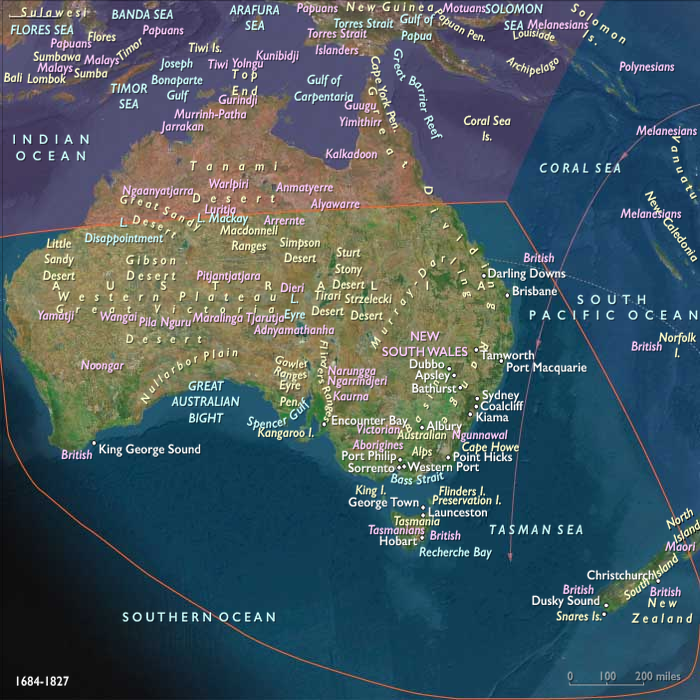
The Wiradjuri inhabit an area bounded by the Blue Mountains in the east, the western slopes in the south, and the change of open forest to grassy plains in the north and west.
The tribes led by Windradyne live in the eastern parts of this territory, connected to the other groups by a common language as well as cultural and trade links.
After passage through the Blue Mountains had been secured, assistant surveyor George Evans and his party had been instructed to further explore the country.
Evans' reports confirmed of excellent pastures beyond the mountains to which Governor Macquarie ordered a road be built from the Nepean River.
In less than six months the one hundred-mile (one hundred and sixty kilometer) road had been completed.
Soon after, Governor Lachlan Macquarie and a large accompanying party set out to view the country.
The journey took nine days by coach from Parramatta and on arrival Macquarie's welcoming ceremony was observed by seven Wiradjuri.
Three days later Macquarie inaugurated the town of Bathurst, then continued to tour the surrounding country.
In 1820, the population of Bathurst is only one hundred and fourteen due to Macquarie's slow and cautious approach to new settlement.
His experience of the Hawkesbury and Nepean Wars of 1795–1816 may also have made him hesitant to start a new conflict.
It seems that the Wiradjuri are willing to tolerate this slow level of growth and peaceful relations are maintained during this period.
However, all of these attempts had failed and it was to be over twenty years before a way across was found.
In May 1813, Gregory Blaxland, William Lawson and William Charles Wentworth had set out with a plan to find a passage through the impenetrable Blue Mountains.
After twenty-one days of traveling through fifty miles (eighty kilometers) of rugged terrain, the party reached Mount Blaxland.
From here they saw a vast expanse of forest and grass.
This was in fact the land of the Wiradjuri people, one of the largest language groups in Australia.
The Wiradjuri inhabit an area bounded by the Blue Mountains in the east, the western slopes in the south, and the change of open forest to grassy plains in the north and west.
The tribes led by Windradyne live in the eastern parts of this territory, connected to the other groups by a common language as well as cultural and trade links.
After passage through the Blue Mountains had been secured, assistant surveyor George Evans and his party had been instructed to further explore the country.
Evans' reports confirmed of excellent pastures beyond the mountains to which Governor Macquarie ordered a road be built from the Nepean River.
In less than six months the one hundred-mile (one hundred and sixty kilometer) road had been completed.
Soon after, Governor Lachlan Macquarie and a large accompanying party set out to view the country.
The journey took nine days by coach from Parramatta and on arrival Macquarie's welcoming ceremony was observed by seven Wiradjuri.
Three days later Macquarie inaugurated the town of Bathurst, then continued to tour the surrounding country.
In 1820, the population of Bathurst is only one hundred and fourteen due to Macquarie's slow and cautious approach to new settlement.
His experience of the Hawkesbury and Nepean Wars of 1795–1816 may also have made him hesitant to start a new conflict.
It seems that the Wiradjuri are willing to tolerate this slow level of growth and peaceful relations are maintained during this period.
Locations
People
Groups
- Australians, Indigenous
- Wiradjuri people
- Britain, Kingdom of Great
- Australia, British
- New South Wales (British colony)
Topics
Commodoties
Subjects
Regions
Subregions
Years: 1820 - 1820
Locations
People
Groups
- Australians, Indigenous
- Wiradjuri people
- Britain, Kingdom of Great
- Australia, British
- New South Wales (British colony)
Topics
Commodoties
Subjects
Regions
Subregions