
The Early Life and Academic Rise of …
Years: 1259 - 1259
The Early Life and Academic Rise of Thomas Aquinas (c. 1225–1259)
Thomas Aquinas, born Tommaso d’Aquino around 1225 at his father Count Landulf's castle of Roccasecca, in the Kingdom of Naples, was of noble lineage. His mother, Theodora, Countess of Theate, connected him to the Hohenstaufen dynasty of Holy Roman Emperors, making his early career prospects particularly significant.
Early Education and Dominican Vocation
- Aquinas began his education at the Benedictine monastery of Monte Cassino, where his uncle, Sinibald, served as abbot. His family intended for him to follow his uncle’s path and pursue a prestigious ecclesiastical career.
- At age 10, he was sent to the University of Naples, where he spent six years (c. 1239–1244) studying the liberal arts, philosophy, and theology. It was here that he encountered members of the Order of Preachers (Dominicans), who sought to recruit the most promising young scholars into their rapidly expanding mendicant order.
The Dominicans and Franciscans represented a new challenge to the well-established clerical hierarchy of medieval Europe, prioritizing poverty, preaching, and academic rigor over monastic isolation and traditional clerical privileges.
Family Resistance and Dominican Entry
- At 16, Thomas declared his desire to join the Dominicans, but his noble family strongly opposed this decision, seeing it as a betrayal of their ambitions for him.
- His family kidnapped him and held him in confinement for over a year, attempting to dissuade him from the mendicant life.
- Finally, in 1244, Pope Innocent IV intervened, and Thomas officially became a Dominican friar.
Studies with Albertus Magnus and the Paris Controversy
- Recognizing his extraordinary intellect, Thomas’s superiors sent him to Cologne, where he studied under Albertus Magnus, one of the most influential philosophers and theologians of the age.
- In 1245, Thomas accompanied Albertus to the University of Paris, where he engaged in the controversy over the rights of the mendicant orders to teach at the university.
- The secular clergy of the university, led by Guillaume de Saint-Amour, opposed the mendicants’ growing influence, arguing that they should not have equal privileges in teaching and administration.
- Thomas defended his order, writing pamphlets and speeches in support of the Dominican cause, ultimately defeating Guillaume de Saint-Amour in theological debate.
- With papal backing, the mendicants secured their teaching privileges, and Thomas graduated as a Bachelor of Theology in 1248.
Teaching Career and Theological Development
- In 1248, Aquinas returned to Cologne, where he was appointed second lecturer and magister studentium under Albertus Magnus.
- Over the following years, he developed into a comprehensive scholar, permanently adopting Aristotle’s method of logical inquiry, which he would later synthesize with Christian theology.
Recognition as Doctor of Theology (1256) and Advisory Role
- In 1256, Thomas and his friend Bonaventure were both granted the title of Doctor of Theology, a milestone that allowed them to lecture independently in Paris, Rome, and various Italian cities.
- He frequently undertook long and arduous journeys, both for academic purposes and to advise the papacy on matters of theology, law, and state affairs.
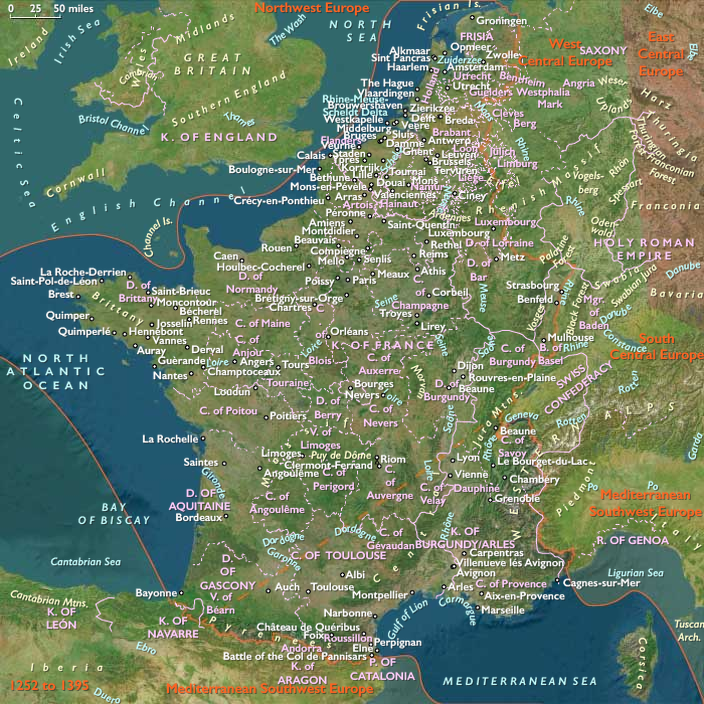
- In 1259, Thomas was present at a major Dominican assembly in Valenciennes, marking his growing influence within his order and his role in shaping Dominican intellectual priorities.
Legacy of His Early Career
By the end of the 1250s, Thomas Aquinas had established himself as:
- One of the most brilliant minds in Christian theology, synthesizing Aristotelian reason with Augustinian faith.
- A key defender of the mendicant orders, securing their place in university life.
- An advisor to the papal court, shaping the relationship between the Church and philosophical inquiry.
His work during these years laid the foundation for his later magnum opus, the Summa Theologica, and his enduring influence on Catholic theology, philosophy, and Western intellectual tradition.
Locations
People
Groups
- Papal States (Republic of St. Peter)
- France, (Capetian) Kingdom of
- Christians, Roman Catholic
- Augustinians, or Order of St. Augustine
- England, (Plantagenet, Angevin) Kingdom of
- Franciscans, or Order of St. Francis
- Dominicans, or Order of St. Dominic
Subjects
Regions
Subregions
Related Events
Showing 10 events out of 46073 total
Years: 1259 - 1259
Locations
People
Groups
- Papal States (Republic of St. Peter)
- France, (Capetian) Kingdom of
- Christians, Roman Catholic
- Augustinians, or Order of St. Augustine
- England, (Plantagenet, Angevin) Kingdom of
- Franciscans, or Order of St. Francis
- Dominicans, or Order of St. Dominic
Subjects
Regions
Subregions