
This opening era of this age marks …
Years: 333BCE - 322BCE
This opening era of this age marks the end of the fourth-century (Late Classical) period of Greek sculpture and its succession by the Hellenistic period.
Greek sculptor Lysippus, active throughout the latter half of the fourth century BCE, had been born in Sicyon, a city with a tradition of both sculpture and painting, and reportedly lives to an old age.
Instrumental in paving the way from pure classical to naturalistic Hellenistic sculpture, Lysippus changes the system of proportions, elongating the body and reducing the size of the head to one-eighth the total height of the figure.
In an important departure from the principle of a uniform frontal plane for statuary, Lysippus allows the limbs of his statues to project in various directions, thus imparting depth and a feeling of motion to his figures.
Alexander the Great, who reportedly prefers him to all other sculptors, is one of the notable personages featured, with athletes and divinities, as the subject of around fifteen hundred bronze statues executed by Lysippus.
No known original works by Lysippus survive, although some Roman marble statues of athletes may be copies of his work.
One such, the Apoxyomenos, or The Scraper, becomes a favorite of the emperor Tiberius; another, the Agias, may be a contemporary replica.
His work, like that of his contemporary, the painter Apelles, is known from the comments of Pliny the Elder.
Apoxyomenos is one of the Greek conventions in representing an athlete, caught in the familiar act of scraping sweat and dust from his body with the small curved instrument that the Romans called a strigil.
The bronze original is lost, but it is known, in part from its description in Pliny the Elder's Natural History, which relates that the Roman general Marcus Vipsanius Agrippa installed Lysippos's masterpiece in the Baths of Agrippa that he erected in Rome, around 20 BCE.
Later, the emperor Tiberius became so enamored of the figure that he had it removed to his bedroom.
However an uproar in the theater, "Give us back our Apoxyomenos", shamed the emperor into replacing it.
The sculpture is represented by the Pentelic marble copy in the Museo Pio-Clementino in Rome, discovered in 1849 when it was excavated in Trastevere.
Plaster casts of it soon found their way into national academy collections, and it is the standard version in textbooks.
The sculpture, slightly larger than life-size, is characteristic of the new canon of proportion pioneered by Lysippus, with a slightly smaller head (1:8 of the total height, rather than the 1:7 of Polykleitos) and longer and thinner limbs.
Pliny notes a remark that Lysippus "used commonly to say"—that while other artists "made men as they really were, he made them as they appeared to be."
Lysippus poses his subject in a true contrapposto, with an arm outstretched to create a sense of movement and interest from a range of viewing angles.
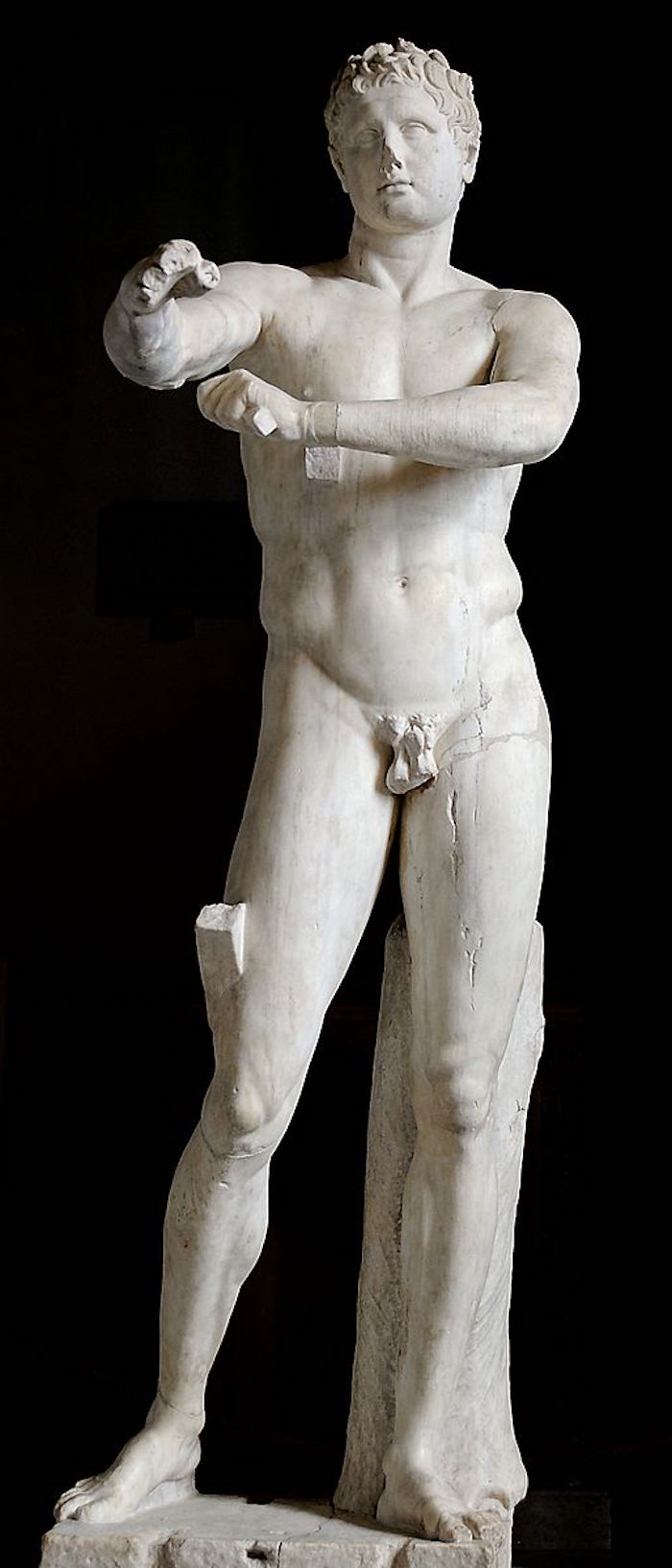
Copy after Lysippos: So-called “Apoxyomenos” (“the Scraper”). Marble, Roman copy of the 1st century CE after a Greek bronze original ca. 320 BCE. Vatican Museums. (Photo by Marie-Lan Nguyen (2009))
Locations
People
Groups
- Sicyon, Greek city-state of
- Macedon, Argead Kingdom of
- Alexander, Empire of
- Greece, Hellenistic
- Greeks, Hellenistic
Topics
Subjects
Regions

Subregions

Related Events
Showing 10 events out of 64522 total
Years: 333BCE - 322BCE
Copy after Lysippos: So-called “Apoxyomenos” (“the Scraper”). Marble, Roman copy of the 1st century CE after a Greek bronze original ca. 320 BCE. Vatican Museums. (Photo by Marie-Lan Nguyen (2009))
Locations
People
Groups
- Sicyon, Greek city-state of
- Macedon, Argead Kingdom of
- Alexander, Empire of
- Greece, Hellenistic
- Greeks, Hellenistic
Topics
Subjects
Regions
Subregions