
…they follow the eastern flank of the …
Years: 1535 - 1535
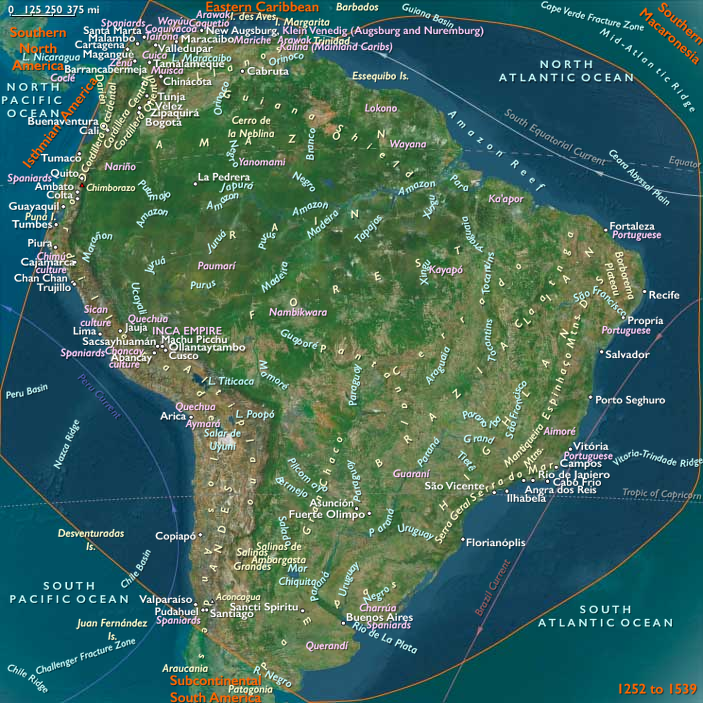
…they follow the eastern flank of the cordilla, tracing the existing salt trade route where it crosses the Andes and enters the lands of the Muisca, whose realm has already been partially conquered by Jiménez de Quesada out of Santa Marta, now Colombia, under orders from Pedro Fernández de Lugo.
After marching together for about two hundred miles, Speyer and Federmann divide into two parties, agreeing to meet afterward.
Speyer experiences great hardships from hostile Indians, and the soldiers, unaccustomed to marching under a burning sun, mutiny several times.
When at last they reach the appointed place of meeting without finding any trace of Federmann, the soldiers are discouraged, but Speyer animates them with the hope of discovering the riches of the El Dorado, of which the survivors of Ehinger's expedition, Federmann among them, had brought the first reports.
They continues the march to the south, but, when the rainy season set in, the overflow of the rivers impedes progress, and the consequent fevers decimate their ranks.
Locations
People
- Bartholomeus V Welser
- Charles V, Holy Roman Emperor
- Georg von Speyer
- Gonzalo Jiménez de Quesada
- Nikolaus Federmann
- Pedro Fernández de Lugo
- Philipp von Hutten
Groups
- Caquetio people
- Augustinians, or Order of St. Augustine
- Muisca (Amerind tribe)
- Chitareros
- Santo Domingo, Captaincy General of
- Wayuu (Amerind tribe)
- Spain, Habsburg Kingdom of
- New Spain (Spanish colony)
- Venezuela Province
- Klein-Venedig
Topics
Commodoties
Subjects
Regions

Subregions
Years: 1535 - 1535
Locations
People
- Bartholomeus V Welser
- Charles V, Holy Roman Emperor
- Georg von Speyer
- Gonzalo Jiménez de Quesada
- Nikolaus Federmann
- Pedro Fernández de Lugo
- Philipp von Hutten
Groups
- Caquetio people
- Augustinians, or Order of St. Augustine
- Muisca (Amerind tribe)
- Chitareros
- Santo Domingo, Captaincy General of
- Wayuu (Amerind tribe)
- Spain, Habsburg Kingdom of
- New Spain (Spanish colony)
- Venezuela Province
- Klein-Venedig
Topics
Commodoties
Subjects
Regions
Subregions