Theuderic IV: A …
Years: 720 - 720
Theuderic IV: A King in Name Only
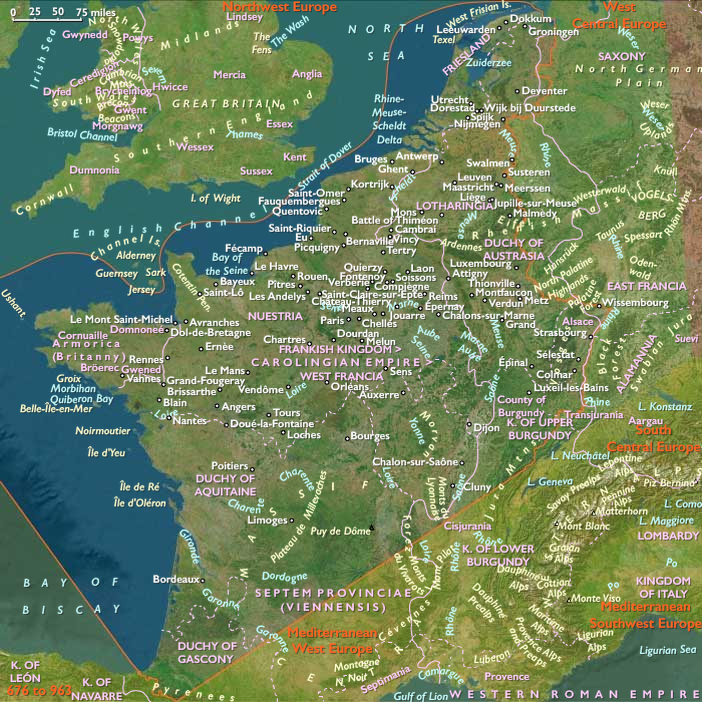
Throughout his reign, Theuderic IV remains a puppet monarch, entirely under the control of Charles Martel. Although officially King of the Franks, he exercises no real authority, as Charles keeps him in custody, first at Chelles Abbeyand later at Château-Thierry—a strategic location in northeastern Francia.
Situated on the Marne River in present-day Aisne département, Château-Thierry is said to have been fortified around 720 by Charles Martel himself, intended as both a royal residence and a prison in all but name for Theuderic. The ruins of the old castle on the slopes of the town’s hill stand as a reminder of the Frankish power structure of the time—where kings were merely symbolic figures, while the true ruler governed from the battlefield and the court.
As Charles tightens his grip on the Frankish realm, Theuderic IV, like his predecessors, serves only as a figurehead, his existence legitimizing the Carolingian hold on power while ensuring the Merovingian line remains politically impotent.
Locations
People
Groups
- Franks
- Alamannia
- Bavaria, Agilolfing Duchy of
- Francia (mayors of the palaces of Austrasia and Neustria)
Topics
Subjects
Regions
Subregions
Related Events
Filter results
Showing 10 events out of 55636 total
Fujiwara no Fuhito had been the most powerful courtier in Empress Gemmei's court up to his death in 720, when his first cousin Prince Nagaya, a grandson of Emperor Temmu and a cousin of the empress, assumes the powers held by Fujiwara.
A second compilation of legendary and semihistorical Japanese traditions, the Nihonshoki (“Chronicles of Japan”), completed in 720 under Empress Gensho, includes legends about the origins of the Japanese people and, like the Kojiki, attributes the foundation of the state to a mythological emperor Jimmu in 660 BCE.
The Nihonshoki focuses more on recent events and contains material on early Japanese contacts with Korea and China, including the legend of the empress Jingo, who allegedly conquered Korea in the second century CE.
The first two of the thirty books comprising the Nihonshoki present an alternate version of the creation myth that appears in the Kojiki; The remaining twenty-eight books concern the history of Japan up to the end of the seventh century.
The Kojiki and the Nihonshoki are regarded in a sense as sacred books of Shinto but they are also books about the history, topography, and literature of ancient Japan.
It is possible to construct Shinto doctrines from them by interpreting the myths and religious practices they describe.
Broadly speaking, Shinto has no founder.
When the Japanese people and Japanese culture became aware of themselves, Shinto was already there.
Nor has it any official scripture that can be compared to the Bible in Christianity or to the Qur'an in Islam.
Japanese temples begin to become larger and more splendid complexes as Buddhism, encouraged by the Nara emperors, begins to spread throughout Japan.
The Japanese Buddhist Hosso sect monastery of Yakushi-ji, founded in 680 in Kashihara, had been moved to its present location after the Japanese capital had moved to Nara and been refounded in 718.
The “kondo,” or assembly hall, constructed around 720, resembles a Chinese throne hall, with the two pagodas situated far from the center of the complex.
Dedicated to Yakushi, the Healing Buddha, it is one of the finest examples of religious architecture of the Nara period.
Among its many treasures of Japanese art are the famous Nara-period sculpture group known as the Yakushi triad (statues of Buddha, Nikko, and Gakko).

Esoteric Buddhism is taken from India to China, according to the Zhenyan tradition, by three missionary monks who have translated the basic Zhenyan texts.
The first monk, Shubhakarasimha, had arrived in China in 716, and he had translated the Mahavairocana-sutra and a closely related ritual compendium, the Susiddhikara, into Chinese.
The other two monks, Vajrabodhi and his disciple Amoghavajra, arrive in 720 and produce two abridged translations of the Sarvatathagatatattvasamgraha (“Symposium of Truth of All the Buddhas”), also known as the Tattvasamgraha.
Leo seals an alliance with his associate Artabasdos by marrying his daughter Anna to him.
(Throughout Leo's reign, Artabasdos will remain the second most powerful man in the empire by virtue of his control of several important military posts.)
Leo's wife, Maria, had in 718 borne him a son, Constantine, whom he crowns in 720.
Yazid ibn al-Muhallab, the former governor of Iraq, leads a rebellion against Caliph Umar in 719-720.
Defeated by the Caliph's forces under Al-Abbas ibn al-Walid and Maslamaibn Abd al-Malik, Al-Muhallab is killed at Basra, the center of his revolt.
Basra remains a focus of the political strife that has arisen between the competing religious factions in Islam, a political friction intensified by a volatile social situation.
Whereas the Arab army constitutes an aristocracy in Basra, the local and various migrant peoples who have settled there (Indians, Persians, Africans, Malays) are merely mawali, or clients attached to Arab tribes.
A Syrian Jew in Babylonia promises in 720 to recapture Palestine for the Jews, and urges that the Talmud be abolished.
Caliph Yazid II 'Umar's successor, arrests this “Messiah” and hands him over to the Jews in Pumbedita for punishment.
Gaon Natronai ben Nehemia urges the Jewish community to readmit their straying brethren into the fold and, though initially reluctant, eventually so do.
Umayyad decline had begun with the disastrous defeat of the Syrian army by Constantinople’s forces in 717.
The Muslims’ failure to capture Constantinople and the feeling in Islam that the end of the world is imminent, leads to a religious revival.
Upon the ascension of the pious and respected Umar ibn Abd al-Aziz to the caliphate in 717 as Umar II, the new caliph, in an usual departure from prevailing Umayyad nationalist policies, had attempted to respond to the growing frustrations and anger of the non-Arab Muslims, or mawali, connected by patronage with Arabs, by promulgating reforms meant to provide equality to all Muslims, without respect of nationality, in regard to taxation.
On the heels of what had been a period of respite for non-Muslims during the Umayyad dynasty, Umar has done his best to force Jews and Christians to convert to Islam.
The caliph's fiscal reforms have led to financial crisis.
At the same time, the recrudescence of feuds between southern (Kalb) and northern (Qays) Arab tribes has seriously reduced military power.
Though Umar does not place as much an emphasis on expanding the Empire's borders as his predecessors had, he is not passive: his armies successfully repel an attack from the people of Azerbaijan, and he has put down a number of Kharijite uprisings.
His reforms in favor of the people have greatly angered the nobility of the Umayyads, and they eventually bribe a servant into poisoning his food.
Umar learns of this on his death bed and pardons the culprit, collecting the punitive payments he is entitled to under Islamic Law but depositing them in the public treasury.
He dies in 720 in Aleppo and is succeeded by his cousin Yazid II, who abandons Umar’s reforms.
Mazandaran in northern Iran, bordering the Caspian Sea on the north, is overrun in about 720 by the Arab general Yazid ibn Muhallab; it is the last part of Iran to be converted to Islam.
Pandya monarch Kochadaiyan Ranadhiran conducts wars of territorial aggression, expanding his kingdom in 720 to include …
…Kongu, to the north of the Cheras, or Keralas (who rule the Kerala coast).
The Umayyad caliph Umar II has imposed humiliating restrictions on his non-Muslim subjects.
Under Umar, the increased conversions to Islam, which arise from convenience as well as conviction, together with a steady tribal inflow from the desert, begin to change the religious character of Palestine's inhabitants.
The predominantly Christian population gradually becomes predominantly Muslim and Arabic-speaking.
Years: 720 - 720
Locations
People
Groups
- Franks
- Alamannia
- Bavaria, Agilolfing Duchy of
- Francia (mayors of the palaces of Austrasia and Neustria)