Filters:
Location: Samye Xizang Zizhiqu (Tibet) China

Theudebert I: A …

Years: 548 - 548

Theudebert I: A Powerful and Independent Merovingian King (r. 534–547/548 CE)

Theudebert I, king of Austrasia, was one of the most ambitious and politically independent of the early Merovingian rulers. Unlike his predecessors, he actively challenged Byzantine authority, expanded Frankish influence, and sought autonomy from Constantinople. His reign is marked by military successes, political marriages, religious patronage, and a break from imperial traditions.


1. Theudebert’s Challenge to Byzantine Authority

  • Since the fall of the Western Roman Empire (476 CE), the Frankish kings had traditionally acknowledged the nominal authority of the Byzantine emperors, often minting gold coins with the emperor’s image as a gesture of deference.
  • However, Theudebert breaks from this tradition, issuing gold coins bearing his own likeness, a direct assertion of his sovereignty.
  • This act signals his rejection of an inferior status to the Byzantine emperor, claiming Frankish rule as an equal force in European politics.
  • His bold assertion of power even leads to rumors in Constantinople, recorded by the Byzantine chronicler Agathias, that Theudebert was considering an invasion of Thrace, a core Byzantine territory.

2. Political Marriages and Personal Scandals

  • As heir to his father, Theuderic I, Theudebert had been betrothed to Wisigard, daughter of Wacho, King of the Lombards, a rare diplomatic marriage for a Merovingian ruler.
  • However, he abandoned Wisigard in favor of Deuteria, a Gallo-Roman noblewoman he met while on campaign in southern Gaul.
  • His supporters were displeased, likely because the Wisigard marriage strengthened Frankish-Lombard relations, while Deuteria had no political value.
  • Under pressure, Theudebert eventually took Wisigard back, but she soon died, and he married yet again.
  • Like other Merovingian kings, Theudebert was known for taking multiple wives as he pleased, though his political marriages suggest a more calculated approach to dynastic strategy than his predecessors.

3. Military Expansion and Frankish Power

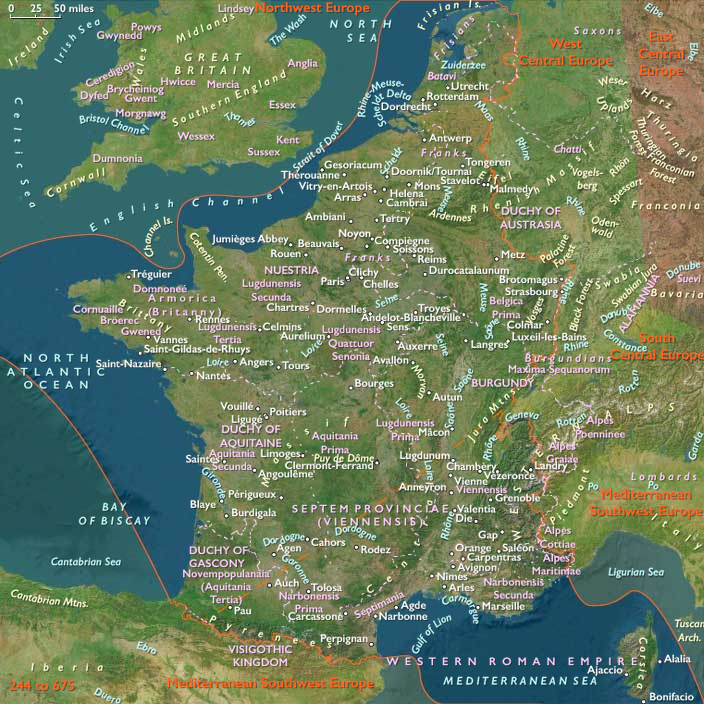
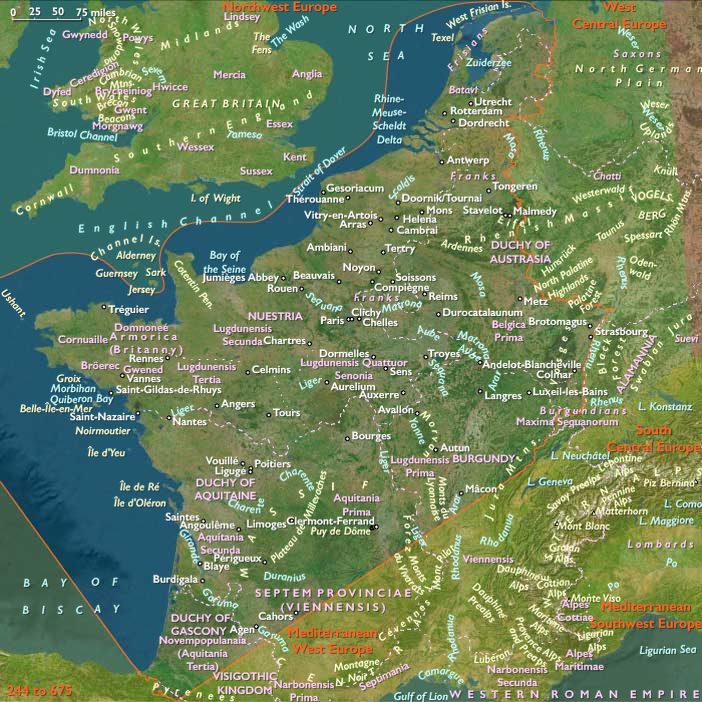
  • Theudebert's letters claim a vast array of lands surrounding Austrasia, including imperial lands once controlled by Rome.
  • He actively campaigned in southern Gaul, extending Frankish dominance over Visigothic-held territories.
  • His aggressive expansion further distanced Austrasia from Byzantine influence, reinforcing the Frankish kingdom’s status as a major power.

4. Patronage of the Gallic Church and Pious Reputation

  • Despite his military ambitions and personal scandals, Theudebert is remembered as a pious king and patron of the Church.
  • Gregory of Tours praises him for his support of the Gallic clergy, while Fortunatus, a contemporary poet, also acknowledges his Christian devotion.
  • His religious patronage strengthens ties between the monarchy and the Church, further legitimizing Merovingian rule.

5. Death and a Smooth Succession

  • Theudebert dies in the fourteenth year of his reign, likely in late 547 or early 548 CE.
  • Unlike many Merovingian successions, his son Theudebald, by Deuteria, takes the throne without internal strife, suggesting a well-established power structure in Austrasia.
  • This peaceful transition contrasts sharply with the violent successions of many Merovingian kings, marking a brief period of stability.

Conclusion: A Bold and Independent Frankish King

Theudebert I was a transformative figure in Merovingian history, known for:

  • Asserting Frankish independence from the Byzantine Empire.
  • Expanding Austrasia's influence beyond its traditional borders.
  • Using strategic marriages to enhance his political standing.
  • Gaining a reputation for piety, reinforcing Church support for the Merovingian dynasty.

His reign marks a critical turning point, where the Franks transition from being former Roman allies to an autonomous European power, paving the way for future Merovingian and Carolingian expansion.

Related Events

Filter results