
There is very little information on the …
Years: 513BCE - 502BCE
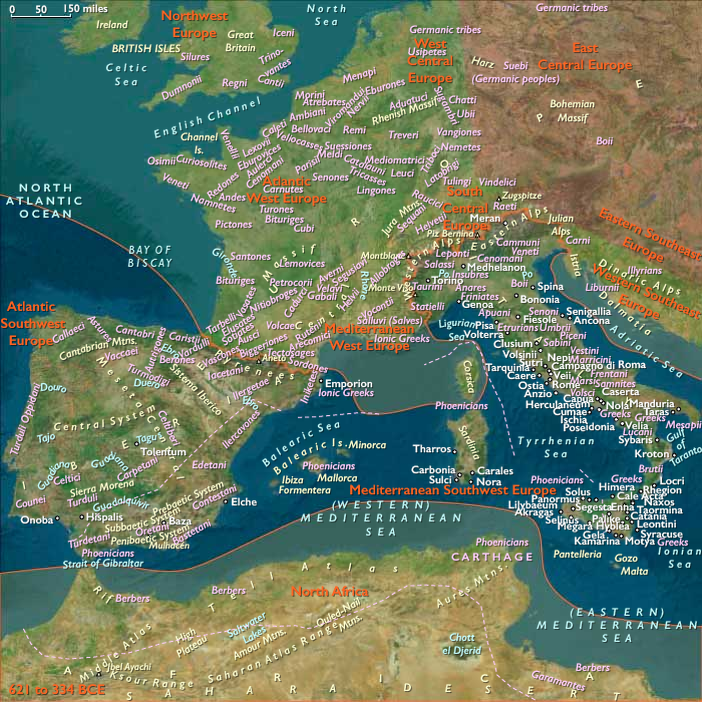
There is very little information on the history of Sybaris after the mid-sixth century until shortly before its fall.
It appears that near the end of the sixth century the government, which had previously been in the hands of an oligarchy, was overthrown by a democratic party headed by a demagogue named Telys who drove a considerable number of the leading citizens into exile.
Subsequently Telys seems to have become the despot or tyrant of the city.
The exiled citizens have taken refuge at Crotona but, not content with their victory, Telys and his partisans demand that the Crotoniats hand over the fugitives.
They refuse to do so and as a result the Sybarites declare war and march upon Crotona with an army said to have amounted to three hundred thousand men.
They are met by the Crotoniats at the river Traeis; the defending army does not amount to more than a third of their numbers.
Nevertheless, the Crotoniats win resoundingly and slaughter most of the Sybarites.
They continue their pursuit to Sybaris' gates, gain control of the city, and determine to raze it to the ground so it can never be inhabited again.
In order to do this, they divert the course of the river Crathis, so that it inundates the site of the city and buries the ruins under its silt deposits.
The surviving inhabitants take refuge at Laüs and Scidrus, on the shores of the Tyrrhenian sea.
This catastrophe occurs in 510 BCE, and seems to have been viewed by many of the Greeks as divine vengeance upon the Sybarites for their pride, arrogance, and excessive prosperity.
More specifically, it is seen as punishment for the contempt they had shown for the great Olympic Games, which they are said to have attempted to supplant by attracting the principal artists and athletes to their own public games.
It is certain that Sybaris was never rebuilt.
Today the site is bare and the exact position of the ancient city cannot be determined.
Explorations undertaken by the Italian government in 1879 and 1887 failed to lead to a precise knowledge of the site.
Locations
People
Groups
- Greece, classical
- Italy, classical
- Magna Graecia
- Sybaris (Achaean Greek) city-state of
- Croton (Achaean Greek) city-state of
Topics
Commodoties
Subjects
Regions
Subregions
Related Events
Showing 10 events out of 65725 total
Years: 513BCE - 502BCE
Locations
People
Groups
- Greece, classical
- Italy, classical
- Magna Graecia
- Sybaris (Achaean Greek) city-state of
- Croton (Achaean Greek) city-state of
Topics
Commodoties
Subjects
Regions
Subregions