
There is some delay when the imperial …
Years: 1169 - 1169
May
There is some delay when the imperial fleet and the army finally arrive in Egypt in 1169.
Inadequate provisions and seasonal rains force both armies to retreat again, each side blaming the other.
In any case, the venture fails, and Shirkuh enters Cairo, subjugating Egypt and thus presenting a broad and competent Muslim front against the crusaders.
Shirkuh has Shawar executed and is named the new vizier, but his reign lasts only two months.
Already an obese man, he dies on May 23 of "indigestion".
His nephew, Saladin, now Nur ad-Din's deputy is left to overcome the remaining opposition and master Egypt.
He is at the age of thirty-one appointed both commander of the Syrian troops in Egypt and vizier of the Fatimid caliphate.
His relatively quick rise to power must be attributed not only to the clannish nepotism of his Kurdish family but also to his own emerging talents.
As vizier of Egypt, he receives the title malik, “king”, although he is generally known as the sultan.
Saladin, although himself an orthodox Muslim, initially does not proclaim the Sunni faith amid a people still devoted to the tenets and practice of the Shi'a sect, but he will soon find himself able to do so; and thus the spiritual supremacy of the Abbasids will again prevail, not only in Syria, but throughout Egypt and all its dependencies.
Locations
People
Groups
- Egypt in the Middle Ages
- Muslims, Sunni
- Muslims, Shi'a
- Abbasid Caliphate (Baghdad)
- Fatimid Caliphate
- Christians, Roman Catholic
- Roman Empire, Eastern: Komnenos dynasty, restored
- Jerusalem, Latin Kingdom of
- Zengid dynasty of Syria
- Damascus, Ayyubid Dynasty of
Topics
Commodoties
Subjects
Regions
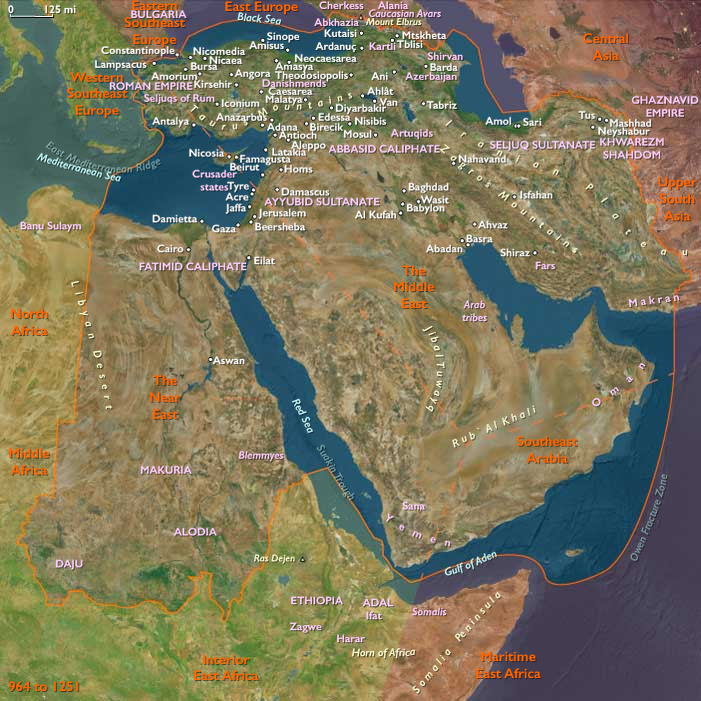
Subregions
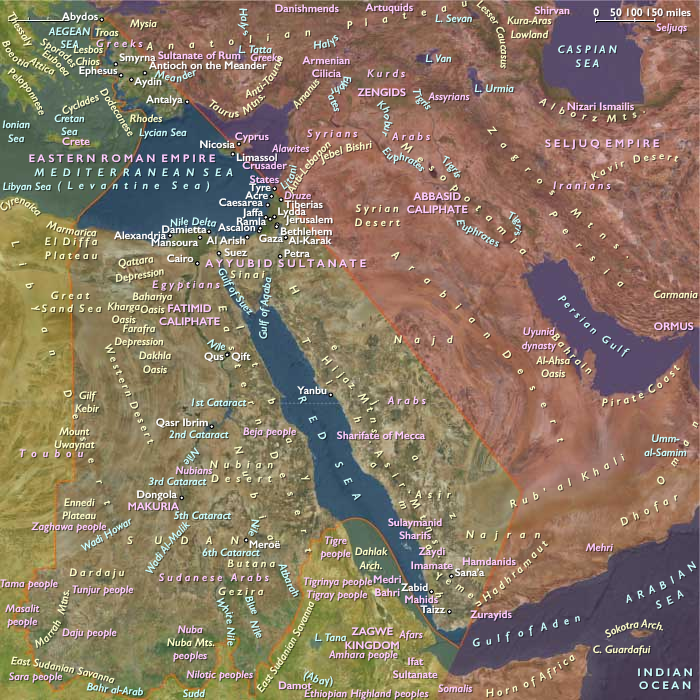
Related Events
Showing 10 events out of 48392 total
Years: 1169 - 1169
May
Locations
People
Groups
- Egypt in the Middle Ages
- Muslims, Sunni
- Muslims, Shi'a
- Abbasid Caliphate (Baghdad)
- Fatimid Caliphate
- Christians, Roman Catholic
- Roman Empire, Eastern: Komnenos dynasty, restored
- Jerusalem, Latin Kingdom of
- Zengid dynasty of Syria
- Damascus, Ayyubid Dynasty of
Topics
Commodoties
Subjects
Regions
Subregions