
There is extensive Mycenaean trade with Cyprus …
Years: 1341BCE - 1198BCE
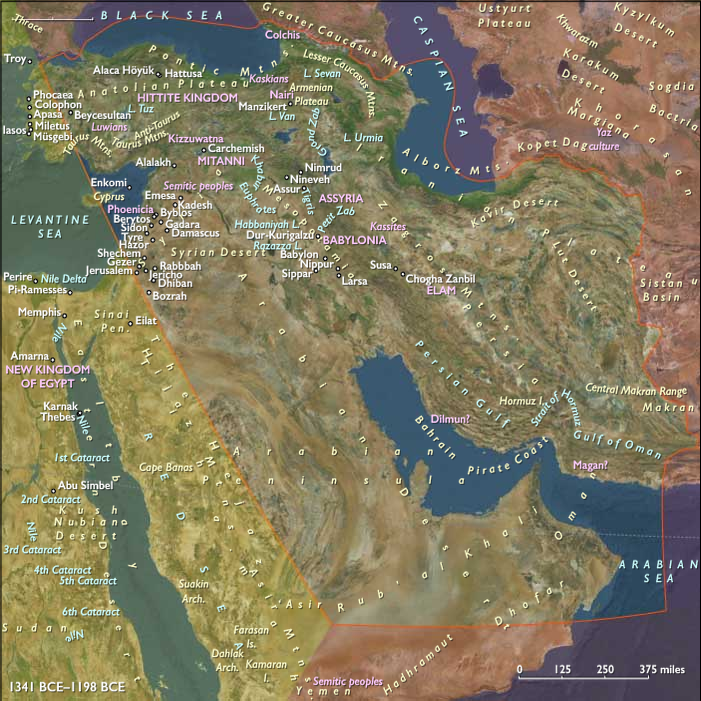
There is extensive Mycenaean trade with Cyprus and Müskebi on the Halicarnassus peninsula.
The LCIIC (1300-1200 BCE) is a time of local prosperity on Cyprus.
Cities such as Enkomi are rebuilt on a rectangular grid plan, where the town gates correspond to the grid axes and numerous grand buildings front the street system or newly founded.
Great official buildings constructed from ashlar masonry point to increased social hierarchization and control.
Some of these buildings contain facilities for processing and storing olive oil, such as Maroni-Vournes and Building X at Kalavassos-Ayios Dhimitrios.
A sanctuary with a horned altar constructed from ashlar masonry has been found at Myrtou-Pigadhes; other temples have been located at Enkomi, Kition, and Kouklia (Palaepaphos).
Both the regular layout of the cities and the new masonry techniques find their closest parallels in Syria, especially in Ugarit (modern Ras Shamra).
Rectangular corbelled tombs point to close contacts with Syria and Palestine as well.
The Cypriot syllabic script was first used in early phases of the late Bronze Age (LCIB) and is to continue in use for about five hundred years years into LC IIIB, maybe up to the second half of the eleventh century BCE.
The practice of writing spreads and tablets in the Cypriot syllabic script have been found at Ras Shamra, which was the Phoenician city of Ugarit.
Ugaritic texts from Ras Shamra and Enkomi mention Ya, the Assyrian name of Cyprus, which thus seems to have been in use already in the late Bronze Age.
Most scholars believe the Cypriot syllabic script was used for a native Cypriot language (Eteocypriot) that survived until the fourth century BCE, but the actual proofs for this are scant, as the tablets still have not been completely deciphered.
Copper ingots shaped like oxhides have been recovered from shipwrecks such as at Ulu Burun, Iria, and Cape Gelidonya, which attest to the widespread metal trade.
Weights in the shape of animals found in Enkomi and Kalavassos follow the Syro-Palestinian, Mesopotamian, Hittite, and Aegean standards and thus attest to the widespread trade as well.
Late Bronze Age Cyprus is a part of the Hittite empire but is a client state and as such is not invaded but rather merely part of the empire by association and governed by the ruling kings of Ugarit.
However, during the reign of Tudhaliya, the island is briefly invaded by the Hittites, either for to secure the copper resource or as a way of preventing piracy.
Shortly afterwards the island is reconquered by his son around 1200 BCE.
Locations
People
Groups
- Cyprus, Archaic
- Canaanite culture, ancient
- Anatolia, archaic
- Ugarit, Kingdom of
- Mycenaean Greece
- Hittites (Hittite Empire), (New) Kingdom of the
- Mycenae, archaic Kingdom of
Topics
Commodoties
Subjects
- Commerce
- Language
- Symbols
- Writing
- Architecture
- Environment
- Labor and Service
- Conflict
- Faith
- Government
- Custom and Law
- Technology
- Archaeology
- Linguistics
- Piracy
Regions
Subregions
Related Events
Showing 10 events out of 67384 total
Years: 1341BCE - 1198BCE
Locations
People
Groups
- Cyprus, Archaic
- Canaanite culture, ancient
- Anatolia, archaic
- Ugarit, Kingdom of
- Mycenaean Greece
- Hittites (Hittite Empire), (New) Kingdom of the
- Mycenae, archaic Kingdom of
Topics
Commodoties
Subjects
- Commerce
- Language
- Symbols
- Writing
- Architecture
- Environment
- Labor and Service
- Conflict
- Faith
- Government
- Custom and Law
- Technology
- Archaeology
- Linguistics
- Piracy
Regions
Subregions