
There are also serious tensions between the …
Years: 1876 - 1876
There are also serious tensions between the Transvaal Republic and the Zulus led by King Cetshwayo.
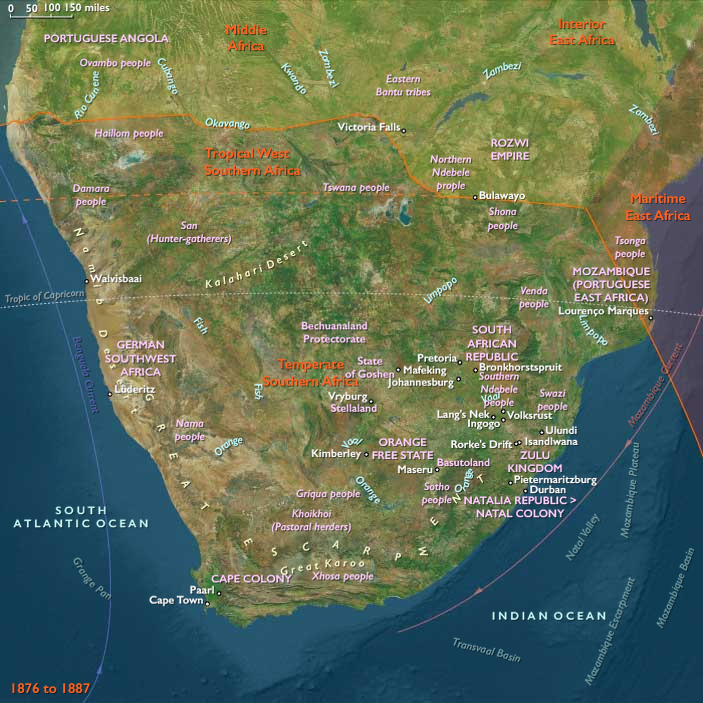
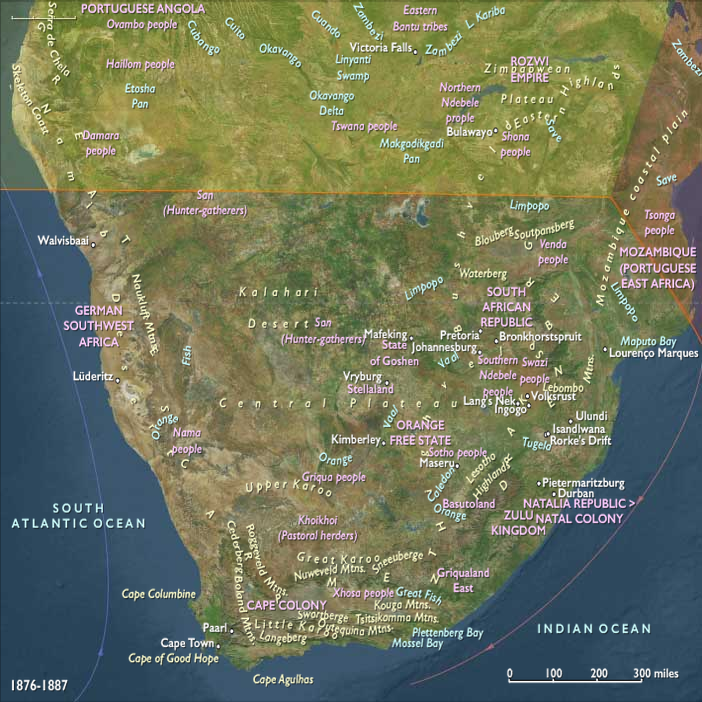
The Zulus occupy a kingdom located to the southeast, bordered on the one side by the Transvaal Republic and on the other by British Natal.
Cetshwayo, a son of Zulu king Mpande and Queen Ngqumbazi, half-nephew of the famous Zulu king Shaka and grandson of Senzangakhona kaJama, had in 1856 defeated and killed in battle his younger brother Mbuyazi, Mpande's favorite, and become the effective ruler of the Zulu people.
He did not ascend to the throne, however, as his father was still alive.
Stories from that time regarding his huge size vary, saying he stood at least between six feet six inches tall (one hundred and ninety-eight) and six feet eight inches tall (two hundred and three centimeters) and weighed close to twenty-five stone (one hundred and fifty-eight kilograms).
His other brother, Umtonga, was still a potential rival.
In 1861, Umtonga had fled to the Boers' side of the border and Cetshwayo had had to make deals with the Boers to get him back.
In 1865, Umtonga did the same thing, apparently making Cetshwayo believe that Umtonga would organize help from the Boers against him, the same way his father had overthrown his predecessor, Dingaan.
Mpande died in 1873 and Cetshwayo had become king on September 1.
As was customary, he has created a new capital for the nation and called it Ulundi (the high place).
Cetshwayo had expanded his army and reintroduced many of the paramilitary practices of Shaka.
He had also started equipping his impis with firearms, although this is a gradual process and the majority have only shields, clubs (knobkerries) and spears (throwing spears and the famous assegais).
Over forty thousand strong, disciplined, motivated and confident Zulu warriors are a formidable force on their own home ground, their lack of modern weaponry notwithstanding.
King Cetshwayo has banished European missionaries from his land, and there are suggestions that he might also have become involved in inciting other native African peoples to rebel against the Boers in the Transvaal.
The Transvaal Boers become increasingly concerned, but King Cetshwayo's policy is to maintain good relations with the British in Natal in an effort to counter the Boer threat.
Locations
People
Groups
- Sotho (Basotho or Basuto) people
- Zulu people
- Boers
- Britain (United Kingdom of Great Britain and Ireland)
- Cape Colony, British
- Zululand
- Zulu, Kingdom of the
- Matabele Kingdom
- South African Republic (the Transvaal)
- Natal Colony, British
- Orange Free State, Republic of the (Boer Republic)
- Transvaal, Republic of the
- South African Republic (the Transvaal) (restored)
- Bechuanaland Protectorate (British)
Topics
Commodoties
Subjects
Regions
Subregions
Years: 1876 - 1876
Locations
People
Groups
- Sotho (Basotho or Basuto) people
- Zulu people
- Boers
- Britain (United Kingdom of Great Britain and Ireland)
- Cape Colony, British
- Zululand
- Zulu, Kingdom of the
- Matabele Kingdom
- South African Republic (the Transvaal)
- Natal Colony, British
- Orange Free State, Republic of the (Boer Republic)
- Transvaal, Republic of the
- South African Republic (the Transvaal) (restored)
- Bechuanaland Protectorate (British)
Topics
Commodoties
Subjects
Regions
Subregions