Theodelinda influences her husband to abandon Arianism …
Years: 603 - 603
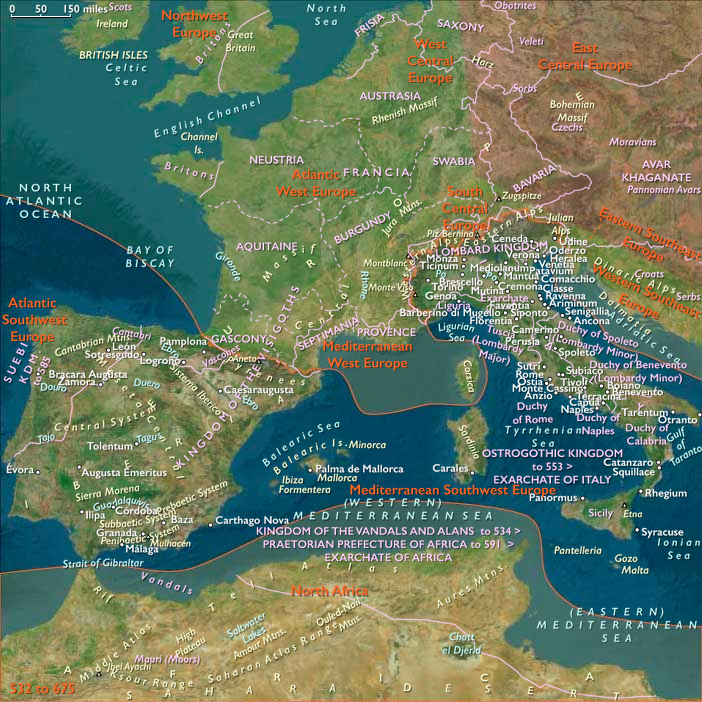
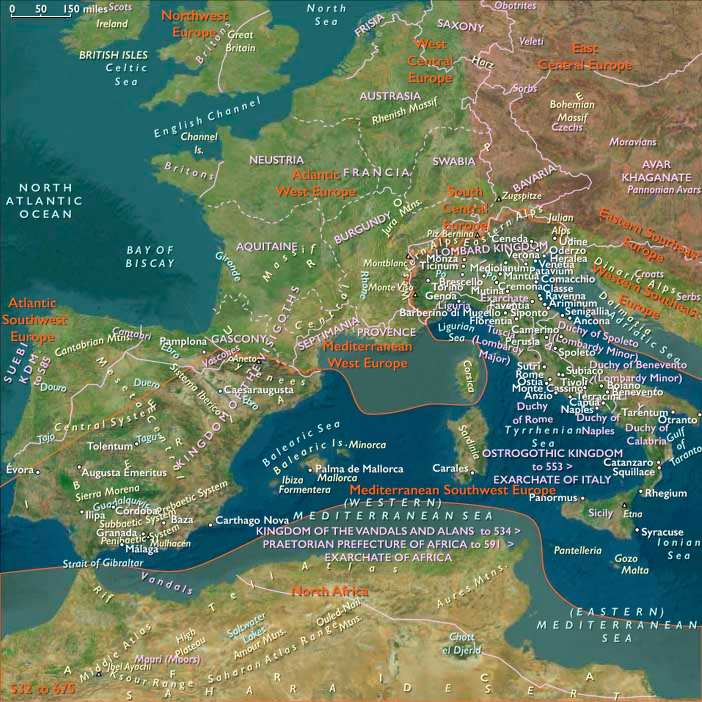
Theodelinda influences her husband to abandon Arianism for Catholicism, and Agilulf is with his son Adaloald baptized in the Cathedral of Monza.
Locations
People
Groups
- Lombards (West Germanic tribe)
- Christianity, Arian
- East, or Oriens, Praetorian prefecture of
- Christianity, Chalcedonian
- Roman Empire, Eastern: Justinian dynasty
- Greeks, Medieval (Byzantines)
- Rome, Duchy of
- Lombards (Italy), Kingdom of the
- Ravenna, Exarchate of
Topics
Subjects
Regions
Subregions
Related Events
Filter results
Showing 10 events out of 10 total
Bohemond dies a broken man on March 3, 1111, without returning to the East, and is buried at Canosa in Apulia.
When his father dies, Bohemond II is a child living in Apulia.
His cousin Tancred takes over the regency of Antioch.
Emperor Alexios wants Tancred to return the Principality of Antioch in its entirety to Constantinople, but Tancred is supported by the County of Tripoli and the Kingdom of Jerusalem.
Tancred, in fact, had been the only Crusade leader who had not sworn to return conquered land to Alexios (although none of the other leaders, save for Raymond IV of Toulouse, had kept their oaths in any event).
Tancred remains regent in Antioch in the name of Bohemond II until his death in 1112 during a typhoid epidemic.
He had married Cecile of France, but dies childless.
He is s succeeded by Bohemond II, under the regency of Tancred's nephew Roger of Salerno.
Roger, the son of Prince Richard of Salerno, who had succeeded his uncle Tancred as regent of Antioch in 1112, forestalls a Seljuq Turkish attempt to reconquer Syria by his victory in the Battle of Sarmin on September 14, 1115.
Antioch and the other Crusader States are constantly at war with the Muslim states of Northern Syria and the Jazeerah, principally Aleppo and Mosul.
After Ridwan of Aleppo died in 1113, there had been a period of a few years peace.
However, Roger of Salerno, ruling Antioch as regent for the child Bohemond II, had not taken advantage of Ridwan's death; likewise, Baldwin II, Count of Edessa, and Pons, Count of Tripoli, had looked after their own interests and had not allied with Roger against Aleppo, which had come under the rule of the Artuqid atabeg Ilghazi of Mardin in 1117.
The marriage of Pons to Cecile of France, the widow of his mentor Tancred, Prince of Galilee, and daughter of Philip I of France, had helped to reconcile the Norman and Provençal Crusaders, who had fallen out during the Siege of Antioch.
In 1118, Pons had allied with Baldwin II, newly crowned as king of Jerusalem.
Roger had captured Azaz in 1118, leaving Aleppo open to attack from the Crusaders; in response, Ilghazi invades the Principality in 1119.
Baldwin and Pons march north to aid Roger, who decides not to wait for them, and he and his army of seven hundred knights and three thousand foot soldiers, including five hundred Armenian cavalry, are slaughtered at the Battle of Ager Sanguinis; Roger is killed by a sword in the face at the foot of the great jeweled cross which had served as his standard.
The rest of the army is completely destroyed; only two knights survive.
One of them, Raynald Mazoir, takes refuge in the fort of Sarmada to wait for King Baldwin, but is soon taken captive by Ilghazi.
Among the other prisoners is likely Walter the Chancellor, who will later wrote an account of the battle.
The massacre leads to the name of the battle, ager sanguinis, Latin for "the field of blood."
The battle has proved that the Muslims can defeat a Crusader army without the help of the Seljuqs.
However, Ilghazi does not advance to Antioch, where Patriarch Bernard is organizing whatever defense he can.
Instead, llghazi is pushed back by Baldwin and Pons on August 14, and Baldwin assumes the regency of Antioch.
The defeat has left Antioch severely weakened, and subject to repeated attacks by the Muslims in the following decade.
As a result, the Principality will eventually come under the influence of Constantinople.

Bohemond is the son of Bohemond I of Tripoli and Constance of France.
When his father died, absent from Antioch, Bohemond II was a child living in Apulia.
His cousin Tancred had taken over the regency of Antioch until he died in 1112; it had then passed to Roger of Salerno, with the understanding that he would relinquish it to Bohemond whenever the latter arrived.
Roger, however, had been killed at the Battle of Ager Sanguinis in 1119, and the nobles of Antioch had invited King Baldwin II of Jerusalem to govern the Principality.
Bohemond had reached his majority in 1124, at the age of sixteen, and has spent the past two years attending to affairs of state in the Mezzogiorno.
After his eighteenth birthday in October 1126, he finally leaves Apulia for Antioch.
According to William of Tyre, he had reached an agreement beforehand with his cousin William II, Duke of Apulia, that whichever of them died first, would leave his lands in Italy to the other.
This is flatly contradicted by Alexander of Telese, who states that Bohemond left his lands under the governance of the Pope, and by Romuald of Salerno, who states that the regency of Taranto went to a relative of Bohemond's, Alexander, Count of Conversano.
To whomever the principality of Taranto was left or promised, as part of his agreement to come to Antioch, Bohemond also marries Baldwin II's daughter Alice.
According to Matthew of Edessa, Baldwin supposedly also promised him the crown of Jerusalem, but Matthew might be confusing Alice with her elder sister Melisende of Jerusalem, who also married a westerner, Fulk V of Anjou, around the same time.
Baldwin II, after winning the Battle of Azaz northeast of Antioch, leads an army of Franks to attack Damascus in early 1126.
His army consists of the usual mounted knights and men-at-arms supported by spearmen and bowmen on foot.
At Marj al-Saffar, thirty kilometers outside Damascus, the Crusaders encounter the army of Damascus, which offers battle.
Toghtekin, founder of the Burid dynasty, rules Damascus at that time.
Only a few details are known about the battle.
The sources are not in agreement about tactical details, but they concur that the Crusaders failed to seize Damascus.
The Franks lost many men to Turkish archery in a very close-fought engagement.
Because of their heavy casualties, the Crusaders were forced to retreat.
Bohemond besieges and captures Kafartab in 1127, killing all the inhabitants.
He also attacks Shaizar, and Usamah ibn-Munqidh supposedly meets the prince himself in battle (and frightens him off, if Usamah is to be believed).
Bohemond’s rule will be marked from 1128 by conflicts with Joscelin I of Edessa and skirmishes in the northern border.
Both Bohemond and Joscelin attack Aleppo individually, but refuse to cooperate in a larger siege against the city.
Roger of Salerno had given away territory to Joscelin, but Bohemond does not consider these donations legitimate as they had been made without his authority, even though he had been a minor at the time.
The dispute comes to open conflict between Antioch and Edessa, with Joscelin allying with the Muslims against Bohemond.
The Latin Patriarch of Antioch places an interdict over the County of Edessa.
Bohemond’s cousin Roger II invades and conquers Taranto in 1128, claiming it as the heir of William II of Apulia.
Bohemond, being away, can do nothing to prevent this.
This year, Baldwin II marches north to mediate in the dispute, and Joscelin abandons his claims.
Meanwhile, the atabeg Zengi consolidates his power over Aleppo and Mosul and the crusaders will never again have a chance to impose their authority over Aleppo.
Baldwin plans to attack Aleppo as well, but Antioch, which had passed to Bohemond II when he came of age in 1126, had begun to fight with Edessa and the plan fell through.
Aleppo and Mosul are united under the much stronger ruler Zengi in 1128, and Crusader control of northern Syria begins to dwindle.
Bohemond, his dispute with Edessa settled, has turned to the north to recover Anazarbus ((a former Antiochene town which had fallen into the possession of Thoros I)) and other territories lost to the Armenian Kingdom of Cilicia.
He marches with a small force up the river Jihan towards his objective.
Leo I, Prince of Armenia, is alarmed and appeals for help to the Danishmend emir, Ghazi Gümüshtigin.
As Bohemond II progresses carelessly up the river, meeting only light resistance from the Armenians, the Danishmend Turks fall on him and massacre the whole of his army in February 1130 near Mamistra.
Bohemond dies in the struggle, and his blond head is embalmed, placed in a silver box, and sent as a gift to the caliph.
However, it is due to Constantinople’s intervention that the Turks do not follow up their victory; and Anazarbus remains in Armenian hands—Michael the Syrian says that John II Komnenos at once started an offensive against the Turks.
Years: 603 - 603
Locations
People
Groups
- Lombards (West Germanic tribe)
- Christianity, Arian
- East, or Oriens, Praetorian prefecture of
- Christianity, Chalcedonian
- Roman Empire, Eastern: Justinian dynasty
- Greeks, Medieval (Byzantines)
- Rome, Duchy of
- Lombards (Italy), Kingdom of the
- Ravenna, Exarchate of