
The Zličané, or Zlitschanen, one of the …
Years: 995 - 995
The Zličané, or Zlitschanen, one of the oldest Czech tribes, had settled in the eastern fold of Bohemia, are the second most powerful tribe in the region.
The Zličan princedom, centered upon the the gord of Libice located at the confluence of the rivers Cidlina and Elbe (Labe), rivals Prague.
Prince Slavník, the founder of the principality, governs the Zličané, as well as the Charvats and Doudlebs tribes, gord Stará (Old) Kouřim and probably also the Świdnica town.
Slavník, a rich and independent ruler who supposedly has consanguinity with the Babenberg Saxon kings, is married to Střezislava, a woman of remarkable beauty, allegedly from the Přemyslid house.
Slavník is also friendly with the Polish royal family, the Piasts.
Slavník has at least seven sons, among whom two —Vojtěch (Adalbert) and the illegitimate Radim (Gaudentius)—will later became saints.
According to Cosmas' Chronicle, Slavník was a happy man all his lifetime.
Vojtěch, who had been born around 956 in Libice nad Cidlinou, has five full brothers: Soběbor (Slavnik's heir), Spytimir, Pobraslav, Porej, Caslav and a half-brother, Radim, from his father's liaison with another woman.
Radim had chosen a clerical career, as had Vojtěch, and the name Gaudentius.
Adalbert is well-educated, having studied for about ten years under Adalbert of Magdeburg, who will later be canonized and be known as the Apostle of the Slavs.
After completing his studies at Magdeburg he had returned to Prague, where he had become a priest.
His father had died in 981, as had Adalbert; upon the death of his mentor, he had taken on the name Adalbert.
Adalbert, still not yet thirty years old, had become the Bishop of Prague in 982.
However, he strongly resented the participation of formally Christian inhabitants in the slave trade.
Although Adalbert descends from a rich family and could afford comfort and luxury, he lives poorly of his own free will.
Gifted and industrious, Adalbert had soon become well-known all over Europe, noted for charity, austerity, and zealous service to the Church.
His duty is difficult even in baptized Bohemia, as the pagan creed is deeply embedded in the peoples' minds.
Adalbert has complained of polygamy and idolatry, which still are not unusual among the Czechs.
Resigned his bishopric and leaving Prague in 989, he had gone to Rome to live as a hermit in St. Alexis Benedictine monastery.
Four years later, in 993, Pope John XV had sent him back to Bohemia, where Adalbert had again become Bishop, founding a monastery in Břevnov, near Prague, the first one for men in the Czech lands.
However, he has continued to meet with the same kind of opposition to his ministry from the nobility that he had faced earlier.
Also, according to Cosmas' chronicle, high clerical office is a burden to Adalbert, and in 994 he had offered it to Strachkvas, the brother of the Přemyslid Duke Boleslav, but Strachkvas refuses.
War between Poland and Bohemia is continual in this period and by 990 Boleslaus the Brave had occupied Silesia.
Meanwhile, Prince Soběbor had rushed to consolidate the princedom's independence, coining money in Libice, (known among numismatists as the silver senars), in spite of the primacy of Prague, and taking other separatist measures.
This is a direct challenge to Boleslav II, head of the Přemyslid family.
As the Přemyslids cannot afford any mighty rivals, Boleslav is determined to add the Slavniks lands to his kingdom.
On September 28, 995, Boleslaus and his confederates, the powerful Czech clan known as the Vršovci, storm Libice and massacre the Slavník dynasty, hunting them down and killing them where they find them, even in church.
Only three family members survive because they are absent from Libice: Soběbor, Radim (Gaudentius), the later archbishop of Gniezno (Hnězdno) and St. Adalbert, who damns the Vršovci in a church for their cruelty and predicts that they will be severely persecuted.
Soběbor, who had been in Germany during the massacre of his family, gains sanctuary in Poland from its Piast prince, Boleslaus.
Thus does the Zličan princedom becomes part of the Přemyslids' estate, Boleslaus' brutal triumph having ensured the unity of Bohemia under a single ruler.
Locations
Groups
- Prussians, Old, or Baltic (Western Balts)
- Christianity, Chalcedonian
- Bohemia, Duchy of
- Hungary, Principality of
- German, or Ottonian (Roman) Empire
- Poland, Principality of
- Czechs [formerly Bohemians] (West Slavs)
Commodoties
Subjects
Regions
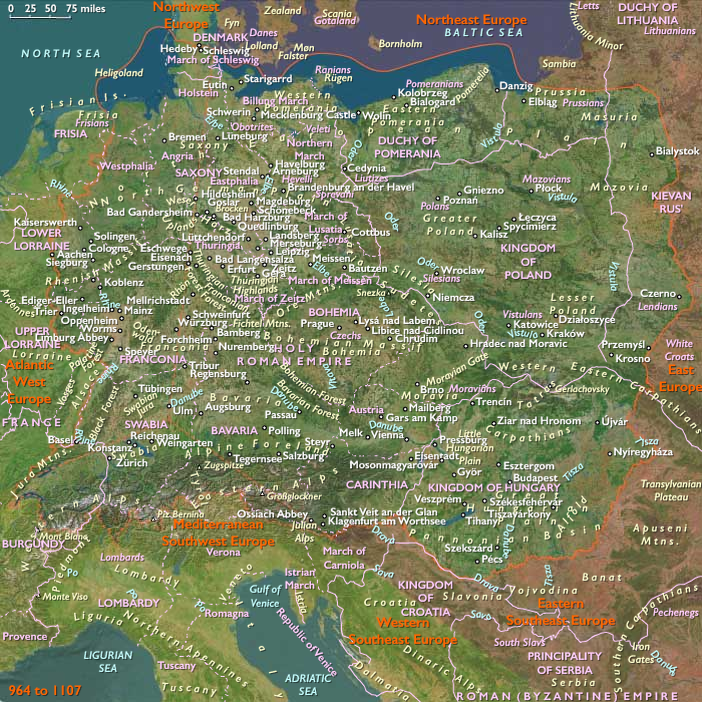
Subregions
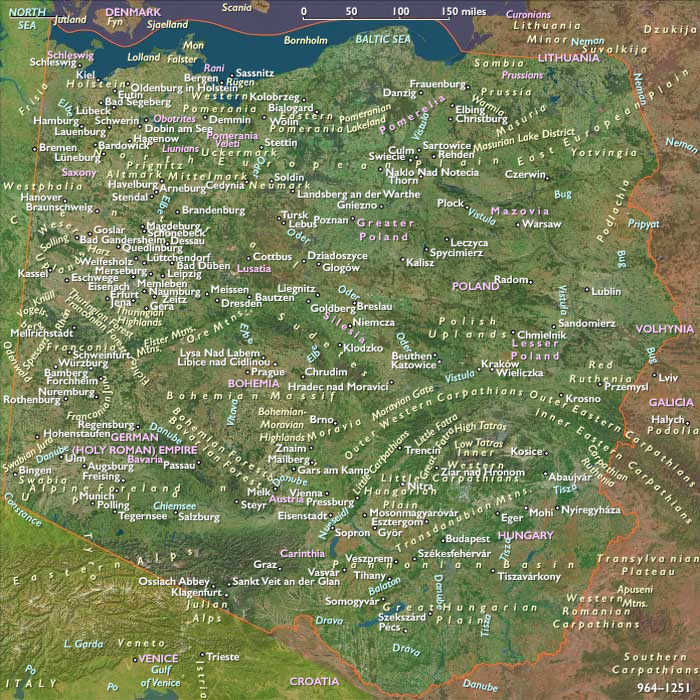
Related Events
Showing 10 events out of 52171 total
Years: 995 - 995
Locations
Groups
- Prussians, Old, or Baltic (Western Balts)
- Christianity, Chalcedonian
- Bohemia, Duchy of
- Hungary, Principality of
- German, or Ottonian (Roman) Empire
- Poland, Principality of
- Czechs [formerly Bohemians] (West Slavs)
Commodoties
Subjects
Regions
Subregions