The Zanj subsequently defeat al-Muwaffaq himself in …
Years: 872 - 872
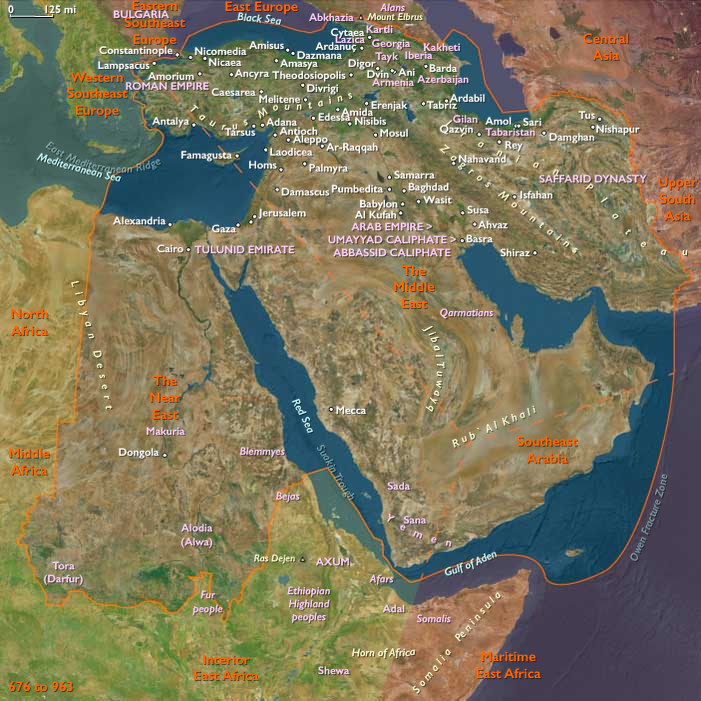
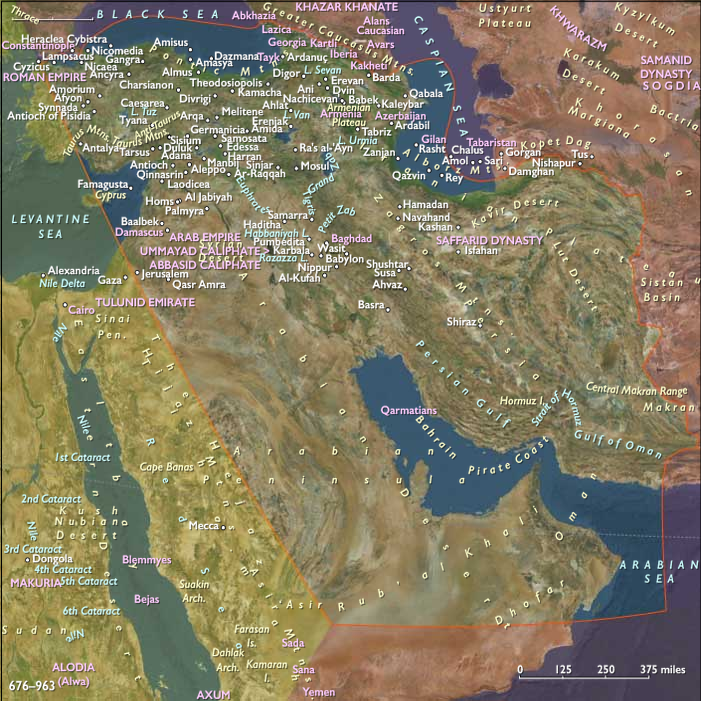
The Zanj subsequently defeat al-Muwaffaq himself in April 872.
Locations
People
Groups
Topics
Commodoties
Subjects
Regions
Subregions
Related Events
Filter results
Showing 10 events out of 53913 total
Borivoj, as the head of the Premyslids who dominate the environs of present-day Prague, had declared himself kníže—in Latin dux, which means sovereign prince—around the year 870.
His title will be later translated by German scholars as "duke" of the Bohemians (Czechs).
Although the German dukes of the era hold the same title, the meaning of his title is in fact completely different.
In contrast to the German dukes, the Czech dux denotes a sovereign ruler.
Borivoj is recognized as such around 872 by his overlord Svatopluk I of Great Moravia, who dispatches Bishop Methodius to begin the conversion of the Bohemian Slavs to Christianity.
As with most of the early Bohemian rulers, Borivoj is a shadowy figure; exact dates for his reign and vital statistics cannot be established.
Nonetheless, several major fortifications and religious foundations are said to have dated from this time.
In old Czech legends, he is said to have been son of a Bohemian prince named Hostivít.
The power of the Paulicians, considered by Constantinople to be dangerous and heretical, has grown to great extent on the borders of the Armenian province in Asia Minor under the sects' current leaders, Karbeas and Chrysocheir, who are crushed militarily by 872, largely owing to the efforts of Basil's son-in-law Christopher.
Many Paulicians flee Anatolia for the Balkans as the empire expands eastward toward the Euphrates.
Louis, released from his oath on returning to Rome, is crowned a second time as emperor by Pope Adrian II on May 18, 872.
Louis wins further successes against the Saracens, who are driven from Capua, but the emperor's attempts to punish Adeichis are not very successful.
Following his defeat at Wilton, Alfred pays a large sum to the Danes to secure an armistice, which they break, conquering Mercia in 872 and raiding the British southwest.
A widespread failure of the agricultural harvest in Tang Dynasty China leads to a widespread famine in 873; in the previous century the central government had been able to curb famine with large grain stores, but this time the central government is already in decline and too weak to properly face the disaster.
Louis the German, king of the East Franks, supports Frankish Catholic missions in Moravia, but has been unable to maintain control in this area and loses a war that leads to full Moravian independence under Rostislav's successor, Svatopluk (reigned 870–894).
Cyril, in Rome with his brother Methodius to defend their invention of what will become the Cyrillic alphabet, had died there in 869.
Methodius, consecrated an archbishop, had returned to Moravia later in the year as a papal legate.
The German authorities imprison him for three years until Pope John VIII secures his release.
Iran’s native Tahirid dynasty has enjoyed a high degree of autonomy in their governance of the Abbasid province Khorasan from 821.
Abdullah ibn Tahir, one of the greatest of the Tahirid rulers, had died in 845 and had been succeeded by his son Tahir II.
Not much is known of Tahir's rule, but the administrative dependency of Sistan was lost to rebels during his governorship.
Tahirid rule had begun to seriously deteriorate after Tahir's son Muhammad ibn Tahir became governor, due to his carelessness with the affairs of the state and lack of experience with politics.
In Khorasan itself, Muhammad's rule has continued to grow increasingly weak, and in 873 he is finally overthrown by the Saffarid dynasty, who annex Khorasan to their own empire in eastern Persia, ruling practically independently of the Samarra-based Abbasid caliphate.
Vímara Peres and the Foundations of Portugal (868 CE)
Vímara Peres, a vassal of King Alfonso III of Asturias, León, and Galicia, is sent to reconquer and secure the western coastal fringe of Gallaecia from the Moors—the Arabs and Berbers who had invaded Visigothic Hispania. His mission covers the territory between the Minho and Douro Rivers, including the strategically important city of Portus Cale (later Porto and Gaia), from which the name Portugal will eventually emerge.
The Birth of the County of Portugal (868 CE)
After successfully expelling the Moors, Vímara Peres is named Count of Portugal in 868 CE, marking the first formal establishment of the county north of the Douro River.
While Portugal will not achieve full independence until the 12th century, later Portuguese historians recognize Vímara Peres' reconquest as the earliest milestone in the formation of the Portuguese state.
The Founding of Guimarães and Vímara’s Legacy
To solidify control over the newly reconquered lands, Vímara Peres establishes a fortified settlement under his own name, Vimaranis, which later evolves into Guimaranis and, ultimately, Guimarães. This city will come to be known as "The Cradle City" (A Cidade Berço) of Portugal.
Vímara Peres dies in 873 CE in Guimarães, leaving the governance of the County of Portugal to his son, Lucídio Vimaranes (Lucídio, son of Vímara), who succeeds him as count.

Hastein’s Seizure of Angers and the Carolingian Response (870–873)
The city of Angers, originally a Gallic settlement and later the Roman city of Juliomagus, is an important Carolingian stronghold located on the Maine River, about 160 miles (257 km) southwest of Paris. Its strategic location makes it a key target during the Viking incursions into West Francia in the 9th century.
Hastein Captures Angers (870)
- Hastein, a prominent Viking chieftain, seizes Angers in 870, likely using the Maine River as an entry route into the Frankish heartland.
- This occupation is part of wider Norse incursions into the Loire Valley, where Vikings had established winter bases at Noirmoutier and along the Loire River.
- However, after a Frankish counteroffensive, Hastein is quickly surrounded and besieged, forcing him to abandon the city.
Hastein Retakes Angers (873)
- Despite his earlier expulsion, Hastein launches another attack in 873, reoccupying Angers.
- His second conquest suggests that Carolingian defenses remain weak, with the kingdom still vulnerable to Viking raids.
- Angers, like many Frankish river towns, is difficult to defend, as Viking longships easily navigate inland waterways, striking before the Franks can respond.
Carolingian Retaliation and the Expulsion of Hastein
- In 873, the Carolingian Emperor (likely Charles the Bald) launches a military campaign to reclaim Angers.
- Hastein is ousted once again, though it is unclear whether he is killed in battle, forced into retreat, or negotiates terms for his withdrawal.
- The successful recapture of Angers marks a temporary Frankish victory, but Viking threats to the Loire Valley continue, forcing the Carolingians to constantly defend the region.
The Significance of the Viking Sieges of Angers (870–873)
- Strategic Importance → The repeated Viking assaults on Angers and the Loire Valley highlight the region’s vulnerability as an access point to deeper Frankish territory.
- Frankish Struggles → The Carolingian response is slow and reactive, showing the difficulty of defending riverine settlements against mobile Viking forces.
- Hastein’s Role → Hastein emerges as one of the most formidable Viking leaders of the 9th century, engaging in raids from Francia to the Mediterranean.
- Foreshadowing Future Invasions → The repeated attacks on Angers are part of a larger pattern of Viking expansion, setting the stage for further raids into Brittany, Neustria, and deeper into Frankish lands.
Though Angers is eventually reclaimed, the Viking incursions of 870–873 further demonstrate the inability of the Carolingians to permanently drive out Norse raiders, who continue to exploit weak river defenses in West Francia.