
The younger (Bavarian) branch of the Wittelsbach …
Years: 1373 - 1373
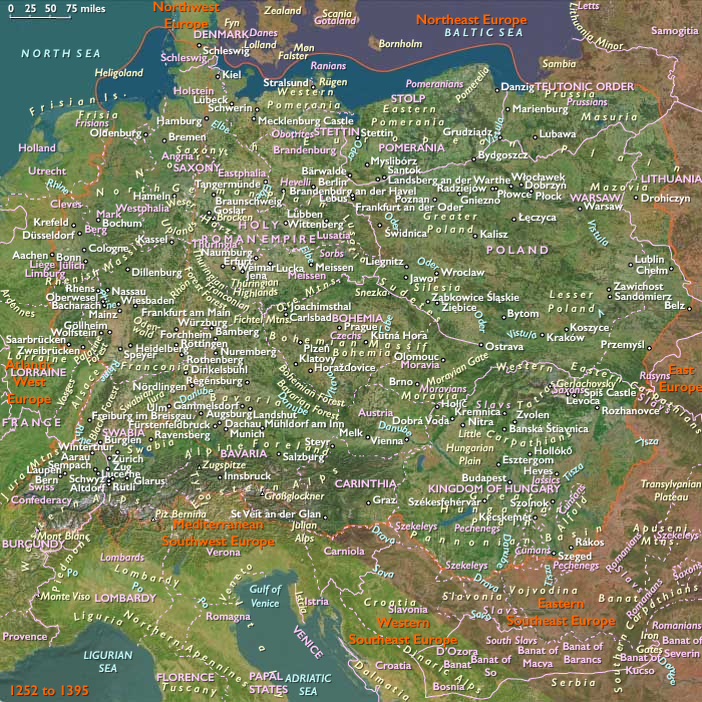
The younger (Bavarian) branch of the Wittelsbach dynasty has, for half a century, also ruled Brandenburg in the northeast of Germany.
Emperor Charles IV has, since the middle of the fourteenth century, been attempting to secure Brandenburg for the House of Luxembourg, as control over the electoral vote of Brandenburg would help assure the Luxembourgs of election to the imperial throne, as they already hold the vote of Bohemia.
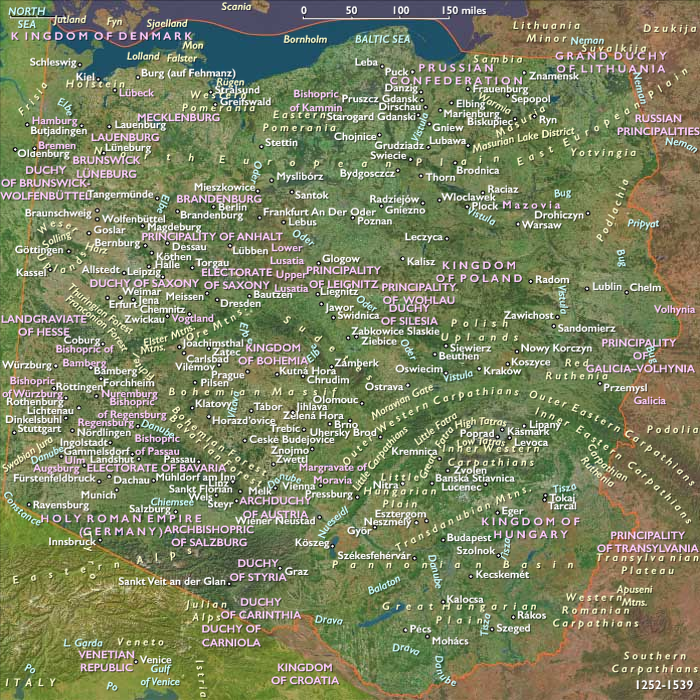
Charles finally succeeds in purchasing Brandenburg from Margrave Otto for five hundred thousand guilders in 1373 and, at a Landtag in Guben, unites Brandenburg and Lower Lusatia with the Kingdom of Bohemia.
The Landbuch of Charles IV, a source for the history of medieval settlement in Brandenburg, originates during this time.
Charles chooses the castle of Tangermünde to be the electoral residence.
Locations
People
Groups
- Bohemia, Kingdom of
- Holy Roman Empire
- Brandenburg, Wittelsbach
- Brandenburg, (Luxembourg) Margravate of
- Bavaria-Munich, Wittelsbach Duchy of
Subjects
Regions
Subregions
Related Events
Filter results
Showing 10 events out of 43786 total
Emperor John V Palaiologos had appealed to the West for help after Ottoman Turks captured Edirne (Adrianopolis).
Instead, he had been detained in Venice as a debtor.
The regent Andronikos, his eldest son by his wife Helena Kantakouzene, whose maternal grandparents are John VI Kantakouzenos and Irene Asanina, had refused to pay the ransom for his father, and John had had to give up the island Tenedos (modern Bozcaada, Turkey) to buy his freedom.
After that event, John assigns his younger son Manuel as his crown prince and accepts the suzerainty of Ottomans in 1373.
Thus, when the Ottoman sultan asks for his services against some rebellions in Ottoman lands, he has to leave his capital.
This absence gives Andronikos a chance to rebel.
He allies with Murad's son Savcı Bey, who is rebelling against his own father, but both rebellions fail.
Murad I blinds and executes his son and demands that John V have Andronikos IV blinded as well, but John V blinds Andronikos in only one eye, imprisons him, and deprives him of his rights to the succession.
Pope Gregory XI had urged Louis to resist the Ottomans, but also pleaded with him to sent reinforcements to Italy to fight against Bernabò Visconti.
A war had broken out between the Republic of Venice and Francesco I da Carrara, Lord of Padua, who is Louis's ally, in the summer of 1372.
Louis had sent reinforcements to Italy to assist Carrara.
The Venetians had defeated the Hungarian troops at Treviso and captured its commander, Nicholas Lackfi, forcing Louis I to sign a peace treaty on September 23, 1373.
King Charles I of Sicily (Charles of Anjou) had been forced to leave the island of Sicily by Peter III of Aragon's troops following the Sicilian Vespers rebellion of 1282.
Charles, however, had maintained his possessions on the mainland, customarily known as the "Kingdom of Naples," after its capital city.
Charles and his Angevin successors have maintained a claim to Sicily, warring against the Aragonese until Queen Joan I of Naples formally renounces the claim in 1373, thereby ending the long, desultory war between Naples and Aragon.
Ferdinand, the ninth King of Portugal and the Algarve, the second but eldest surviving son of Peter I and his wife, Constance of Castile, had succeeded his father in 1367; he is sometimes referred to as the Handsome or rarely as the Inconstant.
On the death of Peter of Castile in 1369, Ferdinand, as great grandson of Sancho IV by the female line, had laid claim to the vacant throne, for which the kings of Aragon and Navarre, and afterwards John of Gaunt, duke of Lancaster (married in 1370 to Constance, the eldest daughter of Peter), had also become competitors.
Meanwhile Henry of Trastamara, the brother (illegitimate) and conqueror of Peter, had assumed the crown and taken the field.
After one or two indecisive campaigns, all parties were ready to accept the mediation of Pope Gregory XI.
The conditions of the treaty, ratified in 1371, had included a marriage between Ferdinand and Leonora of Castile but before the union could take place the former had become passionately attached to Leonor Telles de Menezes, the wife of one of his own courtiers, and having procured a dissolution of her previous marriage, had lost no time in making her his queen.
This strange conduct, although it raised a serious insurrection in Portugal, did not at once result in a war with Henry; but the outward concord had soon been disturbed by the intrigues of the duke of Lancaster, who had prevailed on Ferdinand to enter into a secret treaty for the expulsion of Henry from his throne.
The ensuing war has been unsuccessful, despite English help; and peace is again made in 1373.
The French Seizure of Brittany and the Exile of Duke John IV (1373)
By 1373, Brittany had become heavily indebted to King Edward III of England, further entrenching English influence in the duchy. Duke John IV’s administration was largely controlled by English advisors, including Thomas Melbourne, the Treasurer and Receiver General of the Duchy. This foreign domination, combined with widespread discontent over the implementation of a permanent ducal tax (the hearth tax), led to growing opposition from the Breton nobility, particularly from Olivier de Clisson.
Duke John IV’s Continued Alliance with England
- Facing increasing pressure from French-backed factions in Brittany, John IV chose to reaffirm his alliance with England, signing a new treaty with Edward III.
- To justify this to France, John IV claimed he had no choice but to host English troops in order to counter Olivier de Clisson’s growing influence in Brittany.
- English garrisons were stationed in key strategic locations, including:
- Derval
- Rougé
- Brest
- Saint-Mathieu
Charles V’s Response: The French Invasion of Brittany (March 1373)
- In response to John IV’s continued English alliance, King Charles V of France ordered his Constable, Bertrand du Guesclin, to seize the Duchy of Brittany on March 1, 1373.
- To ensure the support of Olivier de Clisson, Charles granted him the lordship of Guillac, further securing Clisson’s loyalty to the French Crown.
- Du Guesclin and Clisson launched a propaganda campaign, seeking to discredit John IV and turn the Breton nobility against him.
Duke John IV’s Fall and Exile (April 28, 1373)
- The French offensive was swift and effective, with much of the Breton nobility turning against John IV due to:
- Opposition to English rule in Brittany.
- Discontent over excessive taxation.
- With his support collapsing, John IV was forced to flee the duchy.
- On April 28, 1373, he crossed the English Channel into exile, taking refuge in England under Edward III’s protection.
Impact of the French Takeover
- With John IV in exile, Brittany was effectively under French control, with du Guesclin and Clisson consolidating power.
- The defeat of John IV marked a significant shift in Breton politics, strengthening French authority in the duchy.
- However, John IV’s exile did not end the conflict, as he would later attempt to reclaim his duchy with English support.
The French invasion of Brittany in 1373 and the exile of Duke John IV marked a major turning point, as Charles V’s military strategy continued to weaken English influence in France, setting the stage for further conflicts over Breton sovereignty.
Olivier de Clisson’s Rise to Power and the Siege of Derval (1373)
Following the French invasion of Brittany in early 1373 and the exile of Duke John IV to England, Olivier de Clisson emerged as one of the most powerful figures in the duchy. Though he could have claimed the title of Duke of Brittany, King Charles V instead chose his brother, Louis I, Duke of Anjou, to serve as the nominal ruler of the duchy under the title "Lieutenant of the King." However, this appointment was purely symbolic, as the Duke of Anjou never set foot in Brittany.
Instead, Olivier de Clisson was appointed co-regent of Brittany, alongside Viscount John I of Rohan, taking on real political and military authority in the region.
The Political Settlement of Brittany
- Charles V avoided placing Clisson as Duke, likely fearing:
- That Clisson’s personal ambitions could make Brittany too independent.
- That Brittany would need a ruler tied more closely to the Valois monarchy, hence his choice of the Duke of Anjou, who was married to a daughter of Charles de Blois-Penthièvre.
- Since the Duke of Anjou never entered Brittany, Clisson and Rohan became de facto rulers of the duchy, overseeing its defenses and governance in the name of the French Crown.
The Siege of Derval (Summer 1373)
- As the French campaign in Brittany continued, Clisson led the siege of Derval, a strategically significant castle.
- Derval was symbolically important because it belonged to the English general Robert Knolles, a key figure in English military operations in Brittany.
- The siege marked the beginning of a broader French effort to expel English forces from the region.
Impact and Legacy
- Olivier de Clisson’s role as co-regent of Brittany cemented his authority, making him one of the most powerful figures in the duchy.
- The siege of Derval was part of the larger French strategy under Charles V and Bertrand du Guesclin to weaken English influence in Brittany and western France.
- Clisson’s involvement in the governance and military affairs of Brittany positioned him for his later appointment as Constable of France in 1380, where he would become one of the kingdom’s leading military commanders.
The political reorganization of Brittany in 1373, combined with Clisson’s growing power and the siege of Derval, marked a critical phase in the Hundred Years’ War, as France continued its successful campaign to drive out English forces.
The History and Formation of Aunis as a Separate Province (6th–14th Century)
The province of Aunis, a small but strategically important coastal region, is bordered by the Sèvre Niortaise River (north), the Charente River (south), and the Atlantic Ocean (west), with its islands Île de Ré and Île d'Aix. To the east, it is framed by the valleys of the Mignon, Trézence, and Boutonne Rivers and the hills of Saintonge. Over the centuries, Aunis underwent numerous territorial changes, from an unstable Frankish region to a separate province under King Charles V in 1374.
Early History: Frankish Settlement and Carolingian Rule (6th–9th Century)
- Power in Aunis was unstable and autarchic from the time of Frankish settlement in the 6th century until the Carolingian dynasty in the 9th century.
- The region is first recorded in 785 as Pagus Alnensis, under the control of the Counts of Poitou.
- Repeated Viking raids, carried out by way of the region’s rivers and streams, made Aunis a high-risk frontier zone.
- In response to the Viking threat, the Counts of Poitou fortified the coast in the 9th and 10th centuries, constructing a four-tower fortress at Châtelaillon.
Separation from Saintonge and Fortification (10th–11th Century)
- Following the collapse of Carolingian power in the late 10th century, Aunis separated from Saintonge and established its first capital at Châtelaillon.
- To provide greater inland protection, the Duke of Poitou built Surgères (also called the castrum of Benon)as a fortified city.
Expansion and Economic Growth: 11th–13th Century
- The Counts of Poitou expanded inland in the late 11th century, encouraging the clearing of forests to develop settlements and agriculture.
- The first Cistercian abbey in Aunis, Grâce-Dieu Abbey, was founded in Benon, leading the forest-clearing movement that:
- Created space for villages and farmland (growing wheat, oats, and barley).
- Expanded vineyards, laying the foundation for Aunis' wine trade.
- By the end of the 11th century, Aunis had become prosperous due to its salt production, making it a major trading hub.
Rise of La Rochelle and Aunis' Shifting Allegiances (12th–14th Century)
- Châtelaillon became the most important port city in Aunis for salt and wine transport but was eclipsed by La Rochelle after its demise in 1130.
- In 1130, Aunis came under the control of William X, Duke of Aquitaine, whose daughter, Eleanor of Aquitaine, brought the region as part of her dowry first to Louis VII of France, and after their divorce, to King Henry II of England in 1152.
- Aunis was briefly returned to France in 1224 under Louis VIII, but was ceded back to England under the Treaty of Brétigny (1360), part of the Hundred Years’ War.
- By 1371, Aunis revolted against English rule, leading to its restoration to King Charles V of France.
Aunis Becomes an Independent Province (1374)
- In 1374, Charles V officially separated Saintonge and established Aunis as a distinct province, marking the culmination of its long and complex territorial history.
Significance and Legacy
- Aunis' geographic position made it a valuable maritime and trade region, fueling its economic and strategic importance.
- Its gradual separation from Saintonge and integration into France marked it as a contested territorythroughout the Middle Ages.
- La Rochelle remained its most significant city, growing into one of France’s leading ports in later centuries.
The formation of Aunis as an independent province in 1374 symbolized the final consolidation of French control over the region, bringing an end to centuries of territorial disputes and foreign domination.
The English Occupation and French Recapture of Angoulême (1361–1373)
The city of Angoulême, along with the rest of Angoumois, fell under English control following the Treaty of Brétigny (1360), which temporarily expanded English sovereignty in France. However, by 1373, King Charles V’s forces expelled the English, restoring French rule and granting Angoulême numerous privileges.
English Occupation Under John Chandos (1361)
- From October 16 to 22, 1361, John Chandos, Lieutenant of Edward III of England and Constable of Aquitaine, arrived in Angoulême to implement English rule.
- During this time, he:
- Took possession of the city, its castles, and the monastery of Saint-Pierre.
- Received oaths of allegiance from the leading figures of Angoulême, ensuring loyalty to Edward III.
French Reconquest of Angoulême (1373)
- King Charles V of France, having adopted a strategy of reconquering English-held territories, launched a campaign in western France.
- In 1373, French troops expelled the English from Angoulême, marking a turning point in the war.
- As a reward for its return to French rule, Charles V granted the city numerous privileges, reinforcing its economic and political autonomy.
Impact and Legacy
- The recapture of Angoulême was part of the larger French resurgence under Charles V, which saw many English-held territories return to French control.
- John Chandos, a key English commander, would later be killed in battle in 1370, weakening English leadership in Aquitaine.
- The fall of Angoulême signaled the decline of English rule in western France, as Charles V’s reconquests continued to erode English gains from the Treaty of Brétigny.
The French reconquest of Angoulême in 1373 was a significant step in reversing English territorial expansion, ensuring that the city remained under French rule for the remainder of the Hundred Years' War.
The town of Krefeld-Uerdingen am Rhein (Krefeld) originated in Roman times when the legions founded the military camp of Gelduba (today the borough of Gellep). Records first mention Krefeld itself in 1105 under the name of Krinvelde.
Uerdingen, originally an independent town east of Krefeld, chartered in 1255, becomes in medieval times larger and more important than Krefeld, which receives a charter only in 1373.
Julian of Norwich, also called Juliana, on May 8, 1373, experiences fifteen visions of Jesus Christ's suffering, one further revelation on the following day, and is then healed of a life-threatening illness.
She recounts her religious experience in “Revelations of Divine Love,” which contains a treatment of faith, prayer, predestination, the love of God for humanity, human sin, and other aspects of the Christian faith.
Years: 1373 - 1373
Locations
People
Groups
- Bohemia, Kingdom of
- Holy Roman Empire
- Brandenburg, Wittelsbach
- Brandenburg, (Luxembourg) Margravate of
- Bavaria-Munich, Wittelsbach Duchy of
