
The young Nurhaci, born in 1558, had, …
Years: 1616 - 1616
The young Nurhaci, born in 1558, had, according to Chinese sources, grown up as a soldier in the household of Ming Dynasty General Li Chengliang in Fushun, where he had learned Chinese.
His father Taksi and grandfather Giocangga were killed in 1582 in an attack on Gure by a rival Jurchen chieftain Nikan Wailan while being led by Li Chengliang.
Nurhaci began the following year to unify the Jurchen bands; when he was twentyifive, he beheaded Nikan Wailan at Tulin to avenge the deaths of his father and grandfather, who are said to have left him nothing but thirteen suits of armor.
The nine allied tribes of Yehe, Hada, Ula, Hoifa, Khorchin, Sibe, Guwalca, Jušeri, and Neyen had attacked Nurhaci in 1593 but all had been completely defeated at the Battle of Gure.
He had had two of his translators, Erdeni Bagshi and Gagai Jarguchi, create the written Manchu language in 1599 by adapting the Mongolian alphabet.
Nurhaci from 1599 has campaigned against the four Hulun tribes, first attacking the Hada and finally conquering them in 1603.
He had been granted the title of Kundulun Khan by the Mongols in 1606.
Nurhaci had then conquered the Hoifa in 1607, followed by the Ula in 1613.
(He will not defeat the Yehe until the Battle of Sarhu in 1619.)
Nurhaci declares himself Khan (King) in 1616, , thus founding the Jin Dynasty (aisin gurun), often called the Later Jin.
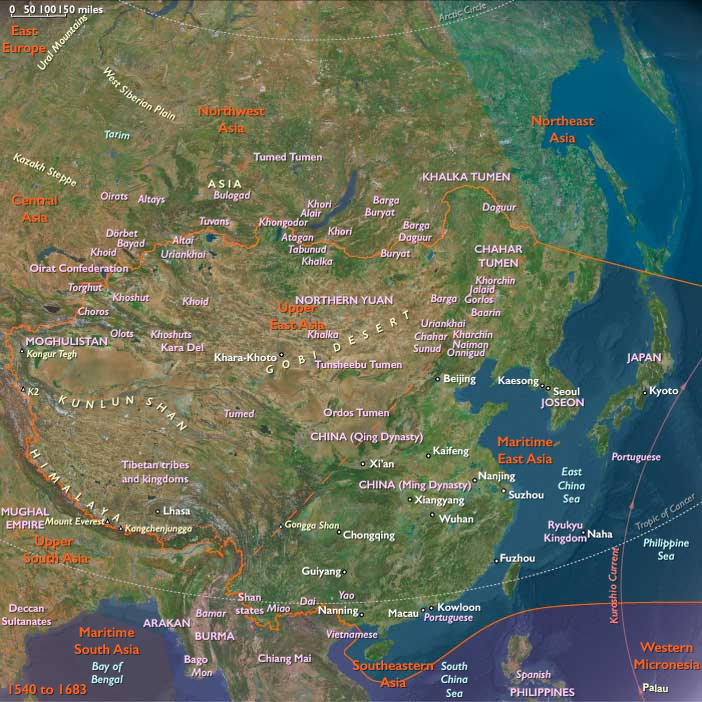
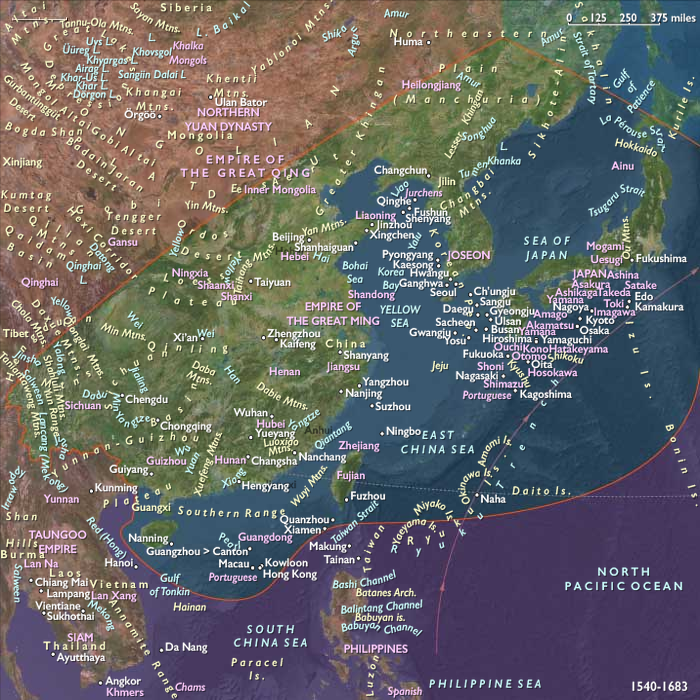
He constructs a palace at Mukden (present-day Shenyang) in Liaoning province. (The earlier Jin Dynasty of the twelfth century had also been formed by the Jurchen.)
Jīn will be renamed Qīng by his son Huang Taiji after his death; Nurhaci is usually referred to as the founder of the Qing Dynasty.
Locations
People
Groups
Topics
Commodoties
Subjects
Regions
Subregions
Related Events
Showing 10 events out of 33161 total
Years: 1616 - 1616
Locations
People
Groups
Topics
Commodoties
Subjects
Regions
Subregions