
The Yangshao people of the cool and …
Years: 5085BCE - 4942BCE
The Yangshao people of the cool and temperate Huang He valley grow millet as their principal grain.
Yangshao farmers employ primitive techniques of cultivation, moving their villages as the soils become exhausted.
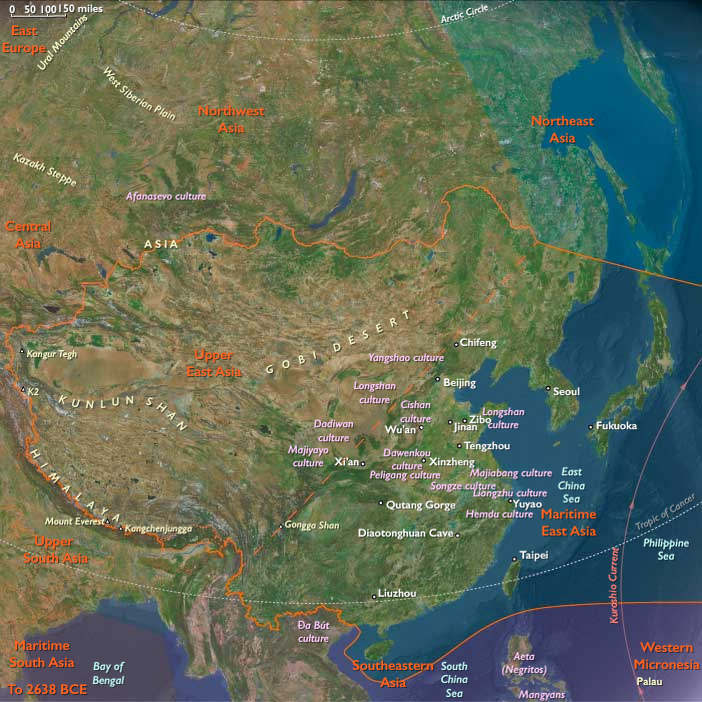
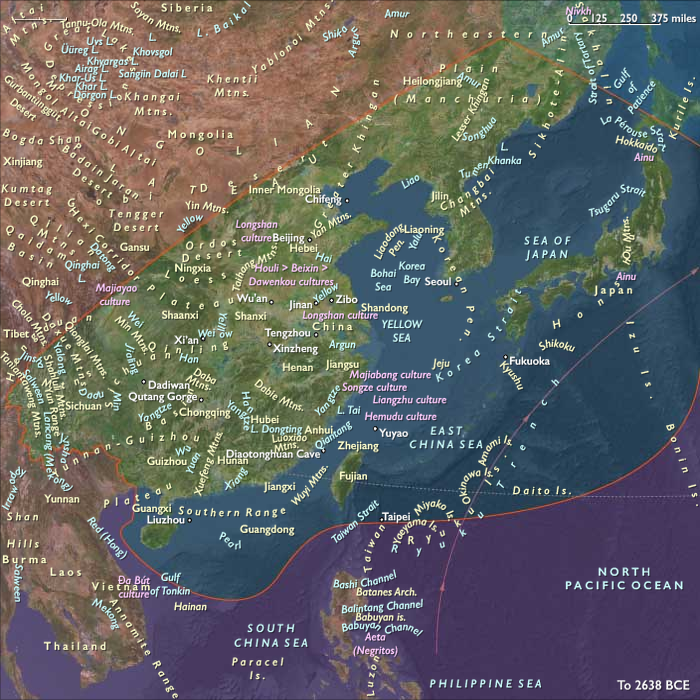
Banpo (Pan-p'o) near present Xi'an (Sian) in central China, the type site associated with the Yangshao Culture, is located about five hundred and seventy-two miles (nine hundred and twenty kilometers) southwest of present Beijing (Peking) in a fertile, alluvial lowland at the foot of the Qing Ling Shan (Tsinling Shan) along the Wei, a tributary of the Huang He (Hwang Ho, or Yellow River).
Archaeological sites with similarities to the first phase at Banpo are considered part of the Banpo phase (5000 BCE to 4000 BCE) of the Yangshao culture.
Banpo was excavated from 1954 to 1957 and covers an area of around 50,000 square meters.
It contains the remains of several well-organized Neolithic settlements dating from approximately 4500 BCE.
It is a large area of five to six hectares and surrounded by a ditch, probably a defensive moat, five or six meters wide.
The houses were circular, built of mud and wood, supported by timber poles and and roofed with overhanging steeply pitched thatch.
They sat on low foundations; many of the houses were semisubterranean with the floor typically a meter below the ground surface.
There appears to be communal burial areas, with the graves and pottery kilns located outside of the moat perimeter.
Locations
Groups
Topics
Commodoties
Subjects
Regions
Subregions
Years: 5085BCE - 4942BCE
Locations
Groups
Topics
Commodoties
Subjects
Regions
Subregions