
The Xianbei people, a federation of sizable …
Years: 424 - 435
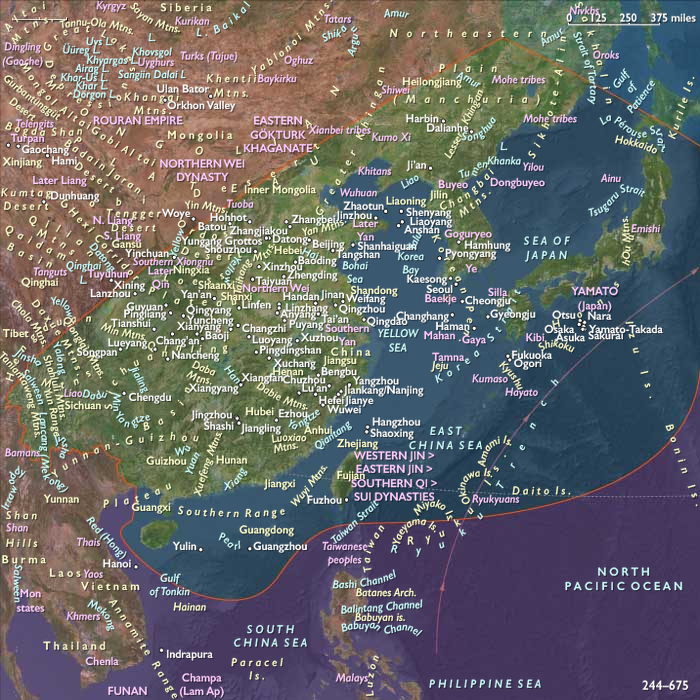
The Xianbei people, a federation of sizable non-Han groups of which the most important is the Tuoba, had first become a significant part of Chinese culture during the Han Dynasty, during which they had occupied the steppes in Mongolia, Hebei and Liaodong.
After the fall of the Han dynasty in 220, the Xianbei had formed a number of empires of their own, including the Yan Dynasty, Western Qin, Southern Liang and most significantly, the Northern Wei.
The Sixteen Kingdoms, or less commonly the Sixteen States, refers to a collection of numerous short-lived sovereignties in China proper and neighboring areas from 304 to 439 after the retreat of the Jin Dynasty (265-420) to South China and before the establishment of the Northern Dynasties.
Almost all rulers of the kingdoms are part of the Wu Hu ethnicity and claim to be the emperors and wangs (kings).
The Han Chinese had founded four of these states: Northern Yan, Western Liang, Former Liang, and the state of Wei.
(The Northern Wei Dynasty is not counted as one of the Sixteen Kingdoms even though it is founded during the Period.)
Locations
Groups
- Xianbei
- Tuoba
- Chinese (Han) people
- Rouran Khaganate
- Northern Wei, Xianbei, or Tuoba Empire
- Northern Yan, Chinese/Xianbei “Empire” of
- Liu Song Dynasty
Topics
- Six Dynasties Period in China
- Sixteen Kingdoms Period in China
- Civil Wars in China triggered by the Wu Hu Invasion
- Southern and Northern Dynasties Period in China
Commodoties
Subjects
Regions

Subregions
Related Events
Filter results
Showing 10 events out of 59010 total
The so-called Reign of Yuanjia, a period in Chinese history under the Liu Song Dynasty that is comparatively wealthy, tranquil, and stable compared to previous and later periods, occurs under the diligent Emperor Wen of the Liu Song dynasty, who is an able administrator.
The Hephthalites, a people of obscure origin called Ephthalites by the Greeks and Hunas by the Indians, are an agricultural people with a developed set of laws.
First mentioned by the Chinese, who described them as living in Dzungaria in 125, they had displaced the Scythians and conquered Sogdia and Khorasan before 425, in which year they cross the Syr Darya (Jaxartes) River and invade Sassanian Persia.
East Central Europe (424–435 CE): Rise of Attila and Bleda, Hun Ascendancy, and Regional Realignments
Between 424 and 435 CE, East Central Europe—including Poland, Czechia, Slovakia, Hungary, and those portions of Germany and Austria lying east of 10°E and north of a line stretching from roughly 48.2°N at 10°E southeastward to the Austro-Slovenian border near 46.7°N, 15.4°E—entered a decisive period marked by the emergence and expanding dominance of the Huns under the brothers Bleda and Attila, following the death of their uncle and predecessor, King Rua (Rugila) (d. 434). Their rise intensified Hunnic influence and further fragmented the remaining Roman authority along the Danube frontier. Nevertheless, the Rugii maintained diplomatic stability, skillfully navigating the shifting balance of power, while proto-Slavic communities persisted, maintaining their cultural coherence amid escalating Hunnic dominance.
Political and Military Developments
Leadership Transition: From Rua to Attila and Bleda
-
Following the death of King Rua in 434 CE, his nephews Bleda and Attila assumed joint leadership of the Huns, swiftly consolidating their authority and significantly expanding Hunnic military power across East Central Europe.
-
Under their rule, Hunnic dominance reached unprecedented heights, decisively reshaping regional geopolitics and establishing their realm as a formidable power.
Accelerated Roman Frontier Decline
-
Roman provinces (Pannonia Prima, Secunda, Savia, and Valeria) struggled severely under intensified Hunnic pressures, losing the capacity to maintain frontier integrity. Roman control became largely nominal, with real power increasingly passing to Hunnic rulers and local tribal leaders.
Rugian Diplomatic Resilience
-
Rugian communities maintained their stability and relative autonomy along the upper Tisza through skillful diplomacy, balancing relationships carefully with the ascendant Huns, fragmented Roman authorities, and neighboring Germanic groups.
Economic and Technological Developments
Localized Economic Adaptation
-
Regional economic structures adapted further to prolonged instability, shifting decisively toward local agriculture, pastoralism, and small-scale, community-based trade networks that operated cautiously under the shadow of Hunnic influence.
Frontier Infrastructure in Decline
-
Maintenance and improvements to Roman frontier fortifications and infrastructure declined substantially, limited mostly to essential defensive works responding to immediate Hunnic threats.
Cultural and Artistic Developments
Heightened Cultural Hybridization
-
Material culture increasingly reflected a strong Hun influence, integrated with Roman and Germanic elements. Jewelry, decorative objects, weaponry, and pottery demonstrated sophisticated cultural blending indicative of the era’s complex interactions.
Proto-Slavic Cultural Stability
-
Proto-Slavic populations remained culturally resilient, continuing their traditional ways of life and maintaining stable social structures despite intensified external pressures from dominant Hunnic and Germanic groups.
Settlement and Urban Development
Roman Frontier Towns in Decline
-
Roman frontier settlements (Carnuntum, Vindobona, Aquincum) deteriorated further in demographic size and economic function, primarily existing as military garrisons with limited civilian populations, struggling to respond effectively to escalating threats.
Rugian Settlements as Stable Centers
-
Rugian communities along the upper Tisza continued their relative stability and prosperity, serving as regional anchors amid broader instability and facilitating localized economic and diplomatic interactions.
Social and Religious Developments
Rugian Leadership Adaptation
-
Rugian tribal elites maintained internal cohesion and regional significance through adaptive diplomacy and strategic alliances, ensuring their continued autonomy despite growing Hunnic dominance.
Proto-Slavic Social Cohesion
-
Proto-Slavic communities maintained strong internal social hierarchies and religious practices, emphasizing collective resilience amid the profound regional transformations driven by Hunnic power.
Long-Term Consequences and Historical Significance
The era 424–435 CE was crucially significant for East Central Europe, marking the decisive rise of Attila and Bleda and the peak expansion of Hunnic authority. The continued erosion of Roman frontier control dramatically altered regional dynamics, while local groups such as the Rugii and proto-Slavic peoples adeptly maintained stability through diplomatic flexibility and cultural resilience. These developments set the stage for the dramatic events and further geopolitical transformations that would characterize subsequent decades, profoundly influencing the region's historical trajectory.
The Notitia Dignitatum: A Window into Late Roman Administration
The Notitia Dignitatum, a unique imperial chancery document, stands as one of the few surviving records of Roman government, offering a detailed account of the administrative and military structures of both the Eastern and Western Empires. Compiled in the late fourth and early fifth centuries, it catalogs thousands of imperial offices, from the highest court officials to provincial administrators, providing an invaluable snapshot of the late Roman state at a time of growing instability.
The Roman Army in the Late Fourth Century
The Notitia also outlines the structure of the Roman army at the end of the fourth century, by which time approximately 200,000 troops guard the empire’s frontiers, supported by an additional 50,000 reserve forces ready for rapid deployment. However, by this period, the composition of the imperial military has undergone a significant shift—many soldiers are now non-Roman auxiliaries, drawn from Germanic federates such as the Alemanni, Franks, Goths, Saxons, and Vandals.
While these foederati serve as crucial reinforcements for the overstretched Roman legions, their growing prominence signals the progressive Germanization of the Roman military, a transformation that will play a pivotal role in the empire’s eventual disintegration.
The Unchecked Settlement of Barbarian Tribes
By 424 CE, Rome’s grip on its Western provinces has weakened to the point that barbarian groups—including the Vandals, Alans, Suebi, and others—begin settling in Roman territory without opposition. This shift from defensive warfare to passive accommodation marks a decisive moment in the collapse of imperial authority, as the empire can no longer enforce its will over large swaths of its own domain.
These barbarian settlements create a wave of displacement, not only for indigenous Gallo-Roman, Hispano-Roman, and Romanized African populations but also for Illyrians and others fleeing the chaos of migration and conquest. The urgent need for large-scale housing construction arises as entire regions are reshaped by newcomers and refugees alike, permanently altering the social and political fabric of Gaul, Hispania, and North Africa.
Though the Notitia Dignitatum provides a detailed record of imperial administration, its static depiction of Rome’s military and bureaucratic structure already lags behind the rapidly changing reality of the Western Empire—an empire that, by the mid-fifth century, is on the verge of fragmentation.
Eastern Southeast Europe (424–435 CE): Stability Efforts and Ongoing Challenges
Settlement and Migration Patterns
Continued Migration Pressures
From 424 to 435 CE, Eastern Southeast Europe continued experiencing significant migration pressures, notably from the Huns and various Germanic groups. These movements necessitated further adaptation of settlements, continuously impacting regional demographics and social structures.
Urban Fortifications and Settlements
Cities including Constantinople and Philippopolis maintained and expanded their defensive infrastructures, fortifying urban boundaries and ensuring protection against external threats. These measures facilitated urban resilience amid continuous demographic changes.
Economic and Technological Developments
Economic Adaptation and Stability
Regional economies adapted to ongoing disruptions through flexible trade practices, sustained agricultural productivity, and strategic resource management. Constantinople notably remained a critical economic hub, securing vital trade routes and ensuring regional economic continuity.
Defensive and Technological Enhancements
Technological developments continued focusing on military defense, including advanced fortifications, military engineering, and improved logistical capabilities. These enhancements significantly supported regional stability and economic resilience.
Cultural and Artistic Developments
Artistic Resilience and Expression
Cultural activities maintained continuity, with artistic traditions evolving and integrating classical, Roman, and Christian influences. Public art, religious architecture, and urban monuments continued to flourish, expressing regional identity and resilience.
Scholarly Continuity and Innovation
Educational and intellectual institutions remained vibrant, preserving classical knowledge and adapting to changing political and social realities. Notably, Emperor Theodosius II funded the construction of the first University of Constantinople, significantly enhancing scholarly activity and reinforcing regional cultural and educational standards.
Social and Religious Developments
Governance Stability
Provincial administration and governance further adapted to ongoing challenges, enhancing local leadership and military preparedness. Effective management practices and administrative resilience ensured continued regional stability and coherence.
Christianity’s Continued Growth
Christianity further expanded its regional influence, solidifying its role in social, cultural, and political life. Religious institutions became increasingly central, reinforcing community bonds and social stability amid ongoing external pressures.
Long-Term Consequences and Historical Significance
The era from 424 to 435 CE was characterized by sustained migration pressures, robust defensive strategies, economic adaptations, and cultural resilience. These efforts significantly contributed to regional stability and established crucial precedents for Eastern Southeast Europe's continued historical development and integration into emerging Byzantine civilization.
Emperor Theodosius II funds the construction of the first University of Constantinople.
The Middle East: 424–435 CE
Armenia: Cultural Flourishing Amid Political Change
Between 424 and 435 CE, Armenia undergoes significant political and cultural transformations. Following Armenia’s earlier division in 387 CE into Roman Armenia and Persarmenia, the region continues to experience divergent trajectories under Roman and Persian influences. Roman Armenia, roughly one-fifth of the original territory, is quickly integrated into the Roman (Byzantine) Empire, contributing significantly to its military and political leadership.
Persarmenia remains under nominal Arsacid rule until 428 CE, when King Artashes IV is deposed at the behest of the powerful Armenian noble class, known as the nakharars, and replaced by a Persian governor (marzpan). This change effectively ends Armenia’s political sovereignty. However, the loss of political independence spurs a cultural renaissance that profoundly shapes Armenian identity.
Rise of Armenian National Identity
Central to this cultural resurgence is the development of the Armenian alphabet and the flourishing of national Christian literature, achievements largely attributed to the monk Mesrop Mashtots and his collaborators. These advancements fortify a distinct Armenian cultural and religious identity, fostering unity and resilience despite political subjugation.
The earlier conversion of Armenia to Christianity under King Tiridates III and Saint Gregory the Illuminator (circa 314 CE) continues to exert a profound influence, firmly entrenching Christianity as a cornerstone of national identity. The Armenian Church, led by the patriarchate, assumes a pivotal role in preserving national cohesion and culture in the absence of political autonomy.
Roman–Sassanian Rivalries
Simultaneously, persistent tensions between the Roman (Byzantine) and Sassanian Empires continue along the contested borders of Armenia and Mesopotamia. Although large-scale conflict is relatively restrained during this period, frequent border skirmishes and diplomatic disputes underline the volatile and strategically critical nature of this frontier.
Continued Urban Prosperity and Religious Institutions
In Roman-controlled Syria, cities such as Damascus, Palmyra, and Busra ash Sham remain vibrant centers of commerce, culture, and learning. The period sees ongoing economic stability supported by robust trade networks and infrastructure, further solidifying these urban centers as hubs of regional influence.
Meanwhile, the consolidation of Zoroastrian orthodoxy continues within the Sassanian Empire, reinforcing cultural identity and social cohesion under Persian rule. The Zoroastrian priesthood remains influential, contributing significantly to the governance and societal structure of Persian-controlled territories.
Thus, the era 424 to 435 CE in the Middle East marks an epoch of critical political realignment, profound cultural renaissance in Armenia, and ongoing geopolitical tension, setting the stage for subsequent historical developments in the region.
Diocletian had forced the Persians to relinquish Armenia, and Tiridates III, the son of Tiridates II, had been restored to the throne under Roman protection in about 287; his reign had determined the course of much of Armenia's subsequent history, and his conversion by St. Gregory the Illuminator and the adoption of Christianity as the state religion in about 314 has created a permanent gulf between Armenia and Persia.
The Armenian patriarchate becomes one of the surest stays of the Arsacid monarchy and the guardian of national unity after its fall.
The chiefs of Armenian clans, called nakharars, hold great power in Armenia, limiting and threatening the influence of the king.
The dissatisfaction of the nakharars with Arshak II had led to the division of Armenia into two sections, Roman Armenia and Persarmenia, in 387).
The former, comprising about one-fifth of Armenia, had been rapidly absorbed into the Empire, to which the Armenians will come to contribute many emperors and generals.
Persarmenia continues to be ruled by an Arsacid in Dvin, the capital after the reign of Khosrow II (330–339), until the deposition in 428 of Artashes IV and his replacement by a Persian marzpan (governor) at the request of the nakharars.
Although the Armenian nobles have thus destroyed their country's sovereignty, a sense of national unity will be furthered by the development of an Armenian alphabet and a national Christian literature; culturally, if not politically, the fifth century is an Armenian golden age.
Kumaragupta (Mahendraditya), ruler of the Gupta Empire from 415, erects an iron pillar to his illustrious father and predecessor, Chandragupta II, today visible at the Qutb complex in Mahrauli, one of the seven ancient cities that make up the present state of Delhi.
One of the world's foremost metallurgical curiosities, the pillar was originally located in the Hindu temple of Muttra, with the idol of Garuda at the top, at a place called Vishnupadagiri (meaning “hill with footprint of Vishnu”), identified as modern Udayagiri, situated in the close vicinity of Besnagar, Vidisha and Sanchi.
(It is the only remaining piece of the temple, the rest of which will be destroyed by Qutb-ud-din Aybak to build the Qutub Minar and Quwwat-ul-Islam mosque.)
Made up of 98% wrought iron of impure quality, it is twenty-three feet, eight inches high and has a diameter of sisteen inches.
A testament to the high level of skill achieved by ancient Indian iron smiths in the extraction and processing of iron, it will continue to withstand corrosion for the next 1600 years, despite harsh weather.
Its unusually good corrosion resistance appears to be due to a high phosphorus content—as one per cent against less than 0.05 per cent in today's iron—which together with favorable local weather conditions promotes the formation of a solid protective layer of iron oxides and phosphates, rather than the non-protective, cracked rust layer that develops on most ironwork.
Another theory suggests that the reason that the pillar resists rust is due to its thickness, which allows the sun to heat the pillar sufficiently during the day to evaporate all rain or dew from its surface.
The accumulated heat also keeps the surface dry at night.
The first of the Buddhist cave monuments at Ajanta, in India’s north Deccan, date from the second and first centuries BCE.
During the fifth century, many more richly decorated caves are added to the original group, their magnificent paintings epitomizing Gupta patronage.
The paintings and sculptures of Ajanta, considered masterpieces of Buddhist religious art, are to have a considerable artistic influence.
India’s monumental Buddhist stupas of the period draw upon Central Asian and Chinese styles.
Years: 424 - 435
Locations
Groups
- Xianbei
- Tuoba
- Chinese (Han) people
- Rouran Khaganate
- Northern Wei, Xianbei, or Tuoba Empire
- Northern Yan, Chinese/Xianbei “Empire” of
- Liu Song Dynasty
Topics
- Six Dynasties Period in China
- Sixteen Kingdoms Period in China
- Civil Wars in China triggered by the Wu Hu Invasion
- Southern and Northern Dynasties Period in China
