The Xianbei do not watch idly as …
Years: 405 - 405
June
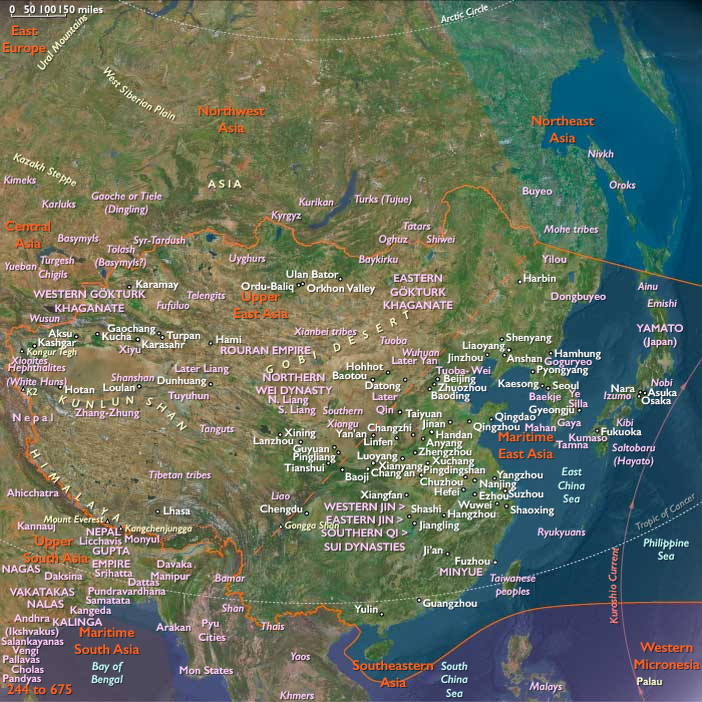
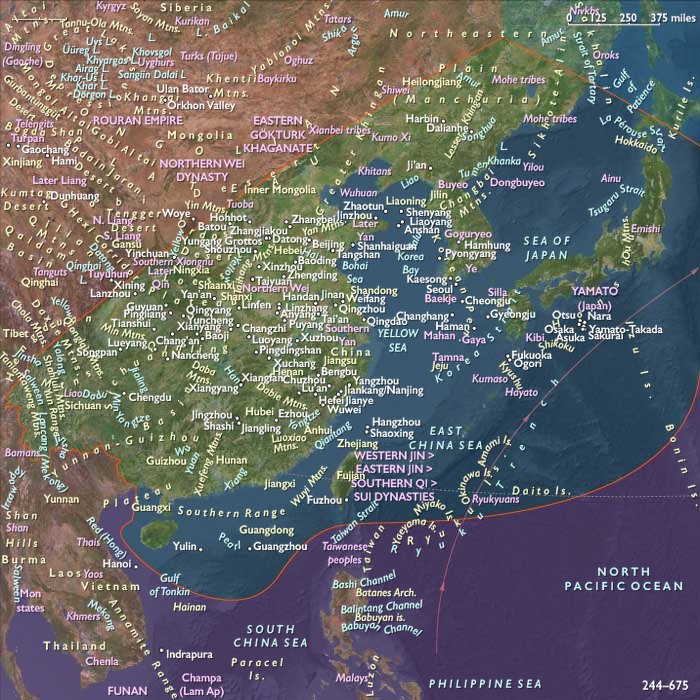
The Xianbei do not watch idly as Goguryeo forces take over their lands.
Forces of the Later Yan cross the Liao River in 405 and attack Goguryeo but are defeated by Gwanggaeto.
Locations
People
Groups
- Korean people
- Xianbei
- Silla, Kingdom of
- Goguryeo (Koguryo), Kingdom of
- Baekje (or Paekche), Kingdom of
- Later Yan, Xianbei kingdom of
Topics
Commodoties
Subjects
Regions
Subregions
Related Events
Filter results
Showing 10 events out of 59223 total
The Khitan, of Xianbei origin, had been part of the Kumo Xi tribe until 388, when the Kumo Xi-Khitan tribal grouping was roundly defeated by the newly established Northern Wei, allowing the Khitan to resume their own tribe and entity, and beginning the Khitan written history.
First mentioned in Chinese chronicles in 405, the Khitan wander along the boundaries of Kara-muren, and had formed part of the Donghu confederation destroyed by the Xiongnu in 150 BCE.
Murong De, who had by 405 has established Southern Yan and become its emperor, has become aware that Murong Chao is being detained in Chang'an, and sends secret messengers to encourage him to flee to Southern Yan.
Murong Chao, not daring to tell even his mother and wife, flees to Southern Yan.
On the way, he passes through the territory of the general Murong Fa, the governor of Yan Province (modern western Shandong), and Murong Fa, believing that he is not truly of imperial descent, disrespects him, leading Murong Chao to bear grudges against Murong Fa in the future.
Murong De is greatly pleased when Murong Chao arrives at the capital, Guanggu (in modern Qingzhou, Shandong), and Murong Chao presents him the golden knife that Murong De had left Lady Gongsun before leaving.
Murong De mourns his mother and brother greatly, but creates Murong Chao to be the Prince of Beihai—the same title that Murong Na had held.
As Murong De has no surviving sons, he considers Murong Chao his probable heir, and he selects talented men to be Murong Chao's assistants.
Murong Chao, at this time, is described to be a careful servant to his uncle and appropriate in all his outward actions, leading the officials and the populace to be happy with him.
In autumn 405, Murong De falls ill, and considers creating Murong Chao crown prince.
During the discussion, an earthquake occurs, and Murong De, taking the earthquake as a bad omen, temporarily terminates the discussion, but his illness grows worse during the night, and he is no longer able to speak.
His wife Empress Duan Jifei asks him whether Murong Chao should be summoned and created crown prince, and Murong De nods, so Murong Chao is created crown prince.
Murong De dies that night, and the next day, Murong Chao takes the throne as emperor.
He honors Empress Duan as empress dowager.
However, Murong Chao immediately shows himself to be capricious and unwilling to listen to criticism.
He immediately makes one of his associates, Gongsun Wulou, a major general, despite Gongsun's commonly perceived lack of qualifications, and he disassociates himself from the officials Murong Zhong, the Prince of Beidi, and Duan Hong, whom Murong De had entrusted with great responsibilities.
He is further described as being surrounded by flatterers and engaging his time on hunting and tours, refusing all advice against doing so.
Moreover, he wishes to restore punishments that include facial tattooing, cutting off noses, cutting off feet, and castration, but in the face of popular opposition, he does not carry out these actions.
He is also described as imposing heavy tax and labor burdens on the people.

Rudrasena II, who in 380 had become emperor of Vakataka in the Deccan Plateau of India, is said to have married Prabhavatigupta, the daughter of the Gupta King Chandragupta II (375-413/15).
Rudrasena II had died in 385 after a very short reign, following which Prabhavatigupta has ruled as a regent on behalf of her two sons, Divakarasena and Damodarasena (Pravarsena II) for twenty years.
During this period the Vakataka realm has been practically a part of the Gupta Empire.
Innocent, who had succeeded to the bishopric of Rome in 401, was, according to his biographer in the Liber Pontificalis, the son of a man called Innocens of Albano; but according to his contemporary Jerome, his father was Pope Anastasius I, whom he was called by the unanimous voice of the clergy and laity to succeed (he had been born before his father's entry to the clergy, let alone the papacy; this is before the time of a universal rule of celibacy for priests).
Innocent loses no opportunity of maintaining and extending the authority of the Roman see as the ultimate resort for the settlement of all disputes; and his still extant communications with Victricius of Rouen, Exuperius of Toulouse, Alexander of Antioch and others, as well as his actions on the appeal made to him by John Chrysostom against Theophilus of Alexandria, show that opportunities of the kind were numerous and varied.
In 405, Innocent promulgates the church’s first official listing of books forbidden to church members without specific permission from a qualified person.
Emperor Honorius closes the Flavian Amphitheatre (the Colosseum) in an austerity move that abolishes amusements.
Radagaisus, having spent the winter in the Po Valley, is observed by Stilicho, who lacks sufficient strength to prepare an offensive against the invading German tribes.
The exact numbers of the migration are unknown, probably nearly one hundred thousand, including Alans, Burgundians, Goths, Vandals, Suebi, and other smaller tribes.
Stilicho, had ordered the destruction of the ancient Sibylline Books, according to the Roman poet Rutilius Claudius Namatianus, possibly because Sibylline prophecies were being used to attack his government in the face of the attack by Alaric.
Radagaisus's force probably consists of about twenty thousand fighting men.
Many of the fighters are accompanied by their families and other noncombatants, meaning that the total size of Radagaisus's group may have approached one hundred thousand.
Radagaisus, whose early career and ultimate origins are unknown, fleeing Hunnic pressures, invades Italy without passing through the Balkans, which indicates that his invasion began somewhere on the Great Hungarian Plain, west of the Carpathian Mountains.
Archaeological finds of coin hoards, buried by residents who were apparently aware of Radagaisus's approach, suggest that his route passed through southeastern Noricum and western Pannonia.
About this time Flavia Solva is burned out and largely abandoned.
Aguntum is a mining and trading center that exploits local sources of iron, copper, zinc and gold.
Craftsmen in the town process the metals to produce a range of goods which are then transported along the Roman roads.
Other exports include wood, milk products (cheese) and mountain crystals from the Tauern range.
The discovery of a layer of ash, as well as the remains of a man and a child in the bath house, points to the sack of Aguntum by the invading barbarians under Radagaisus and Alaric.
Radagaisus's army has had the run of northern Italy for at least six months while Stilicho mobilizes thirty numerii (about fifteen thousand men) from the Italian field army in response to the invasion.
A second contingent of Roman troops, possibly recalled from the Rhine frontier (leaving this sector dangerously weakened), complements the Italian forces.
In addition, they receive help from Gothic auxiliaries under Sarus and Hunnic forces under Uldin.
Stilicho recalls troops from Britannia and the depth of the crisis is shown when he urges all Roman soldiers to allow their personal slaves to fight beside them.
His forces, including Hun and Alan auxiliaries, may in the end have totaled rather less than fifteen thousand men.
Contemporary accounts number the invaders in the hundreds of thousands, though any such figure is highly improbable—unless these numbers include the Alans, Vandals, and Suebi who would, in four months’ time, invade Gaul in large numbers.
Radagaisus's own force probably consists of about 20,000 fighting men.
Many of the fighters are accompanied by their families and other noncombatants, meaning that the total size of Radagaisus's group may have approached 100,000.
They attack the bridgehead community of Florentia and blockade the city, where no less than a third of the Goth's troops and allies are killed.
After two months, Stilicho's army relieves the siege of Florentia as the city is approaching the point of surrender, sending a heavily guarded convoy of provisions into the town and constructing a line of blockhouses, connected by trenches.
The Roman counterattack is extremely successful, compelling the withdrawal of Radagaisus's army into …
…the hills of Fiesole, about eight kilometers away, where, with the aid of the chieftain of the Huns, Uldin, together with his allies the Sciri, Stilicho cuts off their supplies and crushes the army.
Radagaisus abandons his followers and tries to escape, but is captured by the Romans.
Stilicho then executes Radagaisus on August 23, 405, and twelve thousand of his higher-status fighters are either incorporated into the Roman army or sold as slaves.
Some of the remaining followers are dispersed, while so many of the others are sold into slavery that the slave market briefly collapses.
Alaric has remained inactive through the whole episode, committed by treaty to Illyricum.
Years: 405 - 405
June
Locations
People
Groups
- Korean people
- Xianbei
- Silla, Kingdom of
- Goguryeo (Koguryo), Kingdom of
- Baekje (or Paekche), Kingdom of
- Later Yan, Xianbei kingdom of