
The Wu navy is not able to …
Years: 231 - 231
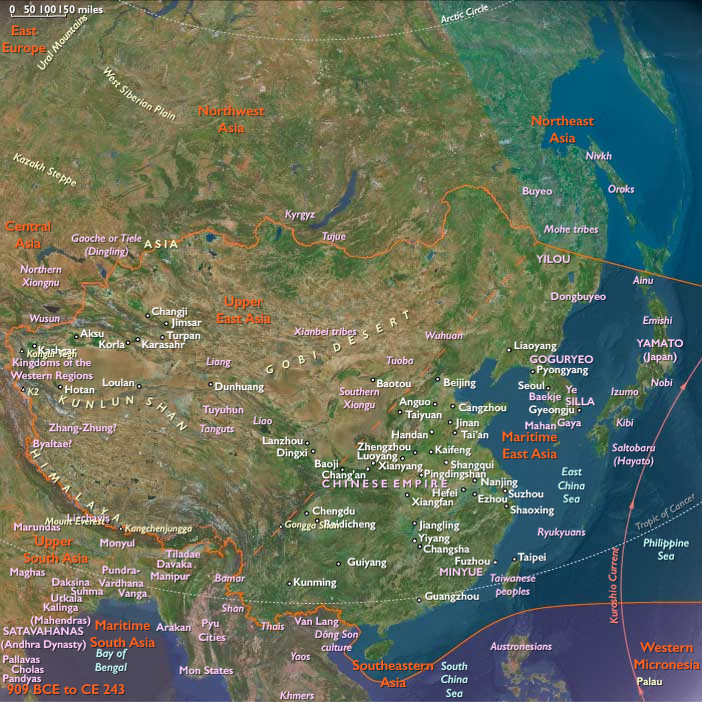
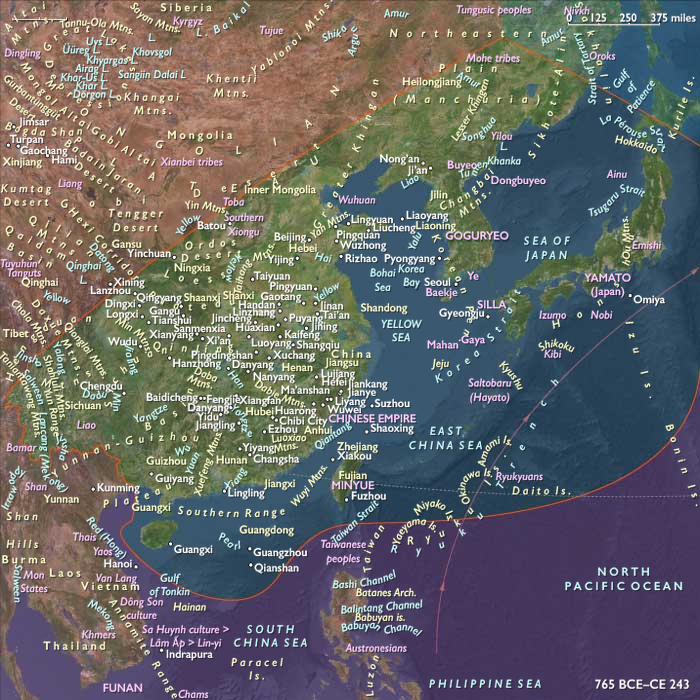
The Wu navy is not able to locate Danzhou but locates Yizhou (Taiwan), and returns in 231 after capturing several thousand men—but only after eighty to ninety percent of the navy has died from illness.
Instead of seeing his own fault in this venture, Sun Quan simply executes Wei Wen and Zhuge Zhi.
Locations
People
- Cao Pi
- Cao Rui
- Cao Xiu
- Jia Kui
- Liu Shan
- Lu Xun
- Lü Dai
- Lü Fan
- Quan Cong
- Sun Quan
- Zhang Zhao
- Zhou Fang
- Zhuge Liang
Groups
- Chinese (Han) people
- Cao Wei, (Chinese) kingdom of
- Shu Han (minor Han), (Chinese) kingdom of
- Wu, Eastern, (Chinese) kingdom of
Topics
Commodoties
Subjects
Regions
Subregions
Related Events
Filter results
Showing 10 events out of 60591 total
Li Yan, unable to supply the troops sufficiently in 231 during one of Zhuge Liang's campaigns, forges an edict by Liu Shan, ordering Zhuge Liang to retreat.
When Zhuge Liang discovers this, he recommends that Li Yan be removed from his office and put under house arrest, and Liu Shan accepts the recommendation.
This is the only real political crisis to occur during Zhuge's regency.
Ardashir I campaigns unsuccessfully against Roman border outposts again in 231.
As a result, the Roman emperor Alexander Severus moves to the east, establishing his headquarters at Antioch, but experiences difficulties in bringing his troops together and thus makes another attempt at diplomacy, which Ardashir I rebuffs.
Vasudeva may have been the Indian king who returned the relics of the Apostle St. Thomas from Mylapore, India in 232 CE, on which occasion his Syriac Acts (the third century Acts of Thomas) were written.
The relics were transferred in triumph to the town of Edessa, Mesopotamia.
The Indian king is named as "Mazdai" in Syriac sources, "Misdeos" and "Misdeus" in Greek and Latin sources, which has been connected to the "Bazdeo" on the Kushan coinage of Vasudeva, the transition between "M" and "B" being a current one in Classical sources for Indian names.
Origen returns from exile in 231 to the relative safety of Caesarea, where he establishes a school of theology.
The reign of Alexander is prosperous on the whole until the rise, in the east, of the Sassanids.
All five expeditions led by Shu's chancellor-regent Zhuge Liang prove unsuccessful and indecisive, but the expeditions have become some of the most well-known conflicts of the Three Kingdoms period.
They overlap in popular history with the "six campaigns from Mount Qi," which is inaccurate, since Zhuge Liang only launched his campaigns from Mount Qi twice.
The culture of the Yayoi people from about 300 BCE to CE 250 shows a marked change in orientation and is more recognizably Japanese in character.
Wet-rice cultivation and bronze technology appear to have been introduced from Korea by way of Kyushu.
As opposed to the robust vigor of Jomon wares, Yayoi ceramics are made with finer clay, are turned on a wheel, and are generally more utilitarian in character, having more casual and at times elegant decoration.
The large settlements of the Yayoi people, centered in southwestern and central Japan, apparently became increasingly stratified under religious leaders.
Bronze weapons, mirrors, and bells, originally close to their Asian prototypes, are evidently used in rituals that have led to the exaggeration of their forms; the bells, especially, suggest the growth in authority of powerful clans that may have governed large areas.
The Crisis of the Third Century (235–284 CE): Rome’s Near Collapse
The Crisis of the Third Century, also called the "Military Anarchy" or "Imperial Crisis," was a period of severe instability in the Roman Empire, lasting from 235 to 284 CE. Marked by external invasions, internal civil war, and economic collapse, this crisis nearly led to the empire’s disintegration and permanently altered Roman institutions, society, and governance.
The Three Simultaneous Crises
-
External Invasions:
- The Goths, Vandals, and Alemanni launched devastating raids across Gaul, the Balkans, and Italy.
- The Sassanid Persian Empire aggressively pushed into Mesopotamia, even capturing Emperor Valerian in 260 CE.
- The Danube and Rhine frontiers collapsed, forcing Rome into constant defensive wars.
-
Internal Civil War:
- More than 25 emperors ruled in just 50 years, most meeting violent ends at the hands of rival factions or mutinous troops.
- Legions declared their own generals as emperors, leading to endless power struggles.
- The empire briefly split into three competing states:
- The Gallic Empire (Gaul, Britain, and Spain).
- The Palmyrene Empire (Syria and Egypt).
- The central Roman Empire, ruled by whoever controlled Italy.
-
Economic Collapse:
- Rome’s currency was devalued, leading to hyperinflation and a breakdown of trade.
- The tax system crumbled, forcing local provinces into a barter economy.
- Cities shrank, and large landowners gained power, beginning a shift toward a feudal-like system.
The Crisis as a Watershed Moment
Historians increasingly view the Crisis of the Third Century as the key transition between the classical Roman world and late antiquity:
-
Political Structure Changes:
- The empire became more militarized and autocratic, reducing senatorial influence.
- The rise of soldier-emperors meant that military power determined leadership, not Roman traditions.
-
Social and Economic Shifts:
- The weakened economy led to localization, with provinces relying on self-sufficient estates rather than long-distance trade.
- Cities declined in importance, while wealthy landowners gained more power, foreshadowing medieval feudal structures.
-
Religious Transformations:
- Traditional Roman polytheism weakened, while new religions, including Christianity and Eastern mystery cults, gained followers.
- The persecution of Christians intensified, as emperors sought to reinforce unity through traditional Roman gods.
The Road to Recovery: Diocletian and the Tetrarchy (284 CE)
- In 284 CE, Emperor Diocletian seized power and ended the crisis, implementing sweeping military, economic, and political reforms.
- He created the Tetrarchy, dividing the empire into Eastern and Western halves, stabilizing governance.
- His policies restored temporary order, but the empire had already fundamentally changed.
Conclusion: A Turning Point for Rome
The Crisis of the Third Century was a watershed moment in Roman history, marking the transition from the Principate (27 BCE–284 CE) to the Dominate (284–476 CE).
While Rome survived, it emerged transformed, setting the stage for:
- The eventual division of the empire into East and West.
- The rise of feudal land structures.
- The growing dominance of Christianity.
This tumultuous period reshaped Rome, leading to a new political and social order that would define Late Antiquity and the Middle Ages.
East Central Europe (232–243 CE): Frontier Tensions and Growing Regional Instability
Between 232 and 243 CE, East Central Europe—encompassing Poland, Czechia, Slovakia, Hungary, and those portions of Germany and Austria lying east of 10°E and north of a line stretching from roughly 48.2°N at 10°E southeastward to the Austro-Slovenian border near 46.7°N, 15.4°E—faced heightened instability due to mounting internal Roman challenges and intensified external pressure from neighboring tribal confederations. During this period, the Roman frontier provinces (Pannonia Superior, Pannonia Inferior, and Noricum) increasingly struggled to manage rising threats posed by Germanic and Sarmatian tribes, signaling a transition toward regional unrest.
Political and Military Developments
Internal Roman Instability
-
The Roman Empire, under the final Severan emperor, Severus Alexander (222–235 CE), and subsequently during the chaotic period following his assassination (235 CE, marking the start of the Crisis of the Third Century), experienced significant political turmoil.
-
Frontier provinces began to suffer administrative neglect, resource limitations, and diminished military effectiveness due to internal power struggles within the empire.
Increasing Frontier Challenges
-
Tribal groups—particularly the Marcomanni, Quadi, and Iazyges—recognized Roman vulnerabilities and increased pressures along the Danube, testing defenses, and initiating more frequent small-scale incursions.
-
Other tribes, including the Vandals, Carpi, and groups within northern and eastern boundaries, became more assertive, further straining Roman frontier management.
Economic and Technological Developments
Economic Disruptions Intensify
-
Economic prosperity diminished due to increased military and political uncertainties, affecting trade routes and interactions between Roman frontier provinces and tribal communities. Cross-border trade became riskier and more expensive to manage.
Slowing Infrastructure Development
-
Infrastructure projects—roads, bridges, fortifications—slowed significantly, as Roman attention and resources were redirected toward immediate military and defensive needs.
Cultural and Artistic Developments
Shift toward Defensive and Military Themes
-
Artistic and material culture increasingly reflected defensive priorities, producing fortified goods, military equipment, and artifacts emphasizing protection and security.
Reduced but Continued Cultural Integration
-
Cultural interactions persisted despite difficulties, though exchanges were more cautious and influenced by military concerns and the broader uncertainty of the period.
Settlement and Urban Development
Increased Defensive Measures
-
Roman frontier towns (Carnuntum, Vindobona, Aquincum) further intensified defensive structures, reinforcing walls, towers, and garrisons to meet growing external threats.
Tribal Adaptation to Instability
-
Germanic and Sarmatian settlements increasingly adopted defensive and mobile strategies, adjusting settlement locations and fortifications to respond effectively to instability.
Social and Religious Developments
Military Elites Dominating Tribal Leadership
-
Warrior elites and chieftains increasingly dominated tribal hierarchies, emphasizing military strength, strategic alliances, and preparedness for possible conflict as regional stability deteriorated.
Religious Intensification amid Instability
-
Traditional religious rituals among tribes intensified, particularly those emphasizing communal solidarity, protection, and warrior identity in response to increased regional uncertainty and threats.
Long-Term Consequences and Historical Significance
The era 232–243 CE was a crucial turning point in East Central Europe, marking the beginning of significant regional instability driven by internal Roman weaknesses and external tribal assertiveness. These developments anticipated the broader regional transformations and disruptions associated with the subsequent Crisis of the Third Century (235–284 CE), setting conditions for profound historical changes, migrations, and shifting power structures in the ensuing decades.
The Middle East: 232–243 CE
Roman–Sassanid Conflicts and Jewish Legal Developments
The era from 232 to 243 CE marks an intensified phase of conflict between the Roman Empire and the recently established Sassanid Persian Empire under Ardashir I and later his successor, Shapur I. Initially, in 230 CE, Ardashir launches raids into Roman-held Mesopotamia and Syria, boldly demanding Rome’s cession of all territories that once belonged to the Achaemenid Empire.
Roman Emperor Alexander Severus, after unsuccessful diplomatic attempts, responds militarily in 232, eventually repelling the Persian advances. Ardashir, determined and strategic, renews his assaults between 238 and 240, successfully capturing critical cities including Carrhae and Nisibis in Syria and Mesopotamia.
The conflict escalates further under Ardashir's ambitious heir, Shapur I, who initiates a large-scale invasion of Roman Mesopotamia. Shapur's forces, however, suffer a significant defeat in 243 CE near Resaena, allowing the Romans to reclaim Carrhae and Nisibis and temporarily stabilizing their eastern frontier.
Simultaneously, this era witnesses important developments among Babylonian Jews, who recognize Samuel bar Abba (Rav Samuel) as their principal temporal and judicial authority, especially in monetary and civil law. Rav Samuel’s influential rulings—known as responsa—guide dispersed Jewish communities, encouraging adherence to local laws while upholding Jewish traditions. His progressive ordinances notably include prohibitions on marriages without proper courtship and forbid fathers from betrothing daughters without their consent. These rulings significantly shape Jewish social and legal practices, equipping Babylonian Jews with flexible strategies for adapting to life within foreign environments.
Years: 231 - 231
Locations
People
- Cao Pi
- Cao Rui
- Cao Xiu
- Jia Kui
- Liu Shan
- Lu Xun
- Lü Dai
- Lü Fan
- Quan Cong
- Sun Quan
- Zhang Zhao
- Zhou Fang
- Zhuge Liang
Groups
- Chinese (Han) people
- Cao Wei, (Chinese) kingdom of
- Shu Han (minor Han), (Chinese) kingdom of
- Wu, Eastern, (Chinese) kingdom of
