
The work of Desiderio da Settignano shows …
Years: 1464 - 1464
The work of Desiderio da Settignano shows the influence of Donatello, specifically his use of low reliefs.
Desiderio has employed rilievo schiacciato with the utmost delicacy in his “Tabernacle of the Sacrament,” executed in 1461 for San Lorenzo in Florence.
Since then, he has created a number of works: a relief Christ Child with St. John, the Panciatichi Madonna, the Martelli Baptist and a St. Jerome. (Several beautiful portraits of women and children are also attributed to Desiderio.)
Hailingfrom a family of stone carvers and stone masons in Settignano, near Florence, he dies at around thirty-four on about January 16, 1464.
Florentine Maso Finiguerra, one of the first Italian printmakers, is also a master of niello, a technique of decorating incised silver or gold with a black metallic compound.
Finiguerra, who is thought to have assisted Lorenzo Ghiberti in the creation of the east door of the Baptistery in Florence, later associates himself with Antonio Pollaiuolo, whose paintings he may have reproduced in a series of copperplate engravings executed between 1459 and 1464, when he dies at thirty-eight.
In the realm of philosophy, Cosimo, influenced by the lectures of Gemistus Plethon, has established a modern Platonic Academy in Florence, appointing Marsilio Ficino as head of the Academy and commissioning Ficino's Latin translation of the complete works of Plato (the first ever complete translation).
Through Ficino and others associated with the Academy, Cosimo has an inestimable effect on Renaissance intellectual life.
On his death on August 1, 1464 at Careggi, Cosimo is succeeded by his son Piero 'the Gouty', father of Lorenzo the Magnificent or Il Magnifico.
After his death the Signoria awards him the title Pater Patriae, "Father of his Country", an honor once awarded to Cicero, and has it carved upon his tomb in the Church of San Lorenzo.
Luca Pitti supports a return to strict and stronger form of republicanism, but later supports Piero, who is to rule Florence from 1464 to 1469.
Bernardo Rossellino has meanwhile become Capomaestro at the Florence Duomo—completed, after numerous enlargements and delays, in 1462—from 1461 to 1464, when he dies on September 23.
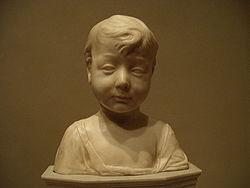
Christ Child (?), marble of c. 1460, in the National Gallery of Art
Locations
People
- Antonio del Pollaiuolo
- Còsimo de' Medici
- Desiderio da Settignano
- Donatello
- Luca Pitti
- Marsilio Ficino
- Piero di Cosimo de' Medici
Groups
Topics
Subjects
- Sculpture
- Painting and Drawing
- Fashion
- Decorative arts
- Faith
- Government
- Scholarship
- Philosophy and logic
Regions
Subregions
Related Events
Showing 1 events out of 1 total
Years: 1464 - 1464
Christ Child (?), marble of c. 1460, in the National Gallery of Art
Locations
People
- Antonio del Pollaiuolo
- Còsimo de' Medici
- Desiderio da Settignano
- Donatello
- Luca Pitti
- Marsilio Ficino
- Piero di Cosimo de' Medici
Groups
Topics
Subjects
- Sculpture
- Painting and Drawing
- Fashion
- Decorative arts
- Faith
- Government
- Scholarship
- Philosophy and logic
Regions
Subregions