
John Walter funds The Times on January …
Years: 1785 - 1785
Unhappy because people always omit the word Universal, Ellias will change the title after nine hundred and forty editions on January 1, 1788 to The Times.
Walter had lost his job by the end of 1784 after the insurance company where he was working went bankrupt because of the complaints of a Jamaican hurricane.
Being unemployed, Walter decided to set up a new business.
It is in this time when Henry Johnson invents the logography, a new typography that is faster and more precise (three years later, it will proved that it is not as efficient as had been said).
Walter bought the logography's patent and to use it, he had decided to open a printing house, where he would daily produce an advertising sheet.
Locations
Groups
Commodoties
Subjects
Regions
Subregions
Related Events
Filter results
Showing 10 events out of 24657 total
These events contribute significantly to an increase in poverty and famine that may contribute to the French Revolution in 1789.
Laki is only one factor in a decade of climatic disruption, as Grímsvötn is erupting from 1783 to 1785, and there may have been an unusually strong El Niño effect from 1789 to 1793.
The ships of James Cook’s third expedition, Resolution and Discovery, had called at Canton in December 1780, on their return voyage from the North Pacific.
While there, the crews of the ships had enjoyed unexpected success in selling for high prices the sea otter pelts they had obtained for trinkets on the North West Coast of America.
Most of these valuable furs had been collected in trade with the local Mowachaht-Muchalaht people during Cook’s stay during March–April 1778 at Nootka Sound, a large opening of bays, islands, channels, and inlets on the west central coast of Vancouver Island.
At first Cook called it King George's Sound, but this is later changed to Nootka, based on Cook’s mispronunciation Yuquot, the native name of the place.
The Mowachaht-Muchalaht have been the principal occupants of the Sound for thousands of years.
The description of the possibilities of the North Pacific fur trade in A Voyage to the Pacific Ocean, the official account of James Cook’s expedition third expedition to the Pacific, published in May 1784, has attracted wide attention.
It is based on the journal of James King, who had assumed command of the Resolution after Cook’s death in Hawaii.
In particular, King’s vivid account of the prices paid at Canton for the sea otter furs the crew had gathered on the American coast is repeatedly referred to in public discussion, being published in the London press in September 1785.
King's practical suggestions in A Voyage to the Pacific Ocean of the possibilities of a fur trade between the North West Coast and China and Japan reveal the riches to be gained from this trade with China and, possibly Japan.
This revelation has spurred partners in trade John Henry Cox and John Reid to attempt to take advantage of their situation in Canton and their connections with India.
Specifically, Cox and his associates, including Henry Lane, William Fitzhugh and David Lance—English East India Company supercargoes at Canton trading privately on their own account—sponsor a pioneering voyage under James Hanna in 1785.
Setting out from Macao in the snow Sea Otter, on April 15, 1785, Hanna follows the route of the Manila galleons past Japan, whence the prevailing winds and current bring him to Nootka Sound on August 8.
Although there is one violent altercation in which a number of natives lose their lives, Hanna is successful in trading for furs and returns to Macao with five hundred and sixty pelts worth over twenty thousand Spanish dollars.
The village of Yuquot in Friendly Cove becomes the initial focus of the maritime fur trade due to the prices received by Cook's men at Kamchatka and Macao for furs collected at Nootka Sound.
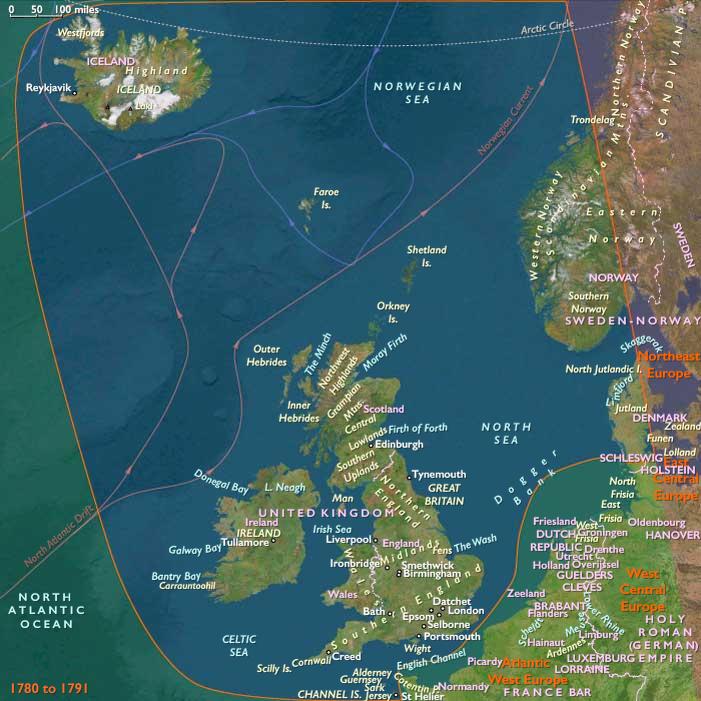
The Meteorological Impact of the Laki Eruption (1783–1785)
The Laki volcanic eruption in Iceland (1783–1784) had severe and long-lasting meteorological effects, significantly contributing to several years of extreme weather across Europe and beyond.
Atmospheric Consequences – A Volcanic Haze Over Europe
- The eruption released massive amounts of sulfur dioxide (SO₂) into the atmosphere, forming a toxic volcanic haze that spread across the Northern Hemisphere.
- The sulfur aerosols reflected sunlight, leading to temporary cooling and causing abnormal weather patterns.
- The dry fog lingered over Europe for months, affecting visibility, air quality, and climate.
Weather Extremes in Europe (1783–1785)
The meteorological impact of Laki continued well beyond the eruption, exacerbating climatic instability for several years:
-
Summer 1783:
- Exceptionally hot in parts of Western Europe.
- Crop failures and water shortages worsened due to the drought-like conditions in some regions.
-
Winter 1783–1784:
- One of the coldest winters on record in Europe.
- Severe frost crippled agriculture and froze major rivers like the Thames and Seine.
-
Spring 1784:
- Massive flooding resulted from rapid snowmelt following the extreme winter.
-
1784–1785:
- Persistent climate anomalies, including irregular rainfall patterns, crop failures, and extended cold spells, further destabilized food supplies.
Global Climate Effects
Beyond Europe, Laki’s eruption had global repercussions:
- In North America, 1784 saw one of the coldest winters on record, contributing to severe disruptions in agriculture.
- Disruptions in the monsoon cycle led to droughts in Africa and India, affecting food production.
Conclusion – A Climate Catastrophe
The Laki eruption significantly altered weather patterns for several years, contributing to:
- Crop failures and famine in Europe.
- Harsh winters and extreme flooding.
- A prolonged period of climatic instability that would later be linked to economic distress and societal unrestin various parts of the world.
Its meteorological effects persisted well into the mid-1780s, making it one of the most disruptive volcanic events in recorded history.
Conceived, written, and composed to celebrate the newly recovered health of Nancy Storace, the Vienna-based, Anglo-Italian soprano destined to become the first Susanna of Figaro, and to welcome her back to the stage after a temporary loss of her singing voice owing to a nervous breakdown, the short work is compelling evidence of what may indeed have been an amicable and cooperative relationship between Salieri and Mozart, formerly thought to have been enemies.
Napoleon Bonaparte was born on August 15, 1769, the second of eight children, in his family's ancestral home Casa Buonaparte, located in the town of Ajaccio, Corsica, a year after the island was transferred to France by the Republic of Genoa.
He was christened Napoleone di Buonaparte, probably acquiring his first name from an uncle (though an older brother, who did not survive infancy, was also named Napoleone).
He is called by this name until his twenties, when he adopts the more French-sounding Napoléon Bonaparte.
The Corsican Buonapartes originate from minor Italian nobility of Lombard origin, who had come to Corsica from Liguria in the sixteenth century.
2012 DNA tests found some of the family's ancestors were from the Caucasus region. (lefigaro.fr (15 January 2012). "Le Figaro – Mon Figaro : Selon son ADN,les ancêtres de Napoléon seraient du Caucase!".
Le Figaro.
Retrieved 28 June 2012.)
The study found haplogroup type E1b1c1* originating in Northern Africa circa 1200 BCE.
("Haplogroup of the Y Chromosome of Napoléon the First; Gerard Lucotte, Thierry Thomasset, Peter Hrechdakian; Journal of Molecular Biology Research".
December 2011.
Retrieved 28 June 2012.)
Naploeon’s father Nobile Carlo Buonaparte, an attorney, had been named Corsica's representative to the court of Louis XVI in 1777.
The dominant influence of Napoleon's childhood was his mother, Letizia Ramolino, whose firm discipline restrained a rambunctious child.
Napoleon has an elder brother, Joseph; and younger siblings Lucien, Elisa, Louis, Pauline, Caroline and Jérôme.
There were also two other children, a boy and girl, who were born before Joseph but died in infancy.
Napoleon was baptized as a Catholic just before his second birthday, on 21 July 1771 at Ajaccio Cathedral.
Napoleon's noble, moderately affluent background and family connections had afforded him greater opportunities to study than were available to a typical Corsican of the time.
In January 1779, Napoleon had enrolled at a religious school in Autun, mainland France, to learn French, and in May he was admitted to a military academy at Brienne-le-Château.
He speaks with a marked Corsican accent and will never learn to spell properly.
Teased by other students for his accent, Napoleon had applied himself to reading.
An examiner observed that Napoleon "has always been distinguished for his application in mathematics.
He is fairly well acquainted with history and geography...This boy would make an excellent sailor."
(McLynn, Frank (1998).
Napoleon, p.21.
Pimlico) On completion of his studies at Brienne in 1784, Napoleon had been admitted to the elite École Militaire in Paris; this had ended his naval ambition, which had led him to consider an application to the British Royal Navy.
Instead, he had trained to become an artillery officer and when his father's death reduced his income, had been forced to complete the two-year course in one year.
He is the first Corsican to graduate from the Ecole Militaire and is examined by the famed scientist Pierre-Simon Laplace, whom Napoleon will later appoint to the Senate.
Upon graduating in September 1785, Bonaparte is commissioned a second lieutenant in La Fère artillery regiment, initially serving served on garrison duty in Valence, Drôme.
Above all other nations, the two leading mercantilist countries are Britain and France, who follow the guidance of Jean-Baptiste Colbert.
Colbert had enforced the policy in seventeenth century France based on his understanding that "natural resources are limited, and the power of the nation depends on what portion of the world’s resources it acquires."
As a result, mercantilist policies go hand-in-hand with colonialism; colonies provide the mother country with access to resources and raw materials, and, in return, act as a market for industrial products made in the mother country.
Both Britain and France have enacted a mercantilist commercial policy that aims at negating foreign imports.
Already known as traditional rivals, these stringent mercantilist policies (specifically the high tariffs, and the race to colonize Africa and East Asia) create tense diplomatic relationships between England and France.
The Treaty of Utrecht (1713) had regulated Anglo-French commercial relations prior to the Eden Treaty.
The reciprocal trading rights stipulated in the treaty had never became operative however, because Great Britain had refused to ratify the crucial Articles 8 and 9 of the agreement, and in the wake of the British refusal the French had quickly returned to their historic prohibitive policies.
The policies of mercantilism in Europe have been eased slightly by a series of agreements between several nations leading up to the Eden Treaty of 1786.
Besides the House of Bourbon renewing their Family Compact in 1761, the French had also opened a few colonial ports to foreign trade in the same year.
Twelve years later the French government negotiated the Franco-Portuguese Agreement of 1773.
In 1778 France had signed the Treaty of Amity and Commerce with the fledgling United States, on a reciprocal trading basis, which broke Britain's mercantile Navigation Acts; they also signed the Franco-American Alliance for mutual defense to protect it, if war erupted as a result, which it did.
Additionally, in the years leading up to 1786, vocal economic leaders like Adam Smith and the Physiocrats have promoted a more liberal trade policy in eighteenth century Britain.
Their publications and discussions garner popularity and create a culture within the country that calls for relaxed trade barriers.
Although the influence of the people probably has little to no effect on policy-makers, the British government, similarly to its French counterpart, is highly concerned with the lack of national revenue being produced.
Both countries urgently seek a remedy; and, out of their urgency, the Eden Agreement of 1786 is agreed upon, effectively softening the stringent mercantile policies of France and Britain.
Martin van Marum reports the characteristic odor of ozone in 1785, but fails to identify it as a unique form of oxygen.
Henry Cavendish, while investigating “phlogisticated air” (atmospheric nitrogen), finds in 1785 that air contains a small proportion (slightly less than one percent) of a substance (now known to be argon) that is chemically less active than nitrogen.
His work, however, is soon forgotten.
The "turtles" used in the Okipa ceremony are saved.
The Sioux will continue consolidating their dominant position on the northern plains.
Petitions and proposals are repeatedly submitted to the state legislature to issue paper currency.
Such inflationary issues will depreciate the currency, making it possible to meet obligations made at high values with lower-valued paper.
The merchants, among them James Bowdoin, are opposed to the idea, since they are generally lenders who stand to lose from such proposals.
As a result, these proposals are repeatedly rejected.
Governor Hancock, accused by some of anticipating trouble, resigns citing health reasons in early 1785.
When Bowdoin (a perennial loser to Hancock in earlier elections) is elected governor this year, matters become more severe.
Bowdoin steps up civil actions to collect back taxes, and the legislature exacerbates the situation by levying an additional property tax to raise funds for the state's portion of foreign debt payments.
