
The Wilhelminer War, a minor war fought …
Years: 880 - 891
The Wilhelminer War, a minor war fought in the March of Pannonia (later Austria) from 882 to 884, is initially a rebellion of the sons of the margraves William II and Engelschalk I, led by Engelschalk II, against the new margrave Aribo.
Svatopluk I of Great Moravia intervenes as an ally of Aribo because he had been at war with William and Engelschalk when the two died in 871.
The "Wilhelminers" are the descendants of William I, father of the two late margraves.
People
Groups
Topics
Commodoties
Subjects
Regions
Subregions
Related Events
Filter results
Showing 10 events out of 53840 total
Jayavarman II, the first king of Angkor, had declared the sovereignty of the Khmer state in 802, eventually establishing his capital at Hariharalaya near modern Siem Reap in Cambodia.
A few decades later, his successors had begun constructing Bakong in stages as the first temple mountain of sandstone at Angkor, its large brick structure elaborately ornamented and filled with stonecut images.
Located in the capital’s center and surrounded by double-walled moats, the inscription on its stele (classified K.826) says that in 881 King Indravarman I dedicated the temple to the god Shiva and consecrated its central religious image, a lingam whose name Sri Indresvara is a combination of the king's own and the suffix "-esvara", which stands for Shiva ("Iśvara").
The Bakong, with one hundred and eight tower-shrines around its central sanctuary, is his state shrine; therefore, it also houses the official Śiva's liṅga.
Although his shrines are bigger than his predecessors, they are modest compared to the later shrines.
It is also the first time in Khmer architecture where nāgas—a deity or class of entity or being, taking the form of a very great snake, specifically the king cobra, found in Hinduism, Buddhism and Jainism—are employed as guardians for the bridge between the human world and the temple, house of god.
Huang Chao is the leader of a ten-year rebellion that seriously weakens China’s Tang dynasty.
One of the strongest empires in the world at this time, the Tang dynasty will dissolve within a few decades after the rebellion, and the empire will break up into the competing states of the Five Dynasties and Ten Kingdoms Period.
Tønsberg had been founded, according to Snorri Sturluson, before the Battle of Hafrsfjord, which, according to Snorri, took place in 871.
What year the battle took place is disputed, however, and most current historians believe the battle took place closer to 900.
If, however, the battle did in fact take place in 871, this would make Tønsberg the oldest present Scandinavian city.
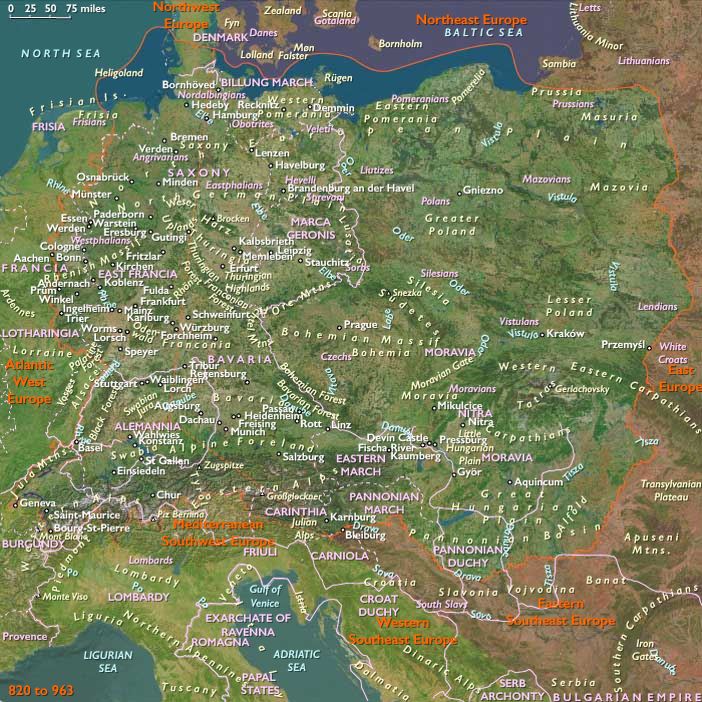
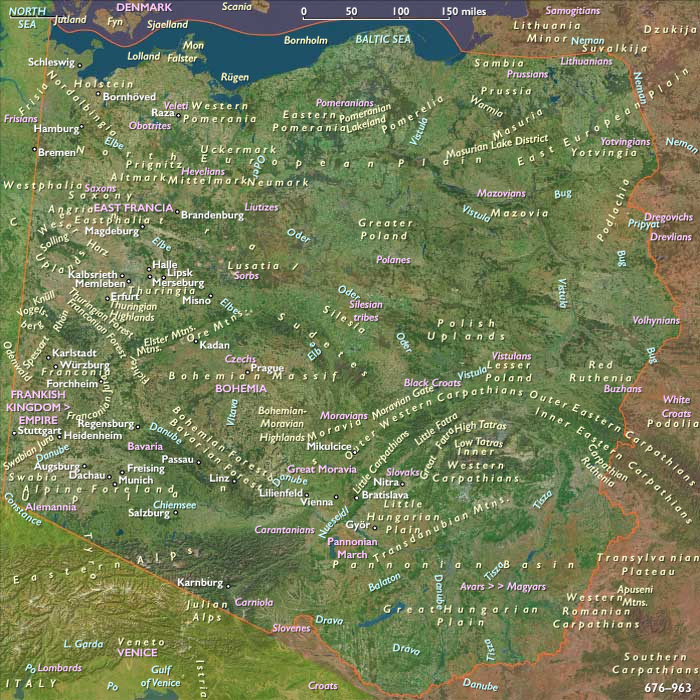
East Central Europe (880–891 CE): Height of Great Moravia under Svatopluk, Carolingian Decline, and Strengthening of Saxon Autonomy
Between 880 and 891 CE, East Central Europe—comprising modern-day Poland, Czechia, Slovakia, Hungary, and eastern parts of Germany and Austria east of 10°E and north of a line from approximately 48.2°N at 10°E to the Austro-Slovenian border near 46.7°N, 15.4°E—entered a pivotal period defined by the peak of Great Moravia’s influence under Svatopluk I (r. 870–894). Concurrently, the gradual decline of centralized Carolingian authority under Louis the German’s successors reshaped regional politics, while the Liudolfing dynasty in Saxony, under Otto the Illustrious, firmly established Saxon autonomy and power.
Political and Military Developments
Peak and Expansion of Great Moravia
-
Under Svatopluk I, Great Moravia reached its territorial and political zenith, significantly expanding influence into neighboring territories, including parts of modern-day Poland, Bohemia, Slovakia, and Hungary, while successfully countering Carolingian military pressures.
Carolingian Decline and Fragmentation
-
Following the death of Louis the German (876 CE), East Francia suffered political fragmentation and internal struggles among his heirs. This instability weakened centralized authority, reducing Carolingian control over frontier territories and enabling greater regional autonomy, notably benefiting Great Moravia and Saxony.
Saxon Strength and the Liudolfing Dynasty
-
In Saxony, Otto the Illustrious (d. 912) expanded and consolidated Liudolfing power, firmly establishing a dynasty poised to dominate future East Frankish and German political developments. Saxony emerged as a stable and influential political center amidst Carolingian disintegration.
Economic and Technological Developments
Thriving Regional Trade
-
Economic prosperity persisted, sustained by active trade networks linking Moravia, Saxony, Bavaria, and Thuringia, fueling commerce in precious metals, textiles, agricultural products, and luxury goods, and fostering sustained regional growth.
Improved Defensive and Administrative Infrastructure
-
Continuing regional tensions prompted significant investments in fortified settlements, roads, and administrative centers, enhancing defense capabilities and administrative efficiency, particularly within Great Moravia and Saxon territories.
Cultural and Artistic Developments
Great Moravian Cultural Pinnacle
-
Svatopluk’s Moravia continued flourishing culturally, prominently featuring Slavic liturgical traditions and the Glagolitic script introduced by Cyril and Methodius. Moravia's distinctive cultural and religious identity was firmly entrenched during this era.
Saxon Integration and Carolingian Cultural Influence
-
Saxony’s Liudolfing rulers actively promoted cultural integration with Frankish traditions through ecclesiastical patronage, establishment of monasteries, and fostering Frankish artistic and administrative customs, solidifying Saxony’s elevated cultural position.
Settlement and Urban Development
Expansion and Consolidation of Moravian Centers
-
Urban centers in Moravia, notably Mikulčice, Nitra, and Devín, further expanded, becoming significant regional hubs of administration, trade, religion, and culture, emblematic of Great Moravia’s political and cultural prestige.
Stable Urban Growth in Saxon, Bavarian, and Thuringian Towns
-
Saxony, Bavaria, and Thuringia experienced steady urban growth, facilitated by prosperous trade, stable governance, and robust administrative structures that endured despite declining Carolingian central authority.
Social and Religious Developments
Deepened Christianization and Ecclesiastical Growth
-
Christianity strengthened across the region, notably in Great Moravia through the efforts of Cyril and Methodius’s followers. Ecclesiastical institutions flourished, shaping the religious and social life of the entire region.
Strengthening of Dynastic and Aristocratic Structures
-
Powerful dynasties, particularly the Liudolfings in Saxony and Mojmirid rulers in Moravia, solidified their social and political hierarchies, establishing enduring patterns of governance and aristocratic dominance that shaped medieval society.
Long-Term Consequences and Historical Significance
The period 880–891 CE was crucial in defining East Central Europe’s medieval political and cultural landscape. The height of Great Moravian power under Svatopluk, the continued decline of Carolingian central authority, and the ascendant influence of the Saxon Liudolfing dynasty significantly reshaped regional identities, politics, and cultural traditions. These developments profoundly influenced the subsequent historical trajectory, laying firm foundations for medieval kingdoms and dynastic alliances across East Central Europe.
Eastern Southeast Europe (880–891 CE): Ecclesiastical Unity and Cultural Consolidation
Settlement and Migration Patterns
Continued Stability and Cultural Assimilation
From 880 to 891 CE, Eastern Southeast Europe sustained demographic stability while experiencing notable cultural integration. The assimilation process intensified, notably among the Daco-Roman populations and Slavic settlers, gradually forming the Romanian people, a process nearing completion by the tenth century.
Political and Military Developments
Ecclesiastical and Political Harmony
The Council of Constantinople in 880 CE marked a significant reconciliation between Eastern and Western churches, restoring normal relations between Rome and Constantinople. The moderate and extremist factions, represented by Patriarchs Photios and Ignatius respectively, reached a notable accord, resolving critical ecclesiastical disputes.
Bulgarian-Serbian Dynamics
In this period, Bulgars and Slavs solidified into a unified Bulgarian identity through cultural shifts, notably the replacement of Greek by Slavic in religious services and literary life. This linguistic and cultural consolidation significantly strengthened the Bulgarian state.
Economic and Technological Developments
Economic Prosperity and Stability
Continued stability and strategic regional conditions maintained economic prosperity. Agriculture remained vibrant, and expanding trade routes continued to enhance economic opportunities, further benefiting local populations and regional stability.
Influence of Italian Maritime Republics
The ongoing economic activities further increased the influence of Italian maritime republics—Venice, Genoa, and Amalfi—whose dominance of Mediterranean trade significantly impacted regional economic dynamics, particularly in trade routes linking Greece and the wider Mediterranean world.
Cultural and Artistic Developments
Revival and Consolidation of Figural Art
The post-843 revival of figural art flourished further during this period, continuing to enrich Byzantine religious and cultural life. This artistic vibrancy complemented ongoing scholarly activities and cultural integration within the Byzantine sphere of influence.
Expansion of Scholarly and Literary Activities
Scholarly endeavors continued to thrive with increased manuscript production, underpinning a sustained intellectual revival that reinforced cultural resilience and continuity across Eastern Southeast Europe.
Social and Religious Developments
Resolution of the Photian Schism
The formal reconciliation achieved at the Council of Constantinople effectively ended the Photian Schism, significantly stabilizing ecclesiastical relationships between Eastern and Western Christianity. This event reinforced ecclesiastical unity and strengthened religious cohesion.
Bulgarian Religious and Cultural Integration
The adoption of Slavic languages in Bulgarian religious and literary contexts unified Bulgar and Slav populations into a cohesive Bulgarian people. This unification was facilitated by Orthodox missionaries, notably Cyril and Methodius, and the establishment of the Bulgarian Church's autocephaly, further enhancing cultural and religious integration.
Long-Term Consequences and Historical Significance
The period from 880 to 891 CE was characterized by crucial ecclesiastical reunification, significant cultural consolidation, and linguistic integration among Bulgarians and Slavs, and the ongoing assimilation of the Slavs by the Daco-Romans. These developments substantially shaped the region's social, religious, and cultural landscape, reinforcing the foundation for future political and cultural stability in Eastern Southeast Europe.
The Council of Constantinople integrates the Eastern and Western churches and normal relations resume between Rome and Constantinople.
In Constantinople, the moderate and extremist factions led by patriarchs Photios and Ignatius, respectively, reach an accord.
Bulgars and Slavs become a unified Bulgarian people through the replacement of the Greek language with Slavic in Bulgarian church services and in literary life.
The term Daco-Roman describes the Romanized culture of Dacia under the rule of the Roman Empire.
The colonization with Roman or Romanized elements, the use of the Latin language and the assimilation of Roman civilization as well as the intense development of urban centers, had led to the Romanization of part of the autochthonous population in Dacia.
The Daco-Romans now begin to assimilate the Slavs to form the Romanian people in a process that is probably concluded by the tenth century.
The Middle East: 880–891 CE
Abbasid Decline and Regional Fragmentation
The era from 880 to 891 CE witnesses continued fragmentation within the Abbasid Caliphate, characterized by persistent rebellions, decentralization of authority, and the rise of semi-independent regional powers.
Continuation and Suppression of the Zanj Rebellion
The Zanj Rebellion, a significant uprising led by Ali ibn Muhammad near Basra, continues to severely disrupt Abbasid governance and trade. Initially a movement by enslaved peoples imported from across the Islamic Empire, the Zanj rebels had seized considerable territory, even founding a fortified capital city, Al-Mukhtara. By 883 CE, however, Abbasid forces, under the capable and ruthless general Al-Muwaffaq, brother of Caliph al-Mu'tamid, decisively suppress the rebellion after sustained, grueling campaigns. The fall of Al-Mukhtara in 883 CE marks the brutal conclusion of this uprising, resulting in extensive casualties and economic devastation in southern Iraq.
Caliph al-Mu'tadid and the Recentralization Efforts
Following Al-Muwaffaq's successes, his son, Abu'l-Abbas Ahmad, known as al-Mu'tadid, emerges as a strong figure at the Abbasid court. Ascending formally to the caliphate in 892 CE, his early influence begins to be felt strongly during this era, as he energetically seeks to recentralize Abbasid power, reorganize the administration, and assert imperial authority against various semi-autonomous provincial governors.
Independent Regional Powers
This era further sees the growing independence of regional dynasties from the Abbasid central authority. The Saffarids, under the ambitious and militarily capable leadership of Ya'qub ibn al-Layth and his successor, Amr ibn al-Layth, dominate eastern Iran and Afghanistan after decisively overthrowing the Tahirids in 873 CE. Meanwhile, the Tulunid dynasty, under Ahmad ibn Tulun and subsequently his son Khumarawayh, firmly consolidates control over Egypt and extends influence into Syria, transforming their domains into prosperous and semi-autonomous states, largely independent from Abbasid authority
Cultural and Economic Continuity Amidst Political Instability
Despite political turbulence, intellectual and cultural life across the Abbasid domains remains vibrant. Baghdad, though politically weakened, continues to be an intellectual beacon, fostering scholarship in philosophy, medicine, astronomy, and literature. Economic activities persist, bolstered by regional dynasties investing in infrastructure, agriculture, and trade, reflecting the enduring resilience of Abbasid cultural traditions even amid political decline.
The period 880–891 CE thus exemplifies a pivotal transitional phase, highlighting both the significant weakening of Abbasid central control and the simultaneous rise of strong regional dynasties, setting the stage for profound shifts in the Middle Eastern geopolitical landscape.
Mediterranean Southwest Europe (880–891 CE): Andalusian Unrest, Carolingian Fragmentation, and Cultural Continuity
The era 880–891 CE in Mediterranean Southwest Europe is characterized by ongoing internal unrest within Umayyad Al-Andalus, further fragmentation within Carolingian Italy, and sustained cultural vitality driven by religious and intellectual communities.
Internal Conflict and Muladi Rebellions in Al-Andalus
Under Emir Muhammad I (until 886 CE) and his successor Al-Mundhir (r. 886–888 CE), Al-Andalus continues experiencing significant internal unrest. Muladi (Muslims of Iberian descent) rebellions persist, reflecting widespread discontent with central Umayyad authority. Local dynasties, including the influential Banu Qasi family in Zaragoza, maintain a semi-independent stance, contributing to a climate of political instability.
Carolingian Fragmentation and Italian Autonomy
In Italy, Carolingian political authority further fragments following the death of Charles the Fat in 888 CE, leading to increased regional autonomy under local nobles. This fragmentation marks the decline of unified imperial control, reinforcing the political complexity that defines Italian territories in subsequent decades. Despite this, regional stability and cultural continuity persist, supported by strong ecclesiastical leadership.
Intellectual and Artistic Flourishing in Rome
Rome continues as a prominent center of intellectual life, benefiting from sustained cultural exchanges with the Byzantine East and Frankish courts. Artistic advancements, notably in wall painting, continue to evolve, exemplified by the sophisticated use of white highlighting techniques, as seen in contemporary Roman churches and monuments. Such artistic developments underscore Rome’s ongoing cultural and intellectual significance during this era.
Lucena’s Continued Jewish Cultural Leadership
In Iberia, the city of Lucena maintains its reputation as the center of Andalusian Jewry, reinforcing its position as an intellectual and religious hub. The city continues attracting scholars and students from across the Islamic world, further enriching its vibrant Jewish cultural life.
Economic Stability and Technological Progress
The regional economy benefits from continued advancements in technology, notably through widespread use of the Catalan forge. This enhanced iron production significantly boosts agricultural productivity, military readiness, and urban craftsmanship, providing a firm foundation for regional economic stability and growth.
Legacy of the Era
The era 880–891 CE highlights persistent political unrest in Al-Andalus, Carolingian fragmentation in Italy, and enduring cultural vitality driven by artistic innovations, Jewish intellectual life, and sustained economic progress. These developments collectively shape the diverse historical trajectory of Mediterranean Southwest Europe during the late ninth century.
Years: 880 - 891
People
Groups
Topics
Commodoties
Subjects
Regions
Subregions