
The Whigs, within a year of George's …
Years: 1715 - 1715
The Whigs, within a year of George's accession, win an overwhelming victory in the general election of 1715.
The Prince of Wales (the future King George II) is in the same year elected as Governor of the South Sea Company at the election of directors.
Both the new King, George I, and his son, the Prince of Wales, have significant holdings in the company, as do some prominent Whig politicians, including James Cragg, the Earl of Halifax and Sir Joseph Jekyll.
James Cragg, as Postmaster General, is responsible for intercepting mail on behalf of the government to obtain political and financial information.
All Tory politicians are removed from the board and replaced with businessmen.
Whigs Horatio Townshend, brother in law of Robert Walpole, and the Duke of Argyll are elected directors.
The new government leads to a revival of the companies share value, which had fallen below its issue price.
The previous government had failed to make the interest payments to the company for the last two years, owing more than one million.
The new administration insists the debt be written off, but allows the company to issue new shares to stockholders to the value of the missed payments.
At around ten million pounds, this now represents half the share capital issued in the entire country.
The company in 1714 had two thousand to three thousand shareholders, more than either of its rivals.
Several members of the defeated Tory Party sympathize with the Jacobites, and some disgruntled Tories side with a Jacobite rebellion which becomes known as "The Fifteen".
The Jacobites seek to enthrone Anne's Catholic half-brother, James Stuart (called "James III" by his supporters and "the Pretender" by his opponents).
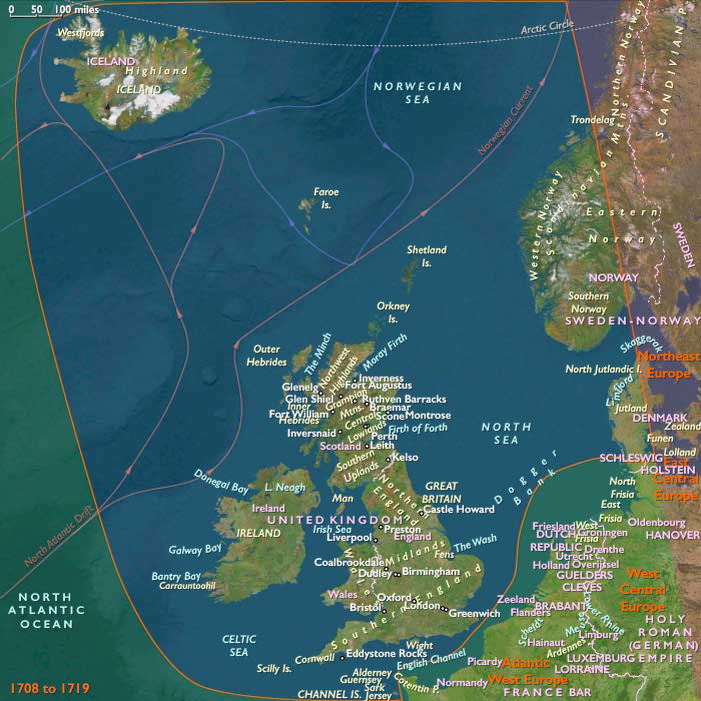
The Pretender's supporters, led by Lord Mar, an embittered Scottish nobleman who had previously supported the "Glorious Revolution", instigates rebellion in Scotland where support for Jacobitism is stronger than in England.
"The Fifteen", however, is a dismal failure; Lord Mar's battle plans are poor, and the Pretender arrives late with too little money and too few arms.
The rebellion by the end of the year has all but collapsed.
Locations
People
- Anne, Queen of Great Britain
- Daniel Defoe
- George I of Great Britain
- George II of Great Britain
- James Francis Edward Stuart
- John Churchill, 1st Duke of Marlborough
- John Erskine, 22nd and de jure 6th Earl of Mar
- Jonathan Swift
- Robert Harley, 1st Earl of Oxford and Earl Mortimer
- William Paterson
Groups
- Anglicans (Episcopal Church of England)
- Bank of England (independent)
- Spain, Bourbon Kingdom of
- Britain, Kingdom of Great
- Jamaica (British Colony)
- East India Company, British (United Company of Merchants of England Trading to the East Indies)
- South Sea Company, the
Topics
Subjects
Regions
Subregions
Years: 1715 - 1715
Locations
People
- Anne, Queen of Great Britain
- Daniel Defoe
- George I of Great Britain
- George II of Great Britain
- James Francis Edward Stuart
- John Churchill, 1st Duke of Marlborough
- John Erskine, 22nd and de jure 6th Earl of Mar
- Jonathan Swift
- Robert Harley, 1st Earl of Oxford and Earl Mortimer
- William Paterson
Groups
- Anglicans (Episcopal Church of England)
- Bank of England (independent)
- Spain, Bourbon Kingdom of
- Britain, Kingdom of Great
- Jamaica (British Colony)
- East India Company, British (United Company of Merchants of England Trading to the East Indies)
- South Sea Company, the
Topics
Subjects
Regions
Subregions