The well-fortified Euboean port of Negroponte (Chalcis), …
Years: 1470 - 1470
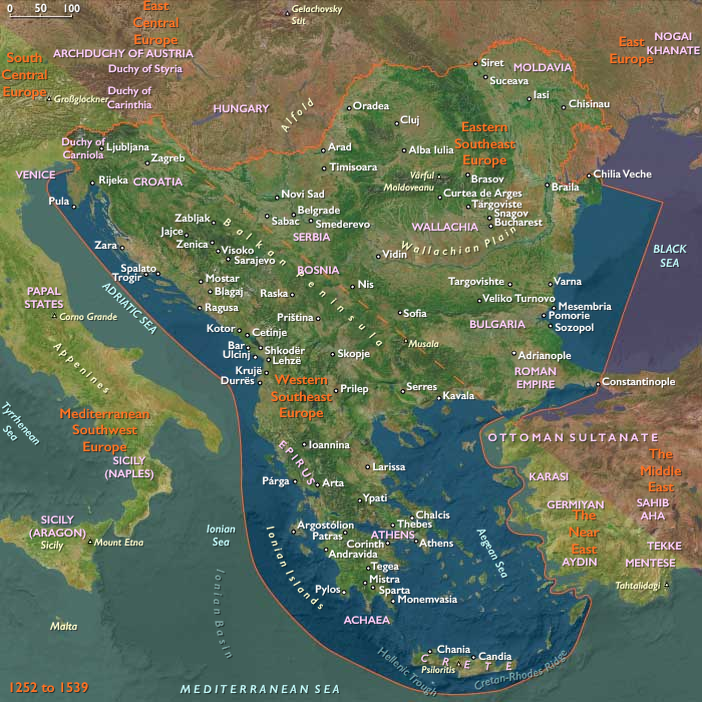
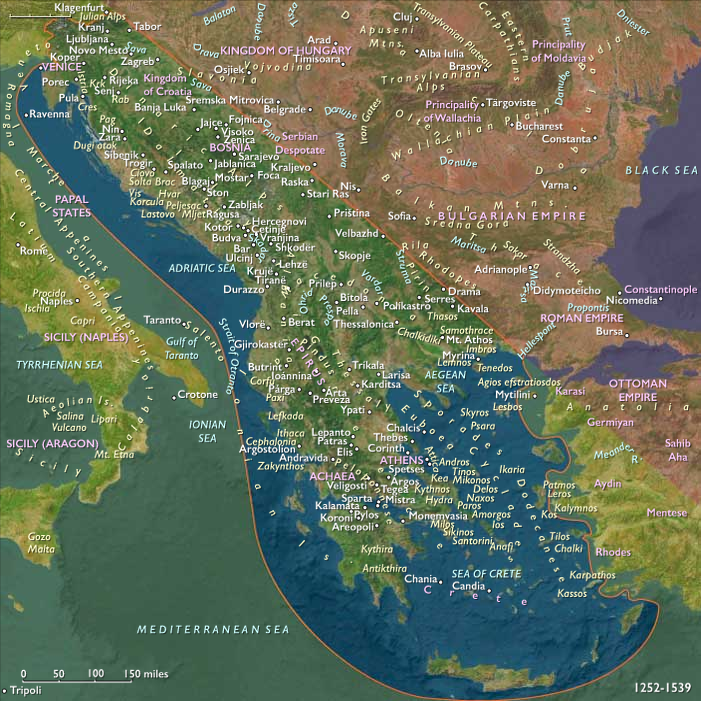
The well-fortified Euboean port of Negroponte (Chalcis), together with the nearby city of Pteléon, after a protracted and bloody siege is on July 12, 1470, wrested from Venice by the sea and land forces of Mehmed II and the whole island falls into the hands of the Ottoman Empire.
Locations
People
Groups
Topics
Commodoties
Subjects
Regions
Subregions
Related Events
Filter results
Showing 10 events out of 40931 total
Contemporary Scandinavian sources refer to Sten Sture as Sten Gustavsson or Herr Sten (Sir Sten); the practice of using noble family names as part of a personal name is not yet in use in Sweden at this time.
He was born around 1440, the son of Gustav Anundsson of the Sture family and Birgitta Stensdotter Bielke, half-sister of the future Charles VIII.
The Sture family is one of the high-ranking noble families of the time, though only distantly related to the royal house; his closest royal ancestor is King Sverker II of Sweden (both through family of Vinga and through family of Aspenäs).
Sture's father, Gustav Anundsson, had been Castellan of Kalmar Castle and a Privy Councilor, but died when Sten was four.
Birgitta Stensdotter remarried Gustav Karlsson of the Gumsehuvud family, and Sten had most likely been raised in their home, first at Kalmar Castle and later at Ekholmen Castle.
The fifteenth century in Sweden is largely defined by the political struggles and civil wars between the unionists of the Kalmar Union, seeking to unite Sweden with Denmark and Norway under the rule of the Danish monarchs, with Danish support, and the separatists seeking to reestablish Sweden as an independent kingdom under a rival Swedish monarch.
Due to his close family ties to the Swedish King Charles, the young Sten Sture had become part of the Swedish separatist political movement from an early age, and had visited Charles during his exile in Danzig.
He is mentioned as a knight in 1462 and as a privy councilor in 1466, and has taken up residence on the family estate at Räfsnäs north of Mariefred.
Sture had fought with Bishop and Regent Kettil Karlsson Vasa during the uprising against the Danish King Christian I in 1464, taking part in the decisive victory at Haraker.
He served as a military commander under King Charles VIII, defeating Erik Karlsson Vasa's uprising at Uppbo in 1470 and later in the same year successfully beating back Christian I's forces at Öresten.
He had married Ingeborg Tott, niece by marriage of Magdalen of Sweden, in 1467; she is a renaissance personality interested in theology and science and seems to have had some importance in the intellectual development during his reign.
The marriage is childless.
Sture's uncle, King Charles VIII, has named Sture heir to Charles' personal domains, and has left Sture in charge of the crown lands, including the city of Stockholm and Stockholm Castle.
On the death of Charles on May 15, 1470, Sture immediately becomes the most powerful noble and political force in the country.

Matthias soon orders the collection of an extraordinary tax without holding a Diet, raising widespread discontent among the Hungarian Estates.
He visits Emperor Frederick in Vienna on February 11, 1470, hoping the Emperor will contribute to the costs of the war against Poděbrady.
Although the negotiations last for a month, no compromise is worked out.
The Emperor also refuses to commit himself to promoting Matthias's election as King of the Romans.
After a month, Matthias departs Vienna without taking formal leave of Frederick III.
Matthias, having realized the Hungarian Estates' growing dissatisfaction, holds a Diet in November 1470.
The Diet again authorizes him to levy an extraordinary tax, stipulating that the sum of all taxes payable per porta cannot exceed one florin.
The Estates also make it clear that they oppose the war in Bohemia.
Moldavia and its prince, Stephen III, are the Romanian principalities' last hope of repelling the Ottoman menace.
In order to secure his southern frontier from Ottoman threats, Stephen wants to liberate Wallachia—where the hostile Radu the Handsome, the half-brother of the imprisoned Vlad Țepeș rules—from Ottoman dominion.
In 1470, he invades the country and burns down the town of Brăila.
Uzun Hasan, following the defeat and execution of Abu Said, the Timurid ruler of southern and western Persia, had had Yadgar Muhammad Mirza proclaimed as Abu Sa'id's successor and provided him with Timurid forces so that he could take over Khurasan, which is controlled by Sultan Husayn Mirza Bayqarah.
Although Yadgar Muhammad Mirza had been defeated by Husayn in battle in September 1469, fresh reinforcements had been sent by the Ak Koyunlu leader.
Furthermore, two of Uzun Hasan's sons have arrived to assist him.
Eventually Husayn is compelled to evacuate Herat, which Yadgar Muhammad Mirza occupies in July 1470.
Despite this, his troops are unreliable and Husayn reenters Herat six weeks later.
Yadgar Muhammad Mirza, who is captured and promptly executed by his enemy, is the last descendant of Shahrukh Mirza to play a dominant role in the politics of the Timurid principalities.
Politian was born as Angelo Ambrogini in Montepulciano, in central Tuscany in 1454.
His father Benedetto, a jurist of good family and distinguished ability, had been murdered by political antagonists for adopting the cause of Piero de' Medici in Montepulciano; this circumstance had given his eldest son, Angelo, a claim on the House of Medici.
At the age of ten, after the premature death of his father, Politian had begun his studies at Florence, as the guest of a cousin.
Here he has learned the classical languages of Latin and Greek.
From Marsilio Ficino he has learned the rudiments of philosophy.
At thirteen he began to circulate Latin letters; at seventeen he wrote essays in Greek versification; and at eighteen, he published an edition of Catullus.
He wins he title of homericus adulescens in 1470 by translating books II-V of the Iliad into Latin hexameters.
Lorenzo de' Medici, the autocrat of Florence and the chief patron of learning in Italy at this time, takes Politian into his household, makes him the tutor of his children, and secures him a distinguished post at the University of Florence.
During this time, Poliziano lectures at the Platonic Academy under the leadership of Marsilio Ficino, at the Careggi Villa.
Francesco de Giorgio Martini, the renowned Sienese painter, sculptor, and architect, comes to Urbino in 1470 to work as an architect on the cathedral here.
Guglielmo Ebreo da Pesaro (William the Hebrew of Pesaro) is one of the earliest choreographers and one of several Jewish dancing masters of the time whose surname acknowledges their ethnic heritage.
A favorite of Lorenzo il Magnifico, the Medici ruler of Florence, Guglielmo teaches dancing and produces fetes at various Italian courts.
He writes a number of important treatises, among them Tratto della danza (Way of the Dance) and De Praticha seu arte tripudii vulghare opusculum (The Practice and Art of Sacred and Profane Dance), in which he outlines the qualifications for a dancer and describes his own works and those of his master, Domenico de Piacenza.
Botticelli had painted a Madonna and Child with Young Saint John and Two Angels in about 1468 in a style clearly based on those of his mentor Lippi and the fashionable Verrocchio.
This early work indicates Botticelli's understanding of Lippi's ability to endow fleshy, firmly modeled figures with suavity and grace.
By 1470, Botticelli has his own workshop.
Even at this early date, his work is characterized by a conception of the figure as if seen in low relief, drawn with clear contours, and minimizing strong contrasts of light and shadow which would indicate fully modeled forms.
In Botticelli's first documented work, Fortitude, painted in 1470, he attempts to bring his youthful manner into line with that of Verrocchio, conveying in Fortitude’s posture the tension, and in her draperies, the sharp contrast of light and dark, that often characterize the work of an artist influenced by a painter-sculptor.
Botticelli also includes details of classical ornament and displays a characteristically precise attention to reflections and textures.
Alberti’s smaller studies, pioneering in their field, include a treatise in cryptography, De componendis cifris, in which he describes a cipher disk capable of enciphering a small code, and the first Italian grammar.
With the Florentine cosmographer Paolo Toscanelli he collaborates in astronomy, a close science to geography at this time, and produces a small Latin work on geography, Descriptio urbis Romae (The Panorama of the City of Rome).
Just a few years before his death, Alberti completes De iciarchia (On Ruling the Household), a dialogue about Florence during Medici rule.