
Filters:
The earliest traces of human occupation in …
Years: 9549BCE - 7822BCE
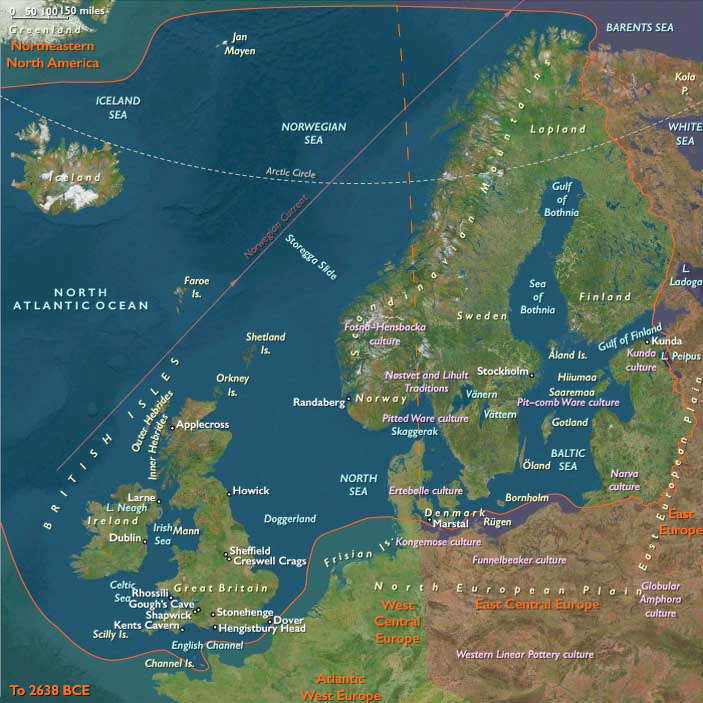
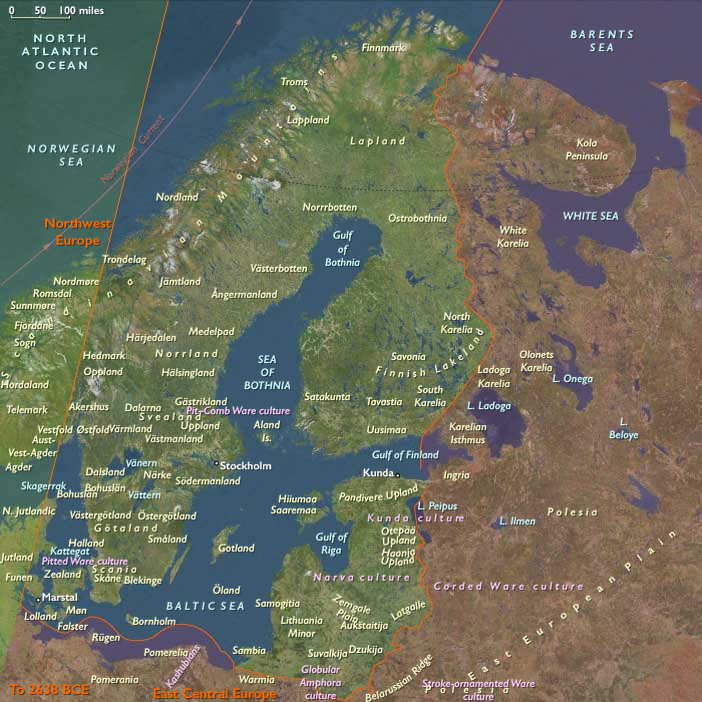
The earliest traces of human occupation in Norway are found along the coast, where the huge ice shelf of the last ice age first melts between 11,000 and 8,000 BCE.
The oldest finds are stone tools dating from 9,500 to 6,000 BCE, discovered in Finnmark (Komsa culture) in the north and Rogaland (Fosna culture) in the south-west.
However, theories about two altogether different cultures (the Komsa culture north of the Arctic Circle being one and the Fosna culture from Trøndelag to Oslofjord being the other) will be rendered obsolete in the 1970s.
More recent finds along the entire coast have revealed to archaeologists that the difference between the two can simply be ascribed to different types of tools and not to different cultures.
Coastal fauna provide a means of livelihood for fishermen and hunters, who may have made their way along the southern coast about 10,000 BCE, when the interior is still covered with ice.
It is now thought that these so-called "Arctic" peoples came from the south and followed the coast northward considerably later.
The oldest finds are stone tools dating from 9,500 to 6,000 BCE, discovered in Finnmark (Komsa culture) in the north and Rogaland (Fosna culture) in the south-west.
However, theories about two altogether different cultures (the Komsa culture north of the Arctic Circle being one and the Fosna culture from Trøndelag to Oslofjord being the other) will be rendered obsolete in the 1970s.
More recent finds along the entire coast have revealed to archaeologists that the difference between the two can simply be ascribed to different types of tools and not to different cultures.
Coastal fauna provide a means of livelihood for fishermen and hunters, who may have made their way along the southern coast about 10,000 BCE, when the interior is still covered with ice.
It is now thought that these so-called "Arctic" peoples came from the south and followed the coast northward considerably later.
Groups
Topics
Commodoties
Subjects
Regions
Subregions
Years: 9549BCE - 7822BCE
Groups
Topics
Commodoties
Subjects
Regions
Subregions