
Atlantic West Europe (388–399): The Decline of …
Years: 388 - 399
Atlantic West Europe (388–399): The Decline of Roman Authority and the Emergence of Barbarian Power
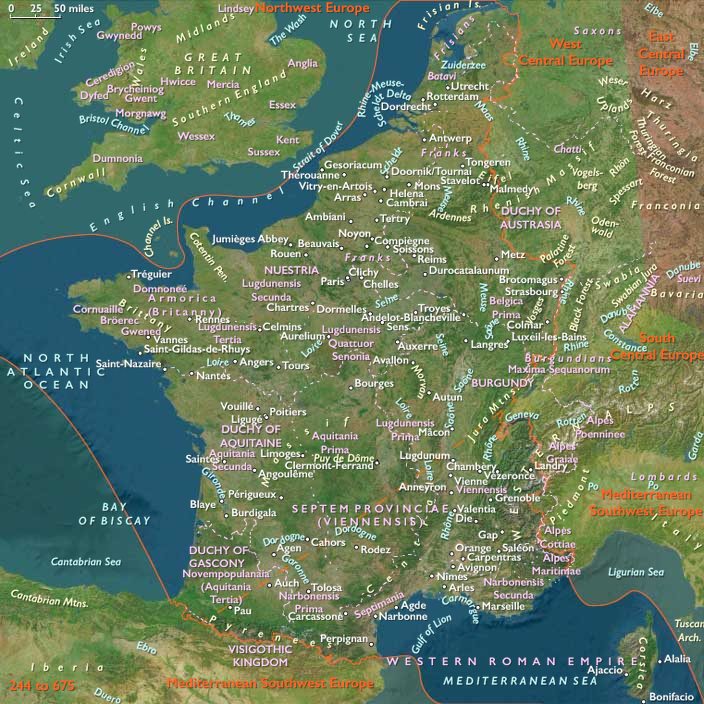
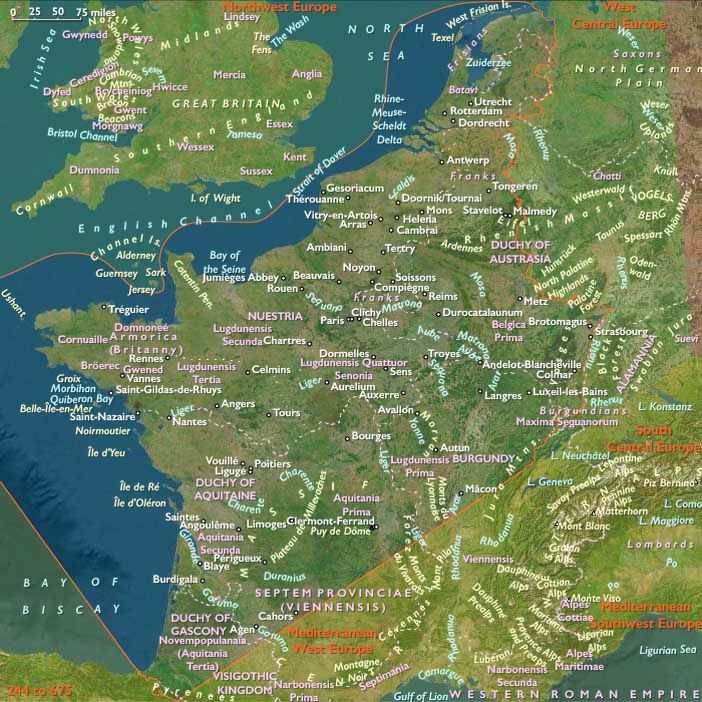
Between 388 and 399, Atlantic West Europe—including Roman Gaul (Aquitania, Gallia Belgica, Gallia Lugdunensis), Britannia, Armorica (later Brittany), and the Rhine frontier—experienced accelerated political and military turbulence, marking a pivotal shift from Roman control toward emerging barbarian influence.
Political and Military Developments
Roman Authority Under Strain
-
Theodosius I (r. 379–395), the last emperor to rule a unified Roman Empire, briefly restored stability following the usurpation of Magnus Maximus (executed 388), reasserting imperial control over Gaul and Britannia.
-
Following Theodosius's death (395), the empire permanently split between his sons: Honorius (West) and Arcadius (East). This division weakened imperial governance in the Western provinces, particularly Gaul and Britannia.
Barbarian Pressures and Settlement
-
Germanic tribes increasingly pressured the Rhine frontier, exploiting Roman internal divisions.
-
The Franks, notably the Salian Franks, expanded into northern Gaul and Belgica, gradually establishing semi-independent territories along the lower Rhine and Meuse rivers.
Revolts and Usurpations
-
Arbogast, a Frankish general serving Rome, effectively governed Gaul on behalf of Valentinian II. After Valentinian’s death (392), Arbogast supported the usurper Eugenius, defeated by Theodosius at the Battle of the Frigidus (394).
-
This conflict depleted Roman strength, leaving the Western Empire vulnerable to further barbarian incursions and internal instability.
Economic and Social Developments
Economic Decline and Regionalization
-
Declining trade and monetary circulation throughout Gaul and Britannia weakened economic cohesion, increasing reliance on local agricultural production.
-
Villas in Aquitania and the Loire Valley became more isolated, signaling declining central control and the early stages of ruralization.
Urban Decline and Defensive Fortifications
-
Cities in northern Gaul (e.g., Trier, Cologne) and Britannia (e.g., Londinium) saw decreased population and economic activity.
-
Fortifications and castra were reinforced, reflecting anxiety over barbarian attacks and the empire's diminishing capacity to guarantee protection.
Religious and Cultural Developments
Rise of Christianity
-
Christianity continued to expand in urban centers, driven by influential bishops such as Martin of Tours (d.397), whose missionary work significantly shaped the region’s religious identity.
-
The foundation of monasteries, including Ligugé (360s, near Poitiers) and Marmoutier (near Tours, founded c. 372 by St. Martin), set early precedents for monastic communities in Gaul.
Pagan-Christian Cultural Tensions
-
The period witnessed ongoing tension and occasional violence between lingering pagan communities and ascendant Christian authorities, notably in urban centers across Gaul.
Key Figures
-
Theodosius I (r.379–395): Last ruler of unified Roman Empire, whose death triggered long-term instability.
-
Arbogast (d.394): Frankish-Roman general whose influence exemplified shifting power dynamics.
-
Martin of Tours (d.397): Influential bishop, missionary, and monastic founder, pivotal to Christianity’s establishment.
Long-Term Significance
This era marked a critical inflection point in Atlantic West Europe:
-
The final effective Roman authority over Gaul and Britannia began to collapse, setting the stage for barbarian kingdoms.
-
Germanic tribes, notably the Franks, started forming independent power structures.
-
The increasing influence of Christianity, particularly through monastic foundations, shaped the cultural and religious identity of the region for centuries to come.
People
Groups
- Polytheism (“paganism”)
- Franks
- Gallo-Roman culture
- Armorica
- Gallia Belgica (Roman province)
- Gallia Lugdunensis (Roman province)
- Gallia Aquitania (Roman province)
- Britain, Roman
- Gaul, Diocese of
- Christianity, Nicene
- Gaul, Praetorian prefecture of
- Roman Empire: Valentinian dynasty (Rome)
- Roman Empire: Theodosian dynasty (Constantinople)
- Roman Empire, Western (Milan)
Topics
- Roman Age Optimum
- Late Antiquity
- Migration Period
- Fall of the Western Roman Empire
- Frigidus, Battle of the
Commodoties
Subjects
Regions
Subregions
Related Events
Showing 10 events out of 59517 total
Years: 388 - 399
People
Groups
- Polytheism (“paganism”)
- Franks
- Gallo-Roman culture
- Armorica
- Gallia Belgica (Roman province)
- Gallia Lugdunensis (Roman province)
- Gallia Aquitania (Roman province)
- Britain, Roman
- Gaul, Diocese of
- Christianity, Nicene
- Gaul, Praetorian prefecture of
- Roman Empire: Valentinian dynasty (Rome)
- Roman Empire: Theodosian dynasty (Constantinople)
- Roman Empire, Western (Milan)
Topics
- Roman Age Optimum
- Late Antiquity
- Migration Period
- Fall of the Western Roman Empire
- Frigidus, Battle of the
Commodoties
Subjects
Regions
Subregions