
The warlike rulers of the Western Xia …
Years: 1204 - 1204
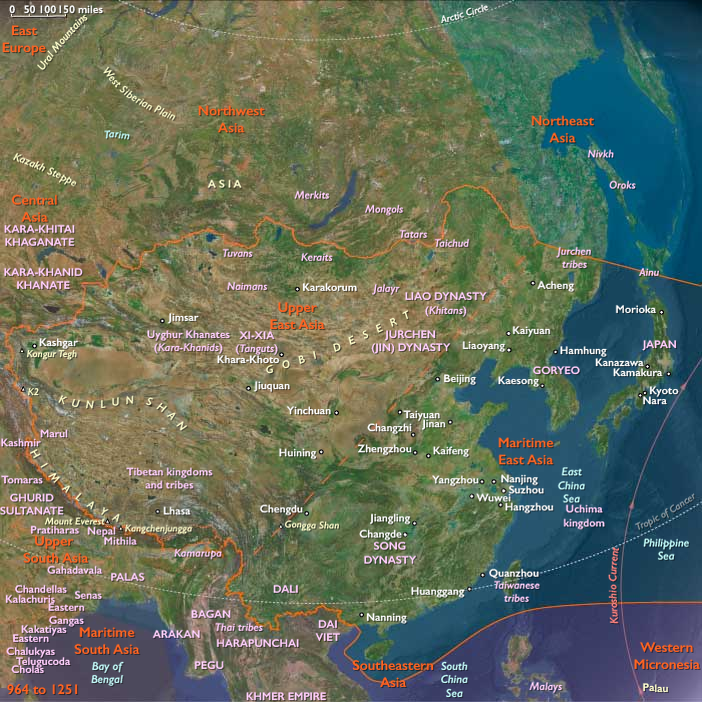
The warlike rulers of the Western Xia dynasty, Tibetan in race and Buddhist in religion, had emerged in 1038, and had eventually grown to cover what are now the northwestern Chinese provinces of Ningxia, Gansu, eastern Qinghai, northern Shaanxi, northeastern Xinjiang, southwest Inner Mongolia, and southernmost Outer Mongolia.
A fairly small state, Western Xia struggles for dominance with its larger and more powerful neighbors, the Liao dynasty to the east and northeast, and the Song dynasty to the southeast.
After the Jin dynasty emerged in 1115 and displaced the Liao, Western Xia had eventually accepted vassal status to the new empire.
Aiding Jin in their wars against the Song, Western Xia has gained thousands of square miles of former Song territory.
The relations between Western Xia and Jin have over many years gradually declined however.
Western Xia conducts border raids in a struggle with the southern Song dynasty over control of the Chang Jiang river valley.
Upon the death of its fifth ruler, Emperor Renzong, in 1193, his thirteen-year-old son had ascended the throne as Emperor Huanzong as Western Xia's power began to fail.
The Western Xia, though militarily inferior to the neighboring Jin, still exert a significant influence upon the northern steppes.
The state had often welcomed deposed Kerait leaders because of close trade connections to the steppes and because of the possibility of using the refugees as pawns in the Mongolian Plateau.
Temujin, soon to be Genghis Khan, had in the late 1190s and early 1200s begun consolidating his power in Mongolia.
Following the death of the Keraid leader Ong Khan to Temujin's emerging Mongol Empire in 1203, Khereid leader Nilqa Senggum had led a small band of followers into Western Xia territory, from which he is expelled after his adherents take to plundering the locals.
Huanzong has tried to follow the dictates of his late father, but the high-ranking officials in the Western Xia government have become more corrupt as time passed, starting the irreversible decline of the Tangut state.
The rise of the Mongols under Genghis Khan has begun to pose threats as Mongols begin raiding border villages.
After Genghis Khan had unified the northern grasslands of Mongolia, the Xianbei who resided near Mount Yin had self-proclaimed to be "White Mongols" and joined them.
Receiving the same considerations as the Mongols, these Xianbei will partake in the westward conquests in Central Asia and Europe.
The Mongol troops led by Genghis during this period, which had begun in 1202 will over a span of twenty-two years carry out six rounds of attacks against Western Xia.
Locations
People
Groups
- Buddhism, Tibetan
- Xianbei
- Tanguts
- Western Xia, or Tangut Kingdom
- Mongols
- Chinese Empire, Nan (Southern) Song Dynasty
- Jin Dynasty (Chin Empire), Jurchen
Topics
Commodoties
Subjects
Regions
Subregions

Related Events
Showing 10 events out of 47639 total
Years: 1204 - 1204
Locations
People
Groups
- Buddhism, Tibetan
- Xianbei
- Tanguts
- Western Xia, or Tangut Kingdom
- Mongols
- Chinese Empire, Nan (Southern) Song Dynasty
- Jin Dynasty (Chin Empire), Jurchen
Topics
Commodoties
Subjects
Regions
Subregions