The multi-ethnic confederacy Sarmatian confederacy of western …
Years: 150BCE - 150BCE
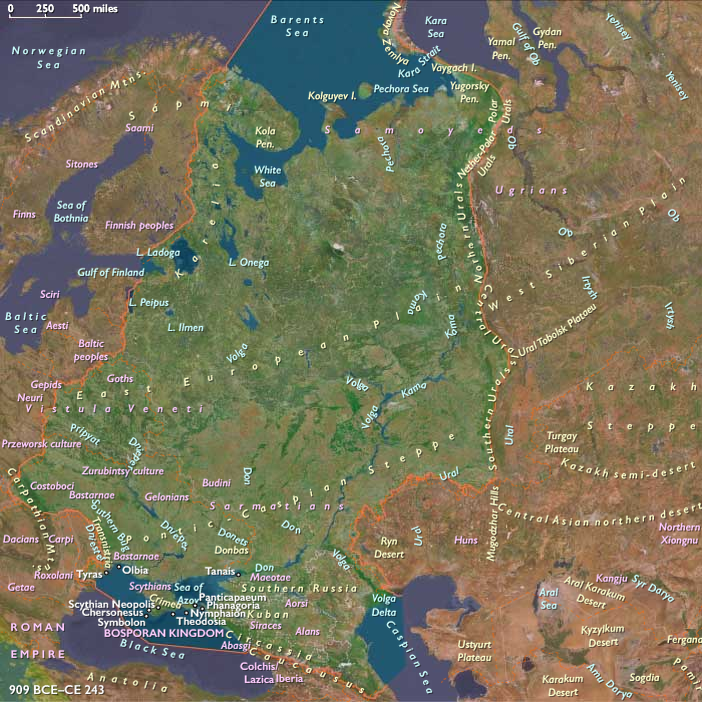
The multi-ethnic confederacy Sarmatian confederacy of western Scythia, warlike nomadic pastoralists of varied backgrounds mentioned by classical authors from Herodotus onward, have by 150 BCE divided into three nations: the Alans, an Iranian people, to the East, living near the Sea of Azov; …
Locations
Groups
Topics
Subjects
Regions
Subregions
Related Events
Filter results
Showing 10 events out of 63144 total
…the Roxolani, believed to be an offshoot of the Alans, between the Don and Dnieper Rivers; and …
…the Iazyges, or Jazyges, or Iazygians, of the lower Dnieper, in the steppes of what is now Ukraine.
Heracleides has persuaded the Roman senate to support the young pretender against Demetrius.
The Romans conspire in 150 with Attalus II of Pergamon to supply Alexander Balas with mercenaries in his challenge and subsequent slaying of Demetrius.
With the support of the Roman Senate and the Egyptian Ptolemaic dynasty, Balas, also called Alexander Epiphanes, assumes control of Syria and the remains of the Seleucid Empire.
Thus the family of Timarchus has contributed in no small way to the disintegration of the Seleucid realms.
Laodice, the sister of Alexander Balas, had, after 152 BCE, married Mithridates V of Pontus, who reigns as king from 150 BCE–120 BCE.
Little is known regarding her relationship with her husband or her reign as Pontian Queen, although Laodice will bear Mithridates seven children: Laodice of Cappadocia, Mithridates VI of Pontus, Mithridates Chrestus, Laodice, Nysa (sometimes spelt as Nyssa), Roxana and Statira.
The territories of Indo-Greek king Menander I cover the eastern dominions of the divided Greek empire of Bactria and extend to India (modern day Pakistani provinces of the NWFP, Punjab and parts of Himachal Pradesh and the Jammu region).
His capital is supposed to have been Sagala, a prosperous city in northern Punjab (believed to be modern Sialkot), Pakistan.
He is one of the few Bactrian kings mentioned by Greek authors, among them Apollodorus of Artemita, quoted by Strabo, who claims that the Greeks from Bactria were even greater conquerors than Alexander the Great, and that Menander was one of the two Bactrian kings, with Demetrius, who extended their power farthest into India: "The Greeks who caused Bactria to revolt grew so powerful on account of the fertility of the country that they became masters, not only of Ariana, but also of India, as Apollodorus of Artemita says: and more tribes were subdued by them than by Alexander-- by Menander in particular (at least if he actually crossed the Hypanis towards the east and advanced as far as the Imaüs), for some were subdued by him personally and others by Demetrius, the son of Euthydemus the king of the Bactrians; and they took possession, not only of Patalena, but also, on the rest of the coast, of what is called the kingdom of Saraostus and Sigerdis.
In short, Apollodorus says that Bactriana is the ornament of Ariana as a whole; and, more than that, they extended their empire even as far as the Seres and the Phryni."
(Strabo 11.11.1) Strabo also suggests that these Greek conquests went as far as the capital Pataliputra in northeastern India (today Patna): "Those who came after Alexander went to the Ganges and Pataliputra" (Strabo, 15.698).
The Indian records also describe Greek attacks on Mathura, Panchala, Saketa, and Pataliputra.
This is particularly the case of some mentions of the invasion by Patanjali around 150 BCE, and of the Yuga Purana, which describes Indian historical events in the form of a prophecy: "After having conquered Saketa, the country of the Panchala and the Mathuras, the Yavanas (Greeks), wicked and valiant, will reach Kusumadhvaja.
The thick mud-fortifications at Pataliputra being reached, all the provinces will be in disorder, without doubt.
Ultimately, a great battle will follow, with tree-like engines (siege engines)."
(Gargi-Samhita, Yuga Purana chapter, No.
5).
In the West, Menander seems to have repelled the invasion of the dynasty of Greco-Bactrian usurper Eucratides, and pushed them back as far as the Paropamisadae, thereby consolidating the rule of the Indo-Greek kings in the northern part of the Indian Subcontinent.
The Milinda Panha gives some glimpses of his military methods: "Has it ever happened to you, O king, that rival kings rose up against you as enemies and opponents?
-Yes, certainly.
-Then you set to work, I suppose, to have moats dug, and ramparts thrown up, and watch towers erected, and strongholds built, and stores of food collected?
-Not at all.
All that had been prepared beforehand.
-Or you had yourself trained in the management of war elephants, and in horsemanship, and in the use of the war chariot, and in archery and fencing?
-Not at all.
I had learnt all that before.
-But why?
-With the object of warding off future danger."
(Milinda Panha, Book III, Chap 7)

Alexander Balas, his claims recognized also by the Roman Senate after he defeats Demetrius I to win the Seleucid throne, receives the further honor of marriage to Cleopatra Thea, daughter of his allies Ptolemy VI and Cleopatra II, who may have been engaged to her uncle Ptolemy VIII king of Cyrene in 154, but he eventually married her sister Cleopatra III.
The wedding takes place in Ptolemais (Acre) in the presence of Ptolemy VI.
According to 1 Maccabees, Jonathan Apphus had been invited but arrives after the wedding ceremony while celebrations continue.
He appears with presents for both kings, and is permitted to sit between them as their equal; Balas even clothes him with his own royal garment and otherwise accords him high honor.
A Jewish community, possibly Essenes, begins construction in about 150 on a walled complex of buildings at the site of Qumran, located below the cliffs overlooking the northwest corner of the Dead Sea.
Cisterns, fed by canals leading down from the cliffs above, are used to store water.
Most of the Dead Sea Scrolls, found here, date from this period.
Galba again marches into Lusitania in the spring of 150 BCE and ravages the country.
The Lusitanians send an embassy to him, declaring that they repent of having violated the treaty which they had concluded with Atilius, and promise henceforth to observe it faithfully.
In one of history’s most infamous atrocities, Galba receives the ambassadors kindly, and laments that circumstances, especially the poverty of their country, should have induced then to revolt against the Romans.
He promises them fertile lands if they will remain faithful allies of Rome.
He induces them, for this purpose, to, leave their homes, and assemble in three hosts, with their women and children, in the three places which he fixes upon, land in which he himself will inform each host what territory they are to occupy.
When they are assembled in the manner he has prescribed, he goes to the first body, commands them to surrender their arms, surrounds them with a ditch, and then sends his armed soldiers into the place, who promptly massacre them all.
He treats the second and third hosts in the same manner, killing some nine thousand in all.
Few of the Lusitanians present escape the carnage; another twenty thousand are later enslaved and sold in Gaul.
(Appian states that Galba, although very wealthy, was extremely niggardly, and that he did not even scruple to lie or perjure himself, provided he could thereby gain pecuniary advantages.)
Carthage, its power effectively destroyed in the Second Punic War, is no longer a great power, but its economic recovery has made it again a target of an insecure Rome, where resentment lingers.
Cato the Elder, a stern moralist who has consistently opposed Roman entanglement in the East but remains an implacable enemy of Carthage, constantly reiterates in the Senate "Ceterum censeo Carthaginem esse delendam" ("Further, I think that Carthage must be destroyed"), ending every speech with this phrase no matter the topic.
In 150 BCE, an appeal is made to Scipio by the Carthaginians to act as mediator between them and King Massinissa of Numidia.
The subjugation of Ireland’s previous inhabitants by the Gaels is complete by 150 BCE.
The “tuatha,” or petty kingdoms—of which perhaps one hundred and fifty exist in Ireland at this time—form the basic units of Gaelic society.
The tuatha, although maintaining independence from one another, share a common language, Gaelic, and a class of men called “brehons,” who are schooled in customary law.