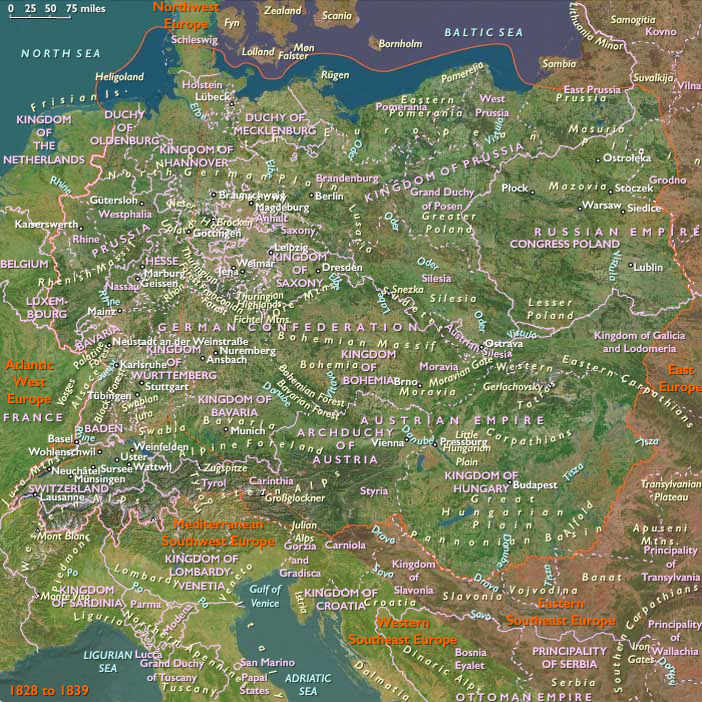
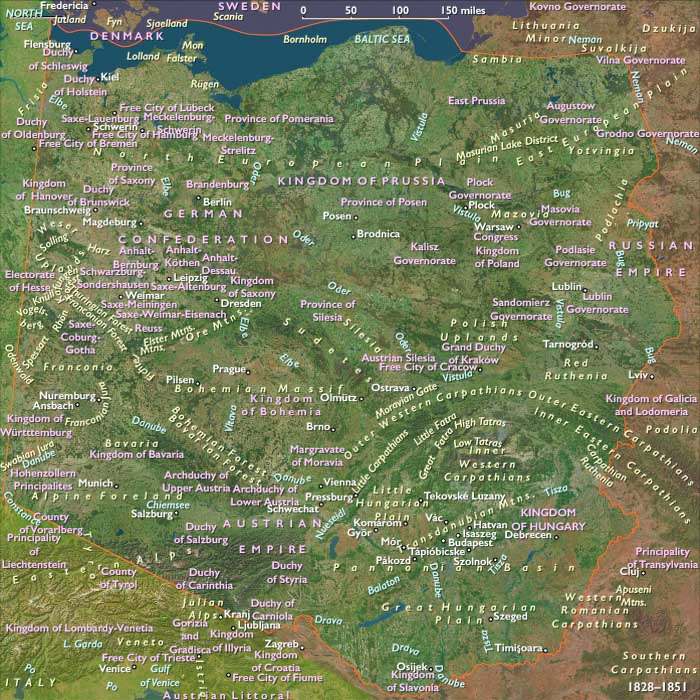
The Vitkovice steelworks, with the region's first …
Years: 1829 - 1829
The Vitkovice steelworks, with the region's first blast furnace, are built in the Northern Moravian city of Ostrava in 1829.
Locations
Groups
Topics
Commodoties
Subjects
Regions
Subregions
Related Events
Filter results
Showing 10 events out of 19238 total
Newly arriving colonists at the mouth of the Swan River in present Western Australia have their first view of the Australian mainland on June 1, 1829.
Captain James Stirling, who establishes the site as the political center of the free settler Swan River Colony on June 3, will later state that the site is "as beautiful as anything of this kind I had ever witnessed."
This secures the western third of the Australian landmass for the British.
On August 12 of this year, Mrs. Helen Dance, wife of the captain of the ship Sulphur, cuts down a tree to mark the founding of the town.
Stirling, a Scot, chooses the name Perth for the new town in accordance with the wish of Sir George Murray, Secretary of State for War and the Colonies, that the town be named after Perthshire, which was his birthplace as well as his parliamentary seat in the British House of Commons.
Although the British Army had established a base at King George Sound (later Albany) on the south coast of western Australia in 1826 in response to rumors that the area would be annexed by France, Perth is the first full scale settlement by Europeans in the western third of the continent, and secures the area for Britain.
The colony itself will be officially designated Western Australia in 1832, but will be known informally for many years as the Swan River Colony after the area's major watercourse.

Charles Sturt charts the course of the Murray River in an 1829 expedition that nearly blinds him and forces him to retire from the army.
A revolt in 1829 under Mahommed Ali Khan and Yusuf, brother of Jahanghir, results in the Qing government’s concession of several important trade privileges to the Muslims of the district of Alty Shahr (the six cities), as it is called at this time.
While in exile, his stature as a poet has enabled him to publish two of his most important poetic works: “Crimean Sonnets” and the long narrative poem “Konrad Wallenrod.”
In the latter work, a narrative poem describing the battles of the Teutonic Knights with the heathen Lithuanians, Mickiewicz represents the sanguinary passages of arms and burning hatred that has characterized the long feuds of the Russians and Poles.
The thinly veiled subject of the poem, though obvious to many, had escaped the Russian censors, who had allowed the poem’s publication in 1828, complete with the telling motto, adapted from Machiavelli: "Dovete adunque sapere come sono duo generazioni da combattere - bisogna essere volpe e leone"—"Ye shall know that there are two ways of fighting - you must be a fox and a lion."
This striking poem contains beautiful lyrics.
Mickiewicz has secretly made up his mind never to return to Russia, or to his native Poland so long as it remains under the government of Imperial Russia.
Nikolai Gogol, a twenty-one year-old Russian writer, moves in 1829 from his home village of Sorochintsi in Poltava Guberniya (now Ukraine) to St. Petersburg, where he writes a poem, Ode to Italy, and Hanz Küchelgarten, a narrative poem published under the pseudonym "V. Alov” to scathing reviews.
Mortified, Gogol, buys up and burns the unsold copies and briefly flees Russia.
Carl Gustav Jacob Jacobi, from 1826 a professor of mathematics at Königsberg University and a prolific writer, publishes “Fundamenta nova theoria functionum ellipticarum” (“New Foundations of the Theory of Elliptic Functions”) in 1829.
This classic treatise on elliptic functions is of great importance in mathematical physics, because of the need to "integrate second order kinetic energy equations.”
The motion equations in rotational form are integrable only for the three cases of the pendulum, the symmetric top in a gravitational field, and a freely spinning body, wherein solutions are in terms of elliptic functions.
Chalmers University, today the Chalmers Institute of Technology, is founded in 1829 in Gothenburg, Sweden, following a donation by the late William Chalmers, a Freemason and director of the defunct Swedish East India Company, whose ships had sailed across the world to supply Europe with goods from the East until the company folded in 1813.
Dying in 1811, he had donated some of his fortune for the establishment of an “industrial school.”
Danish author and poet Steen Steensen Blicher had written the novella “Alas, How Changed!”, one of the most pessimistic of his early prose works, in 1828.
Blicher continues as Denmark’s sole representative of bleak realism with “The Parson at Vejlbye,” drawing on his own experiences as a country parson.
August Bournonville, returning to Copenhagen in 1828 from a two-year stint with the Paris Opera Ballet, had been appointed choreographer, teacher and first dancer of the Royal Danish Ballet, where he will create the distinctive movements of Danish ballet.
Although influenced from the Paris ballet, the style is entirely his own, characterized by light, floating jumps and precise footwork.
Jöns Jacob Berzelius discovers thorium in 1829 and names the new element after the Norse god Thor.
In the same year, Berzelius fails to find anything new in a sample supplied by Gottfried Osann, who now withdraws his claim for the discovery of ruthenium.