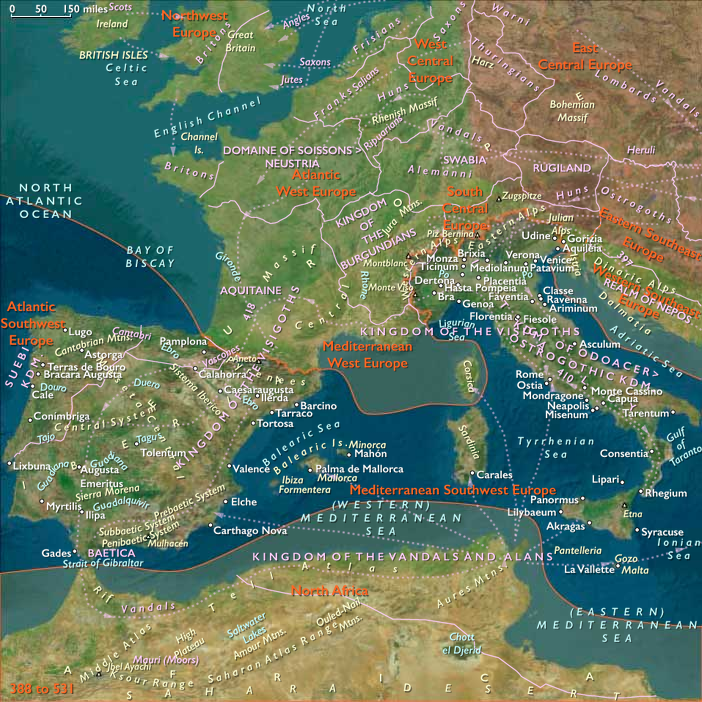
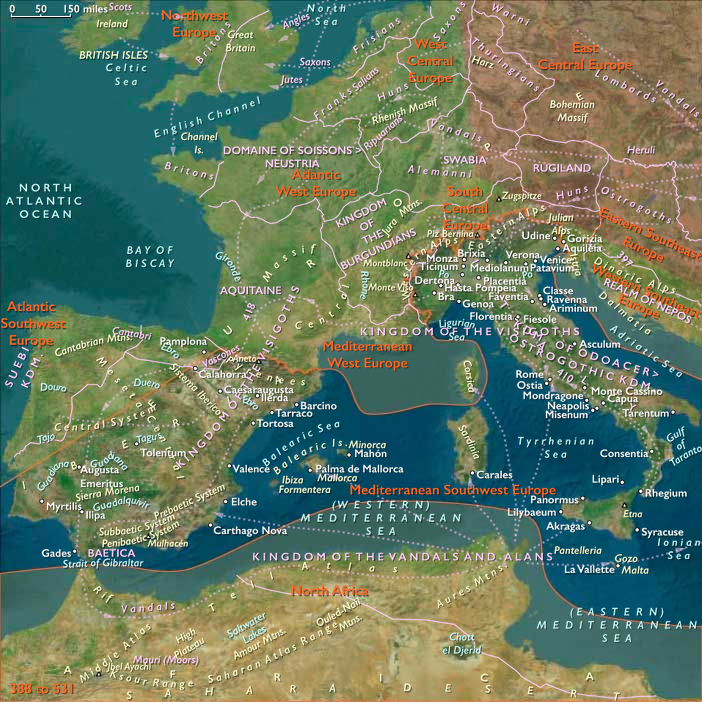
The Germanic Alemanni tribe invades the Ripuarian Frankish kingdom of Cologne.
Clovis, responding to a Ripuarian appeal, leads the Salian Franks to a decisive victory over the Alemanni at the Battle of Tolbiac, southwest of Cologne, and (possibly) again, at the same place, ten years later (some historians believe this later battle to be the only Battle of Tolbiac).
The pagan Frankish king Clovis, influenced by his wife Clotilda, a Christian Burgundian princess, according to Gregory of Tours, writing a century or so after Tolbiac, converts after the battle to orthodox Christianity, baptized by Remi, archbishop of Reims, supposedly with three thousand followers. (Clovis reputedly prayed to his wife’s god during the battle, promising to convert to her faith if he prevailed.)
The Frankish nation follows his example.
He regularizes the relations of his kingdom with the episcopate in Gaul and essentially allies with the church.
This is a significant departure from the path of other Germanic kings, like those of the Visigoths and Vandals, who had embraced Arianism.
Though this act strengthens the bonds between his Roman Christian subjects, who follow the orthodox line, and their Germanic conquerors, this conversion from Clovis’s Frankish pagan beliefs alienates many of the other Frankish sub-kings (as Bernard Bachrach has argued) and will serve to weaken his military position over the next few years. (Gregory of Tours wrote that the pagan beliefs which Clovis abandoned were in Roman gods such as Jupiter and Mercury, rather than their Germanic equivalents, which is an indication of the extent which the Franks had already adopted Roman culture.)
Gregory first inserted the thematic element that has shaped subsequent interpretations of Tolbiac as a climacteric in the course of European history: Clovis is said to have attributed his success to a vow that he had made: if he won, he would convert to the religion of the Christian God who had aided him.
He became a Christian in a ceremony at Reims at Christmas 496; the traditional date of the battle of Tolbiac has been established to accord with this firmly attested baptismal date, by accepting as literal truth Gregory's account, which has a clear parallel with the conversion of Constantine I, connected by Lactantius with the equally conclusive Battle of the Milvian Bridge.
A surviving letter from Avitus of Vienne, congratulating Clovis on his baptism, makes no mention of the supposed recent battlefield conversion.
The traditional date of the battle in 496 was challenged in the late nineteenth century by Augustine van de Vyver, whose revised chronology placed the battle in 506.
This was extensively debated and is followed in some modern accounts.
The date of 506 also follows Gregory’s chronology, which places the death of Childeric around the same time as that of St. Pertpetuus who died in 491.
Hence fifteen years from 491 would be 506.
Coin evidence from Childeric's grave contain coins of Emperor Zeno who died in 491, but none after.