The Vandals invade Epirus (modern Albania). …
Years: 469 - 469
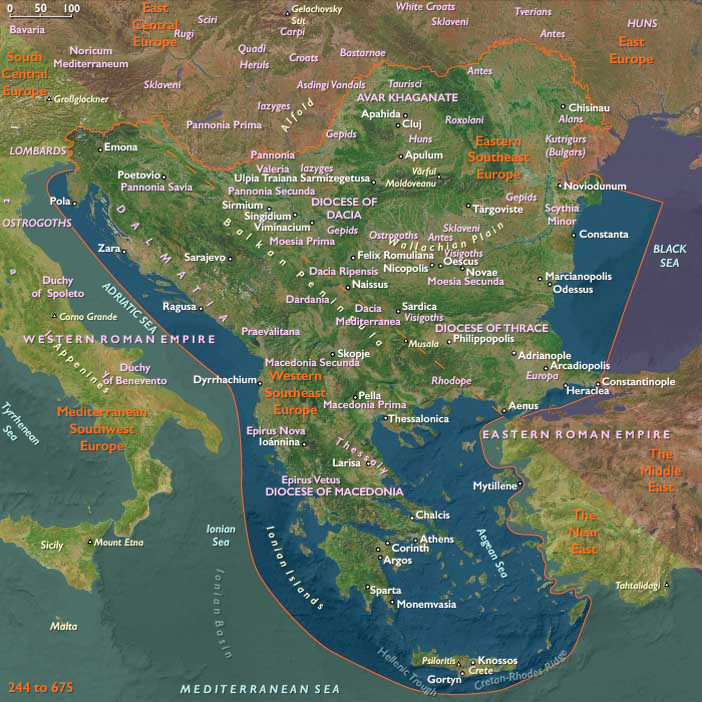
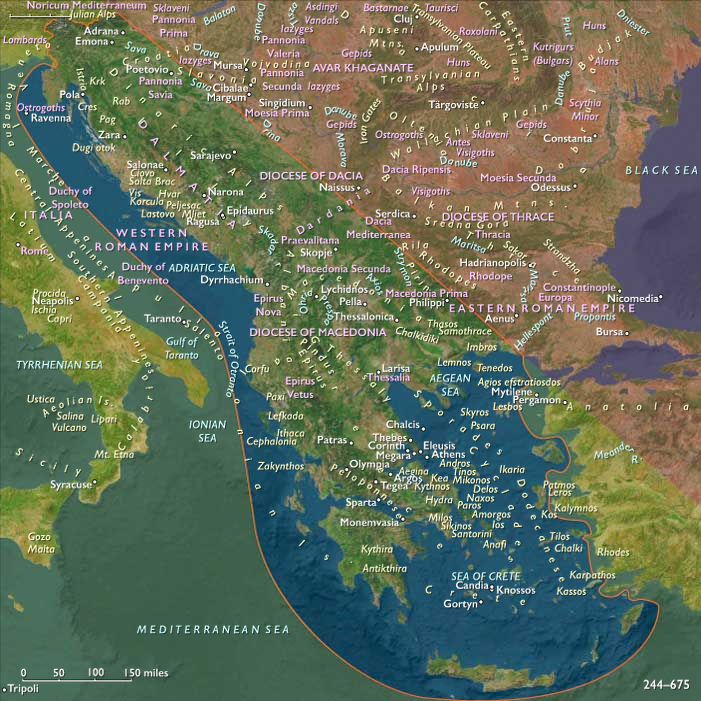
The Vandals invade Epirus (modern Albania).
Expelled from the Peloponnese (Greece), the Vandals, in retaliation, take five hundred hostages at Zakynthos: they are slaughtered on the way back to Carthage.
Locations
Groups
- Greeks, Hellenistic
- Roman Empire, Western (Ravenna)
- Vandals and the Alans, Kingdom of the
- Roman Empire, Eastern: Leonid dynasty
- Albanians
Topics
Commodoties
Subjects
Regions
Subregions
Related Events
Filter results
Showing 10 events out of 58580 total
The Roman Emperor Leo I supports an anti-Goth coalition of German tribes, despite the advice of his General Aspar.
The two sides meet in 469 near the river Ipeľ in present day Slovakia and Hungary in an engagement called in the Battle of Bolia.
Theodomir leads his Goths in a decisive victory over the combined forces of Heruli, Rugii, Scirii, and Suebi.
A group of Suebi had settled in parts of Pannonia after the Huns were defeated in 454 in the Battle of Nedao.
The Suebian king Hunimund fights against the Ostrogoths at Bolia.
After the Suebian coalition loses the battle, parts of the Suebi therefore migrate to southern Germany.
Basiliscus, who had returned to Constantinople after the disastrous expedition against the Vandals, had been forced to seek sanctuary in the church of Hagia Sophia to escape the wrath of the people.
Leo I had given him imperial pardon, but had banished him for three years to Heraclea Sintica (Thrace).
Zeno, as member of the protectores domestici, had not taken part in the expedition.
In 469, during which he holds the honor of the consulate, he is appointed magister militum per Thracias and leads an expedition in Thrace.
The sources do not clearly state what enemy he fought there, and historians had proposed either Goths or Huns, or the rebels of Anagastes.
Either way, before leaving, Leo and Zeno had asked for Daniel the Stylite's opinion about the campaign, and Daniel had answered that Zeno would have been the target of a conspiracy but would have escaped unharmed.
What happened was that Leo had sent some of his personal soldiers with Zeno to protect him, but they had been bribed by Aspar to actually capture him.
Zeno had been informed of their intention and fled to Serdica, and because of this episode, Leo grows even more suspicious of Aspar.
After the attack, Zeno had not returned to Constantinople, where Aspar and Ardabur are and have still considerable power.
Instead, he moves to the "Long Wall" (the Chersonese Long Wall or, less probably, the Anastasian Wall), then to Pylai and from there to Chalcedon.
While waiting here for an opportunity to return in the capital, he is appointed magister militum per Orientem.
He takes the monk Peter the Fuller with him and leaves for Antioch, his office's see, passing through Isauria, where he puts down the rebellion of Indacus.

King Euric declares his kingdom independent from the Western Roman Empire in 469.
Ricimer has been successful throughout his ascendancy in defending Italy against the Vandals and the provinces against the Ostrogoths and the Alani, whereas the popularity of Anthemius has suffered in Italy because as a Greek and a philosopher he is suspected of wanting to restore paganism.
The emperor incurs Ricimer's displeasure upon the total defeat of the vast expedition planned jointly by Anthemius and Leo against Vandal Africa.
Pamplona had undergone much disruption and destruction during the Germanic invasions of 409 and later as a result of Rechiar’s ravaging, starting a cycle of general decline along with other towns across the Basque territory but managing to keep some sort of urban life.
Euric now extends the Visigothic power in Hispania; peacefully conquering the cities of Pamplona, …
…Zaragoza and …
…Mérida.
In 469 CE, the Suebi achieve a major victory by capturing Lisbon, aided by Lusidius, a native Roman who betrays the city to them.
Following this, Lusidius leads a Suebi delegation to the court of Emperor Anthemius, possibly seeking diplomatic recognition or political negotiation.
However, with the Chronicle of Hydatius ending in 468 CE, the later fate of Remismund remains uncertain, leaving a gap in the historical record regarding his rule and the subsequent direction of the Suebic Kingdom.
Childeric I: The "New Constantine" and His Role in Gaul (469 CE)
By 469 CE, Childeric I, king of the Salian Franks, continues to solidify his power in northern Gaul, maneuvering between Roman, Visigothic, and Saxon influences. His growing influence does not go unnoticed by the Pope, who reportedly offers him the title of "the new Constantine"—a comparison to the first Christian Roman emperor—on the condition that he convert to Christianity.
The Pope’s Offer and Its Significance
- The title "New Constantine" is a highly symbolic gesture, implying that Childeric could become a protector of the Christian Church much like Emperor Constantine the Great had been in the early fourth century.
- While Childeric remains pagan throughout his reign, this offer foreshadows the later conversion of his son Clovis I, which will reshape Frankish identity and tie the Franks to Roman Catholic Christianity.
- The Papal outreach demonstrates the growing political importance of the Franks as Rome’s influence continues to decline in Gaul.
Childeric's Campaign Against the Visigoths (469 CE)
At the request of Syagrius, the ruler of the Domain of Soissons, Childeric launches another military campaign against the Visigoths, whose power continues to threaten northern Gaul. This attack:
- Reinforces the Frankish-Roman alliance between Syagrius and Childeric.
- Checks Visigothic expansion in Gaul, though it does not eliminate their influence.
- Further establishes the Franks as the dominant force in northern and central Gaul.
Clearing Anglo-Saxon Pirates from the Loire
Shortly after his campaign against the Visigoths, Childeric turns his attention to the Anglo-Saxon pirates, who have been raiding settlements southwest of Orléans, near Angers. By driving them out, he:
- Restores security to the region, reaffirming Frankish control.
- Demonstrates his ability to protect Gallo-Roman populations, further cementing his authority.
- Strengthens his position as a key defender of northern Gaul against external threats.
The Path to Frankish Dominance
These events mark a crucial stage in the rise of the Franks as the dominant force in Gaul. While Childeric does not convert to Christianity himself, his ties to the Papacy, his military victories, and his alliances with Syagrius and the Gallo-Romans lay the groundwork for:
- The eventual conversion of the Franks under Clovis I.
- The definitive conquest of Gaul, which will lead to the formation of the Frankish Kingdom.
- The merging of Roman, Germanic, and Christian influences, which will shape the future of medieval Europe.
Riothamus and the British-Roman Resistance Against the Visigoths (c. 469 CE)
According to Jordanes, in The Origin and Deeds of the Goths, the British king Riothamus supports the Romans in their struggle against the Visigoths, who are expanding their power in Gaul under King Euric.
Riothamus and His British Army in Gaul
- Riothamus, sometimes considered a "King of the Britons", crosses into Gaul with a British army, likely a force of Brittonic warriors from Armorica (Brittany) or the British Isles.
- His troops are sent to reinforce the Roman war effort, possibly at the request of Syagrius, the ruler of the Domain of Soissons, who is desperately resisting Visigothic expansion.
- The British force is tasked with defending Roman territories in central Gaul, particularly in the district of Berry.
The Visigothic Ambush and Defeat of Riothamus
- As Riothamus and his forces advance, King Euric of the Visigoths intercepts them.
- Facing overwhelming odds, the British force is decisively defeated.
- This Visigothic victory cements their control over Berry, marking a major setback for the Romans and their allies.
The Aftermath and the Decline of Roman Influence in Gaul
The defeat of Riothamus’ forces further weakens Roman authority in Gaul and accelerates the Visigothic conquest of the region. With:
- Syagrius struggling to maintain control of northern Gaul,
- The Franks growing in power,
- And the Western Roman Empire in terminal decline,
the Visigoths emerge as the dominant force in southern and central Gaul, further consolidating their kingdom, which will later evolve into the Visigothic Kingdom of Toulouse.
Riothamus' campaign, though ultimately unsuccessful, reflects the wider struggle between the last remnants of Roman rule and the rising barbarian kingdoms, which will define the transition from Late Antiquity to the early medieval period.
Years: 469 - 469
Locations
Groups
- Greeks, Hellenistic
- Roman Empire, Western (Ravenna)
- Vandals and the Alans, Kingdom of the
- Roman Empire, Eastern: Leonid dynasty
- Albanians