
The Aztec, after much wandering and a …
Years: 1252 - 1395
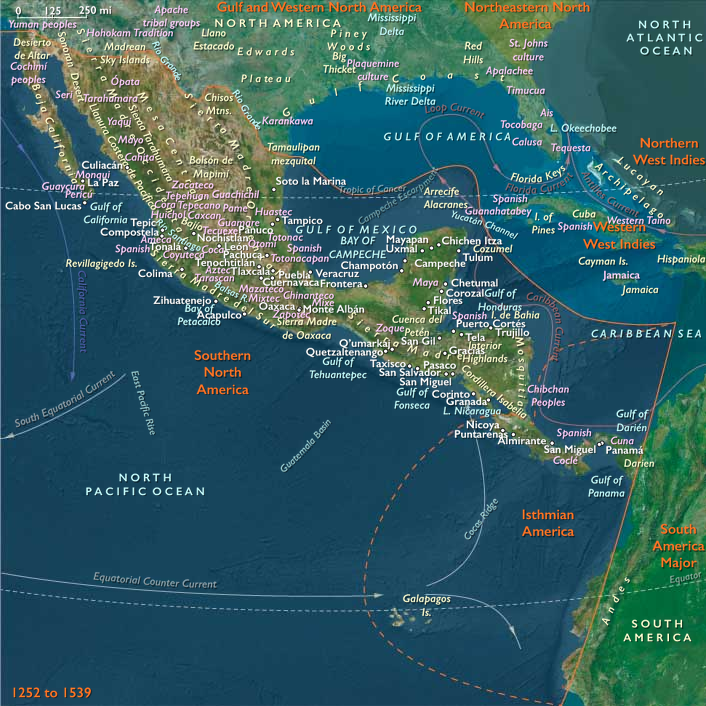
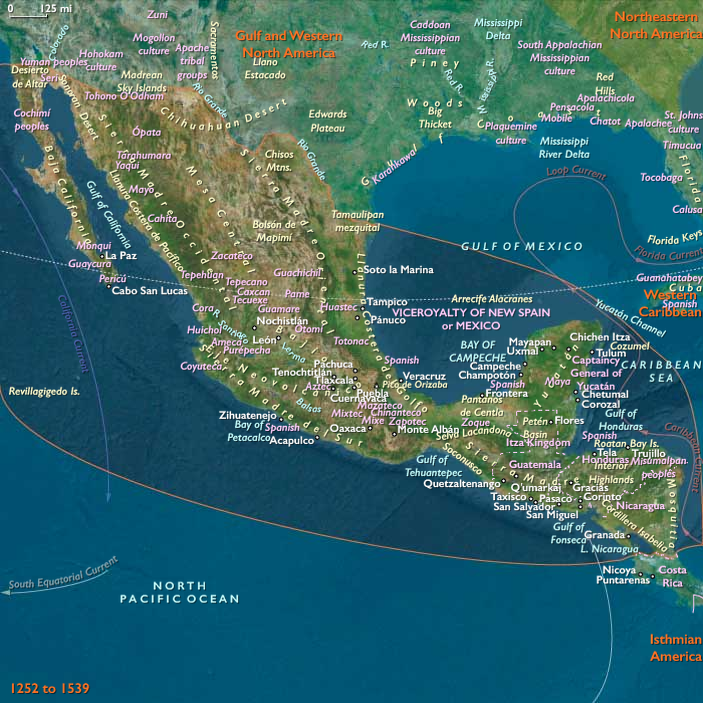
The Aztec, after much wandering and a few wars, in the early 1300s, reach the marshy islands in Lago de Texcoco (site of present-day Mexico City), where they see an eagle perching on a cactus tree and holding a snake in its beak (an image reproduced on the modern Mexican flag).
According to Aztec legend, this is a sign indicating where they should build their new capital city.
Tenochtitlan is eventually built on an island in Lago de Texcoco and gradually becomes an important center in the area.
Drinking water comes from Chapultepec hill on the mainland, and causeways connect the island to the shores of the lake.
The Aztec establish a monarchy in 1376, naming Acamapichtli as their first king.
Locations
Groups
Topics
Subjects
Regions
Subregions
Related Events
Filter results
Showing 10 events out of 78 total
Central Europe (1252–1395 CE): Dynastic Crowns, Mining Economies, and Alpine Confederations
Between the Vistula and the Rhine, from the Carpathian passes to the Alpine lakes, Central Europe in the Lower Late Medieval Age entered a period of consolidation, reform, and urban ascent. The age’s empires and kingdoms—the Luxembourgs of Bohemia, the Angevins and early Jagiellons in Hungary and Poland, and the emergent Habsburgs on the Danube—combined dynastic ambition with pragmatic governance. Mining booms, expanding universities, and the spread of urban leagues drew this vast inland heart of the continent into closer alignment with the Mediterranean and Baltic worlds.
In the east and north, the Kingdom of Bohemia, under the Přemyslid and later Luxembourg dynasties, became an imperial powerhouse. Ottokar II (r. 1253–1278) extended Bohemian rule across Austria and Styria before falling at Marchfeld to Rudolf of Habsburg. A generation later, the Luxembourgs transformed Prague into the political and cultural capital of the Holy Roman Empire. Charles IV (r. 1346–1378), King of Bohemia and Holy Roman Emperor, issued the Golden Bull of 1356, defined the imperial electors, founded Charles University (1348), and raised Prague’s Gothic skyline with the Charles Bridge and St. Vitus Cathedral. Prosperity flowed from Kutná Hora’s silver mines, whose revenues funded coinage, civic works, and imperial patronage.
To the east, Poland, long fragmented among regional dukes, was reunited under Władysław I Łokietek in 1320 and reached maturity under Casimir III “the Great” (r. 1333–1370). His reforms of law and administration, his founding of Kraków University (1364), and his incorporation of Red Ruthenia restored the kingdom’s authority. Following Casimir’s death, the Polish crown passed in personal union to Louis I of Hungary, and after his reign the Union of Krewo (1385) joined Poland and Lithuania under Jogaila (as Władysław II Jagiełło) and Queen Jadwiga, forging the Polish–Lithuanian Commonwealth’s earliest foundations.
Hungary, meanwhile, rose again under the Angevin line. Charles I (1308–1342) and Louis I “the Great” (1342–1382) reasserted royal power after the decline of the Árpáds, exploiting rich mineral wealth in Kremnica, Rudabánya, and Upper Hungary (modern Slovakia). Gold florins struck at the Kremnica mint circulated across Europe. Mining towns under German law flourished in the Carpathian uplands, and new roads over the Transylvanian passes carried salt, livestock, and silver north toward Kraków. After 1387, Sigismund of Luxembourg ascended Hungary’s throne, binding it dynastically to Bohemia and the Empire.
Along the Danube, the Habsburgs consolidated their Austrian heartland after 1278, making Vienna both a market city and an intellectual center—its university founded in 1365. Across Germany’s eastern marches, the Golden Bull enshrined the electors of Mainz, Trier, Cologne, Bohemia, Brandenburg, Saxony, and the Palatinate, stabilizing imperial governance. Brandenburg, passing from Ascanian to Wittelsbach and then to Luxembourg control, began its slow ascent under the margraves of the late fourteenth century. Urban prosperity followed river networks: the Elbe, Oder, and Vistula bound inland markets to the Hanseatic League ports on the Baltic.
Farther south, East Central Europe blended into the Alpine and Danubian core. The Swiss Confederation, born of rural leagues at Uri, Schwyz, and Unterwalden (1291), defended its autonomy against Habsburg encroachment at Morgarten (1315). Over the next century, alliances of towns and valleys—Lucerne, Zürich, Bern, and Glarus—coalesced into the early Eidgenossenschaft. To the east, leagues in Graubünden such as the Grey League (late 14th c.) coordinated defense and toll control across the Alpine passes.
The southern corridors—Gotthard, Splügen, St. Bernard, and Brenner—carried Lombard cloth and spices north and sent Alpine wool, hides, and cheese south. Merchant guilds operated fortified warehouses and toll stations, and fairs in Zurich, Chur, and along the Rhine–Bodensee system linked the Alpine world to Frankfurt and the Hanseatic ports. Despite recurrent feuds, city militias and confederate alliances kept trade open, transforming the once-peripheral uplands into Europe’s vital north–south hinge.
In West Central Europe, the Rhine–Main heartland thrived on commerce and ecclesiastical wealth. The Golden Bull of 1356 confirmed Mainz, Trier, and Cologne as prince-electors, cementing the political geography of the Empire. Frankfurt, midway between the Alps and the North Sea, hosted the imperial fairs where Italian bankers met Flemish clothiers and Hanseatic merchants. The Rhine wine trade prospered even under cooler Little Ice Age conditions; vintners adapted vineyards along the Moselle and Rheingau to changing climates.
Cathedral cities—Cologne, Worms, Speyer, Mainz, and Basel—dominated both devotion and diplomacy. Their Gothic towers embodied civic pride as well as spiritual renewal. The Black Death (1348–1352) devastated towns, sparking flagellant processions and persecution of Jewish communities in the Rhine cities, but urban guilds soon recovered, consolidating political voice. Basel, rebuilt after its 1356 earthquake, became a bridge between the Empire and the Swiss Confederation, both commercially and intellectually.
Technological and institutional innovations strengthened recovery throughout Central Europe. The spread of the three-field system, heavy ploughs, and watermills improved yields; water-powered pumps and adit drainage revolutionized mining. Civic law—Magdeburg and Lübeck codes—standardized administration from Kraków to Vienna. Universities in Prague, Kraków, and Vienna formed a northern constellation of learning where scholasticism, Roman law, and natural philosophy converged.
The region’s resilience rested on its networks. When plague or war closed overland routes, merchants shifted to the Vistula and Danube, or joined Hanseatic convoys at the Baltic. Dynastic marriages and elective compromises balanced fragmentation with unity: Luxembourgs linked Bohemia, Hungary, and the Empire; Habsburgs and Angevins wove Austria and Hungary together; and the Jagiellonian alliance bridged Poland and Lithuania. Through mining wealth, market towns, and learning, Central Europe forged institutions strong enough to withstand crisis and to shape the continent’s next age.
By 1395 CE, Central Europe had matured into a dense fabric of crowns and communes. Prague glittered as the imperial capital of the Luxembourgs; Kraków anchored a Polish–Lithuanian union; Buda and Vienna stood astride the Danube as twin centers of royal power; and the Swiss Confederates guarded their Alpine freedoms against princely overlords. The Rhine and Danube, the Vistula and Elbe, carried not only goods but the ideas and alliances that would soon ignite the Hussite reforms, Jagiellonian ascendancy, and Habsburg expansion—making Central Europe the decisive heart of the continent’s late medieval transformation.
East Central Europe (1252 – 1395 CE): Přemyslid–Luxembourg Bohemia, Angevin Hungary, and the Polish–Lithuanian Union
Geographic and Environmental Context
East Central Europe includes Poland, Czechia (Bohemia and Moravia), Slovakia, Hungary, northeastern Austria, and the greater part of Germany (including Berlin, Munich, Hamburg).
-
Strategic river axes: Vistula–Oder–Elbe, Danube–Morava, and Upper Dnieper–Vistula corridors.
-
Resource belts: silver (Kutná Hora), salt (Wieliczka–Bochnia), gold (Kremnica), dense forests and fertile loess soils.
Climate and Environmental Shifts
-
Late Medieval Warm Period tails into the early Little Ice Age after c. 1300: slightly cooler, more variable precipitation.
-
Harvest volatility increased in marginal zones, but river-valley and loess basins sustained surpluses; plague years (1348–1352) punctuated demographic growth.
Societies and Political Developments
-
Bohemia & Moravia (Přemyslid → Luxembourg):
-
Ottokar II (r. 1253–1278) expanded into Austria–Styria before defeat at Marchfeld (1278).
-
From 1310, the Luxembourgs (John, then Charles IV, r. 1346–1378) made Prague an imperial capital: Golden Bull (1356), Charles University (1348), reforms, and urban patronage; Wenceslaus IV (1378–1419) faced magnate unrest.
-
-
Hungary & Slovakia (Árpád → Angevin → Luxembourg):
-
After the Árpád extinction (1301), Charles I (Angevin) (1308–1342) restored royal power; Louis I “the Great” (1342–1382) expanded influence (including personal union with Poland 1370–1382).
-
Mining–monetary reforms (gold florins, Kremnica mint); after 1387 Sigismund of Luxembourg took the crown. Slovakia (Upper Hungary) was the mining and urban core.
-
-
Poland (fragmentation → reunification → union):
-
Władysław I Łokietek crowned (1320) reunified the kingdom; Casimir III “the Great” (1333–1370) reformed law, founded Kraków University (1364), and took Red Ruthenia (1340s); after 1370, union with Hungary under Louis I.
-
Union of Krewo (1385): Jogaila marries Jadwiga, becomes Władysław II Jagiełło (1386), inaugurating the Polish–Lithuanian polity.
-
-
Northeastern Austria (Habsburgs):
-
After 1278 the Habsburgs consolidated Austria–Styria; Vienna grew as a Danube market and (from 1365) university town.
-
-
Germany (eastern zones: Brandenburg, Saxony, Bavaria):
-
Electoral order fixed by Golden Bull (1356) (King of Bohemia, Margrave of Brandenburg, Duke of Saxony among electors).
-
Brandenburg passed from Ascanian to Wittelsbach to Luxembourg control (1373); Munich anchored Upper Bavaria; Berlin–Cölln rose on Spree–Havel trade.
-
-
Order states on the Baltic rim (context to Poland/Lithuania):
-
The Teutonic Order state in Prussia and Livonia pressed the Vistula–Neman frontier, shaping Polish–Lithuanian strategy (the great reckoning at Grunwald lies just beyond 1395).
-
Economy and Trade
-
Mining & mints:
-
Kutná Hora silver funded Luxembourg grandeur (Prague groschen).
-
Kremnica gold struck florins for Hungary; salt from Wieliczka–Bochnia underpinned Polish revenue.
-
-
Agriculture & towns: three-field rotations spread; German-law towns (Ostsiedlung legacy) structured markets from Silesia to Little Poland and Upper Hungary.
-
Trade corridors:
-
Danube–Morava–Vienna funneled Adriatic and Alpine goods into the plain.
-
Vistula–Baltic carried Polish grain, timber, and salt to Gdańsk, linking into Hanseatic circuits.
-
Elbe–Oder routes tied Bohemia/Silesia to Saxon–Brandenburg markets.
-
-
Hanseatic connections: eastern German and Polish ports traded cloth, beer, wax, and furs; inland towns brokered metals and salt.
Subsistence and Technology
-
Hydraulic & agrarian tools: heavy ploughs on loess, watermills on rivers, drainage and vineyard terraces in Bohemia and along the Danube.
-
Urban craft clusters: Prague metalwork and glass; Kraków cloth and salt; Upper Hungary mining technologies (adits, water-powered pumps).
-
Fortifications & courts: stone kremlins, castles, and walled towns; law codes (Magdeburg/Lübeck law, Casimir’s statutes) standardized justice and commerce.
Movement and Interaction Corridors
-
Danube trunk: Vienna ⇄ Bratislava (Pressburg) ⇄ Esztergom/Buda integrated Habsburg and Hungarian nodes.
-
Vistula spine: Kraków ⇄ Toruń/Gdańsk linked the Polish heartland to the Baltic.
-
Elbe–Oder passes: Bohemia ⇄ Saxony/Brandenburg; Moravian Gate tied the Danube to the Vistula–Oder basins.
-
Carpathian routes: salt, wine, and livestock over Transcarpathian passes into Poland and Hungary.
Belief and Symbolism
-
Latin Christianity: cathedral and monastic expansion (Prague, Kraków, Vienna); mendicant orders in towns; scholastic culture around the new universities.
-
Orthodoxy & Unions: Ruthenian borderlands under Lithuania remained Orthodox; Latin-rite Poland extended bishoprics into Red Ruthenia.
-
Popular piety: pilgrimage, confraternities, and plague-era devotions; Jewish communities vital to urban finance faced periodic persecution during the Black Death years.
-
Crown ideology: imperial Prague under Charles IV; Angevin regalia and chivalric display in Hungary; Jagiellonian union rhetoric in Poland–Lithuania.
Adaptation and Resilience
-
Institutional depth: estates and diets (Bohemian land diets, Polish sejmik beginnings, Hungarian diets) mediated taxation and war.
-
Demographic shocks: Black Death mortality (from 1348) hit towns hardest; frontier colonization and mining towns helped recovery.
-
Route redundancy: Danube, Vistula, and Baltic carried trade when war blocked overland links; Hanseatic convoys stabilized supply.
-
Dynastic flexibility: Luxembourg, Habsburg, Angevin, and Jagiellonian strategies (marriage, enfeoffment, union) minimized fragmentation costs.
Long-Term Significance
By 1395, East Central Europe had become a constellation of powerful crowns and rising unions:
-
Prague led an imperial–university renaissance;
-
Hungary monetized mining and projected power into the Balkans;
-
Poland–Lithuania formed a durable union that would reshape the northeast;
-
Habsburg Austria entrenched along the Danube.
Shared corridors of metals, salt, grain, and ideas forged an integrated region poised for 15th-century conflicts and cultural efflorescence—from Hussite revolutions to Jagiellonian and Habsburg ascendancy.
Much Polish land lies under foreign occupation as the fourteenth century opens (two-thirds of it is ruled by Bohemia in 1300).
The continued existence of a united, independent Poland seems unlikely.
In the fourteenth century, after a long period of instability and growing menace from without, the Polish state experiences a half century of recovery under the last monarchs of the house of Piast.
By 1320 Wladyslaw Lokietek (r. 1314-33), called the Short, has manipulated internal and foreign alignments and reunited enough territory to win acceptance abroad as king of an independent Poland.
His son Kazimierz III (r. 1333-70) will become the only Polish king to gain the sobriquet "great."
In foreign policy, Kazimierz the Great strengthens his country's position by combining judicious concessions to Bohemia and the Teutonic Knights with eastward expansion.
While using diplomacy to win Poland a respite from external threat, the king focuses on domestic consolidation.
He earn his singular reputation through his acumen as a builder and administrator as well as through foreign relations.
Two of the most important events of Kazimierz's rule are the founding of Poland's first university in Kraków in 1364, making that city an important European cultural center, and his mediation between the kings of Bohemia and Hungary at the Congress of Kraków (also in 1364), signaling Poland's return to the status of a European power.
Lacking a male heir, Kazimierz is the last ruler in the Piast line.
The extinction of the dynasty in 1370 leads to several years of renewed political uncertainty.
Nevertheless, the accomplishments of the fourteenth century begin the ascent of the Polish state toward its historical zenith.
The Ottonian German kings and emperors had during the twelfth century reestablished control over the mixed Slav-inhabited lands of present-day Brandenburg.
Some Slavs, like the Sorbs in Lusatia, have adapted to Germanization while retaining their distinctiveness.
The Roman Catholic Church had brought bishoprics which, with their walled towns, afforded protection from attacks for the townspeople.
The town of Brandenburg an der Havel, the first center of the state of Brandenburg, begins its history with the monks and bishops.
The German magnate Albert the Bear had been granted the Northern March by the Emperor Lothar III in 1134 in the wake of a German crusade against the Wends.
Albert had formally inherited the town of Brandenburg and the lands of the Hevelli from their last Wendish ruler, Pribislav, in 1150.
After crushing a force of Sprevane, a Slavic tribe who had occupied the town of Brandenburg in the 1150s, Albert had proclaimed himself ruler of the new Margraviate of Brandenburg.
Albert, and his descendants the Ascanians, had then made considerable progress in conquering, colonizing, Christianizing, and cultivating lands as far east as the Oder.
Slavic and German residents within this region have intermarried.
The Ascanians, aspiring to the extension of their dominion east of the Oder, had by 1242 gained a foothold east of the river in the territory which, after the middle of the fifteenth century, is to become known as the Neumar.
Settlement in the vicinity of Lubusz, or Lebus, has been traced as far back as three thousand years.
The ridges, which provide natural defense, led to fortifications being constructed upon them.
The Germanic Lombards and Semnoni are believed to have lived in the area before the Common Era.
After a settlement gap of approximately one thousand years, the Slavic Leubuzzi tribe settled the area during the eighth and ninth centuries in the Migration Period, and the land on both sides of the Oder became known as Terra Lebusana, or "Land of the Leubuzzi" in Latin.
A swampy area east of Brandenburg, west of Greater Poland, south of Pomerania and north of Silesia, Lubusz Land had in 966 been made a part of Poland at the time of Prince Mieszko I, the county’s founder; it had soon been elevated to a bishopric.
In 1124-1125, records note the new Bishop of Lubusz nominated by Boleslaus III Wrymouth under the Archbishopric of Gniezno to counter the power of Emperor Henry V and Magdeburg.
It has served as an important center for Catholic missionaries preaching in and developing the Oder region.
The Archbishopric of Magdeburg, however, has also tried to obtain control of Lebus.
In 1252, the Archbishopric of Magdeburg and Ascanian Margraviate of Brandenburg purchases the bishopric from the petty Polish Prince Bolesław II the Bald.
This marks the start of Brandenburg's expansion into previously Polish areas.
Lubusz Land will eventually be incorporated into Brandenburg—the new Neumark, with its administrative center in Küstrin, will be created on the border between Pomerania and Great Poland and expanded further to the East on the forest areas between Pomerania and Great Poland.
Germanization of the region is to proceed throughout the thirteenth century and and Lubusz will become predominantly known as Lebus.
The Ascanian dynasty of Brandenburg founds Frankfurt an der Oder In 1253 as a river crossing and staging point for further expansion eastward.
Poland of the thirteenth century is no longer one solid political entity, the sovereignty of the former state having become diffused among a number of smaller independent political units, with only the common bonds of language, race, religion and tradition.
At the death of Ladislaus Odonic Plwacz, duke of Greater Poland, Przemysl, his son by Jadwiga of Pomerania, daughter of Mściwój I, duke of Eastern Pomerania, had inherited the part of Greater Poland controlled by Ladislaus and become duke of Ujście; subsequently he strove to recover the remaining part of Greater Poland.
In 1241, after the death of Henry II the Pious, duke of Silesia at the battle of Legnica, Przemysl and his brother Boleslaus had acquired the duchies of Poznań and Gniezno, and subsequently managed to conquer also the parts of Greater Poland once controlled by Silesia.
In 1244 he had married Elizabeth, Henry’s daughter.
In exchange, he obtained by Wladylaw, duke of Opole, the reincorporation of Kalisz into Greater Poland.
Przemysl had become duke of Poznań and Kalisz in 1247, but had been forced by the local nobility to leave Kalisz to Boleslaus.
He had also obtained Santok (Zantoch) by Boleslaw II the Bald and allied with Bogufal II, bishop of Poznań.
In 1249, he had again exchanged territories with his brother, giving him Gniezno and becoming duke of Poznań and Kalisz.
For unknown reasons, Przemys had had Boleslaus arrested in 1250, becoming in this way the sole ruler of Greater Poland (Poznań, Gniezno et Kalisz) until in 1253, when Boleslaus is freed and given Kalisz and Gniezno.
Przemysl, together with many Polish bishops and princes, participates on May 8, 1254, at Kraków, in the canonization of Stanislaus of Szczepanów, a Bishop of Kraków known chiefly for having been martyred by Polish King Boleslaw II the Bold in 1079.
The first native Polish saint, Stanislaus is venerated in the Roman Catholic Church as Saint Stanislaus the Martyr (as distinct from Saint Stanislaus Kostka).
Low German-speaking colonists from the Holy Roman Empire had begun in the 1230s to settle north and south of the Warta and Noteć Rivers upon the initiative of Pomeranian and Polish lords.
The lords have invited members of the Knights Templar and Knights Hospitaller to establish monasteries, in whose surroundings settlements have begun to develop.
To fortify the borderland Pomeranian and Polish dukes built castles in the north, around which settlements have also grown.
Most of the colonists who settle in Brandenburg's new eastern territory come from Magdeburg or the Altmark ("Old March").
Unlike in the rest of Brandenburg, where the Ascanians have settled knights in open villages, the margraves have begun constructing castles in their land east of the Oder to guard against Poland.
The Slavic inhabitants of the region are becoming gradually Germanized.
Through land purchases, marriage pacts, and services to Poland's Piast dynasty, the Ascanians have extended their territory eastward to the Drawa River and northward to the Parsęta River.
To safeguard the region, Margrave John I founds the town of Landsberg an der Warthe in 1257.
Boleslaw V, son of the assassinated Leszek the White, Prince of Sandomierz, succeeds his brother Przemyzl in 1257 to become prince in Kraków, and thus the predominant prince in fragmented Poland, though the authority of the Duke of Kraków is not adequately defined by law and is ignored in actual practice.
Bolesaw had earlier married Cunegunda (Kinga), daughter of King Béla IV of Hungary. (According to medieval chronicles, the marriage, entered into with reluctance on the bride’s part, was never consummated. Kinga, being extremely pious, was averse to fulfilling her marital duties. At first Boleslaw tried to change her mind, but she demurred and he reluctantly accepted the situation. His religious convictions forbade him to take a mistress. Hence the epithet, "the Chaste" or "the Shy. Kinga’s reign as queen is marked by such charitable works as visiting the poor and helping the lepers.)
Kraków, almost entirely destroyed during the Tatar invasions of 1241, has been rebuilt by Boleslaw on a regular grid pattern and is incorporated in 1257, based on the Magdeburg law, with tax benefits and trade privileges for its citizens, who are mainly German immigrants.
Concurrent with the metamorphosis in the structure of the Polish state and sovereignty had been an economic and social impoverishment of the country.
Harassed by civil strife and foreign invasions, like that of the Mongols in 1241, the small principalities had become enfeebled and depopulated.
The attendant decrease in the incomes of the princes led them to encourage immigration from foreign countries.
A great number of German peasants, who, during the interregnum following the death of Frederick II, had suffered great oppression at the hands of their lords, are induced to settle in Poland under highly favorable conditions.
Thus, alongside the Polish "grody" have come into existence a large number of towns, with German laws, customs and institutions.
The ancient towns of Kraków, Lwów, Poznań, Plock and others having received a large influx of Germans, the resettled cities come to be regarded by the metropolitan towns in Germany as their branches and as outposts of German trade and civilization in Poland.
The common law of the country is supplanted by the Magdeburg and Halle law, German silver coins become the money of the country, and all municipal records begin to be kept in the German language.
But for the Mongol invasion, Polish towns would have developed without foreign interference and the cities' populations would have remained mainly Polish.
Years: 1252 - 1395
Locations
Groups
Topics
Subjects
Regions
Subregions