The Decline of Stained-Glass Art After 1330 …
Years: 1324 - 1335
The Decline of Stained-Glass Art After 1330
The use of stained-glass windows, a defining element of Gothic art and architecture since c. 1130, began to fade after 1330. One probable factor in this decline was the exhaustion of the primary known source of cobalt oxide, the mineral responsible for the deep Chartres blue and for the purple hues obtained by mixing cobalt with manganese. With this key material no longer available, the stained-glass artist’s palette was significantly reduced.
After this period, glassmakers were largely limited to:
- Red (from oxidized copper),
- Green (from copper bioxide), and
- Yellow (from a combination of manganese and ferrous oxide).
While stained glass continued to be produced, the loss of Chartres blue altered both the aesthetic and compositional possibilities of the medium. Additionally, changing artistic preferences and the economic strains of the 14th century—particularly in the wake of the Great Famine (1315–1317) and the Black Death (1347–1351)—further contributed to the decline of large-scale stained-glass commissions.
Though stained glass never fully disappeared, it would not regain its former prestige until the Gothic Revival of the 19th century, when interest in medieval craftsmanship and color symbolism was rekindled.
Groups
Topics
Commodoties
Subjects
Regions
Subregions
Related Events
Filter results
Showing 3 events out of 3 total
Atlantic Southwest Europe (1324–1335 CE): Portuguese Transition and Stability, Castilian Centralization under Alfonso XI, and Navarrese Diplomatic Resilience
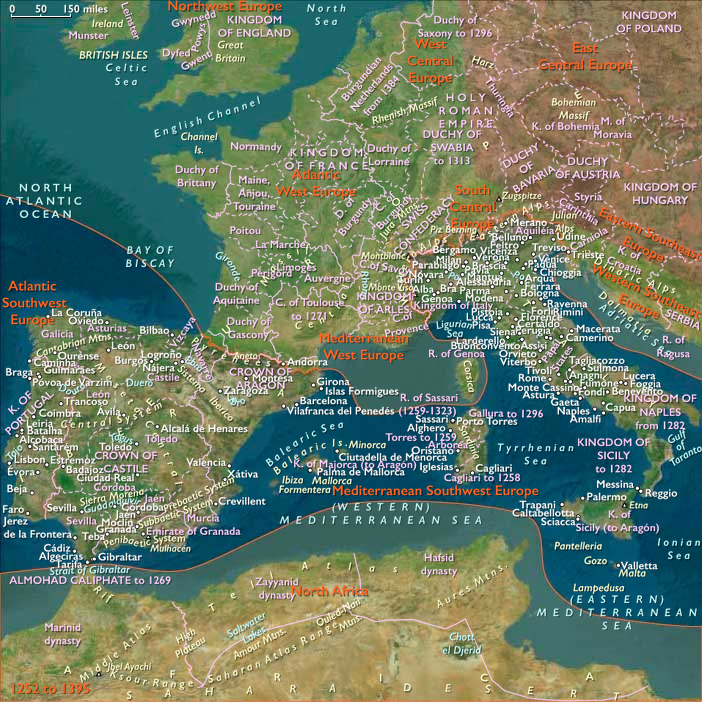
Between 1324 and 1335 CE, Atlantic Southwest Europe—including Galicia, northern and central Portugal, Asturias, Cantabria, and northern Spain south of the Franco-Spanish border (43.05548° N, 1.22924° W)—underwent significant political transitions, economic continuity, and cultural vitality. Portugal saw a smooth transition from the long and prosperous reign of King Dinis (1279–1325 CE) to his successor, King Afonso IV (1325–1357 CE), who decisively continued stable governance and territorial security. Castile, under the now mature and effective King Alfonso XI (1312–1350 CE), achieved renewed political centralization, internal stability, and frontier consolidation after years of aristocratic rivalry. Navarre, under Charles I (1322–1328 CE) and subsequently Joan II (1328–1349 CE), maintained diplomatic neutrality, regional autonomy, and stable governance amid shifting Iberian alliances.
Political and Military Developments
Portuguese Governance Transition and Territorial Stability
Portugal experienced a stable transition following the death of King Dinis in 1325, with his son Afonso IV decisively continuing strong royal governance, territorial administration, and frontier security. Afonso IV solidified his father’s legacy by implementing further legal and administrative reforms, ensuring territorial coherence and Portuguese national stability during his early reign.
Castilian Political Consolidation under Alfonso XI
Castile significantly restored internal governance coherence and centralized royal authority under the mature reign of King Alfonso XI. Alfonso decisively resolved aristocratic tensions and regional conflicts, reinforcing frontier defenses against southern threats. His effective leadership stabilized internal governance, enhanced territorial integrity, and clarified Castilian regional identity, laying durable foundations for Iberian political stability.
Navarre’s Diplomatic Continuity and Governance Resilience
Navarre underwent smooth dynastic transition from Charles I to Joan II in 1328, decisively maintaining diplomatic neutrality, regional autonomy, and stable internal governance. Joan II skillfully navigated diplomatic relationships with Castile, Aragón, and southern Iberian powers, preserving territorial integrity, internal coherence, and northern Iberian geopolitical stability.
Economic Developments
Continued Agricultural Prosperity and Territorial Development
Regional agriculture remained robust, decisively supported by sustained land reclamation projects, agricultural settlements, and irrigation improvements established in previous decades. Diverse cultivation practices (grains, olives, vineyards, citrus, almonds), livestock husbandry, artisanal crafts, and significant mining operations (gold and silver, notably in Galicia and Asturias) reinforced regional economic resilience and demographic stability.
Maritime Commerce and Expanded Trade Networks
Portuguese coastal ports, particularly Lisbon, Porto, Braga, and Coimbra, continued robust maritime commerce, significantly enhancing commercial connections with northern Europe (England, Flanders, Normandy, Brittany). Galicia, notably through A Coruña, maintained active maritime trade, reinforcing regional economic autonomy and prosperity.
Pilgrimage-Driven Economic Continuity
Pilgrimage to Santiago de Compostela continued supporting regional economic vitality, significantly sustaining hospitality industries, artisanal commerce, infrastructure development, and cultural exchanges. Continued pilgrimage significantly reinforced Galicia’s economic resilience, cultural prominence, and regional identity.
Cultural and Religious Developments
Portuguese Cultural Continuity and Intellectual Patronage
Under Afonso IV, Portuguese cultural vitality continued flourishing, decisively supported by continued patronage of education, literature, and scholarly traditions. Intellectual and cultural institutions established by King Dinis remained vibrant, significantly shaping Portuguese linguistic standardization, cultural identity, and intellectual heritage, profoundly influencing Portugal’s medieval historical legacy.
Galician Cultural Resilience and Ecclesiastical Patronage
Galicia maintained vibrant cultural continuity, decisively supported by Santiago de Compostela’s international pilgrimage prominence. Ecclesiastical patronage significantly supported scholarly initiatives, architectural projects, manuscript preservation, and educational institutions, profoundly shaping Galician cultural identity and international recognition.
Monastic Intellectual Contributions and Ecclesiastical Influence
Monastic communities sustained vibrant scholarly traditions, manuscript preservation, agricultural innovations, and educational reforms. Ecclesiastical authorities decisively influenced Iberian religious identity, liturgical uniformity, ecclesiastical discipline, and regional cultural coherence.
Persistent Cultural Syncretism and Local Traditions
Orthodox Christianity continued integrating indigenous Iberian and Celtic traditions, notably in rural Galicia and northern Portugal. Persistent cultural syncretism significantly reinforced distinctive regional identities, social cohesion, and cultural resilience amid broader political transformations.
Civic Identity and Governance
Portuguese Territorial Governance and Civic Stability
Under Afonso IV, Portugal decisively maintained territorial governance stability, administrative coherence, and civic identity. His effective governance significantly solidified Portuguese national identity, territorial integrity, and internal stability, establishing enduring foundations for Portugal’s medieval prosperity and historical trajectory.
Castilian Political Centralization and Regional Identity
Under Alfonso XI, Castile decisively restored internal governance coherence, centralized royal authority, and regional identity clarity following prolonged instability. His effective leadership significantly reinforced Castilian territorial governance, civic coherence, and Iberian geopolitical stability, laying critical foundations for future governance developments.
Navarrese Regional Autonomy and Diplomatic Stability
Navarre carefully preserved regional autonomy, diplomatic neutrality, and stable governance through dynastic transitions under Charles I and Joan II. Navarre’s effective diplomacy significantly preserved territorial integrity, internal governance stability, and northern Iberian geopolitical coherence.
Notable Regional Groups and Settlements
-
Portuguese: Experienced stable governance transition, territorial stability, and cultural vitality under Afonso IV, significantly shaping Portuguese national identity and enduring medieval trajectory.
-
Castilians: Achieved decisive internal governance centralization, territorial integrity, and clearly defined regional identity under Alfonso XI, significantly influencing Iberian geopolitical stability and regional coherence.
-
Galicians: Sustained vibrant cultural prominence and economic resilience, significantly reinforced by pilgrimage traditions, maritime trade, and ecclesiastical patronage.
-
Basques (Navarre): Maintained regional autonomy, diplomatic neutrality, and stable governance through careful dynastic transitions, significantly shaping northern Iberian geopolitical coherence.
Long-Term Significance and Legacy
Between 1324 and 1335 CE, Atlantic Southwest Europe:
-
Achieved continued Portuguese administrative stability, territorial governance, and cultural continuity under Afonso IV, significantly shaping Portugal’s medieval identity and historical trajectory.
-
Experienced decisive Castilian political centralization, internal governance stability, and regional identity coherence under Alfonso XI, decisively influencing Iberian geopolitical stability.
-
Preserved Navarre’s regional autonomy, diplomatic neutrality, and governance resilience through careful dynastic transitions under Charles I and Joan II, significantly shaping northern Iberian political dynamics.
-
Sustained robust economic prosperity, pilgrimage-driven cultural prominence, maritime commerce, and resilient local governance, decisively influencing Atlantic Southwest Europe’s enduring medieval historical legacy.
This pivotal era decisively influenced regional identities, territorial governance stability, diplomatic alignments, and cultural resilience, profoundly shaping Atlantic Southwest Europe’s medieval historical trajectory.

Atlantic Southwest Europe (1336–1347 CE): Portuguese Political Stability, Castilian Consolidation and Military Strength, and Navarrese Diplomatic Prudence
Between 1336 and 1347 CE, Atlantic Southwest Europe—including Galicia, northern and central Portugal, Asturias, Cantabria, and northern Spain south of the Franco-Spanish border (43.05548° N, 1.22924° W)—experienced continued political stability, cultural resilience, and dynamic economic developments. Portugal, under King Afonso IV (1325–1357 CE), maintained strong governance, stable administration, and territorial security. Castile, under the decisive reign of King Alfonso XI (1312–1350 CE), consolidated royal authority, achieving significant military victories and reinforcing internal coherence. Navarre, governed by Joan II (1328–1349 CE), skillfully preserved diplomatic neutrality, regional autonomy, and governance stability amidst complex Iberian alliances.
Political and Military Developments
Portuguese Governance and Territorial Stability under Afonso IV
Under King Afonso IV, Portugal continued robust administrative centralization, frontier security, and territorial coherence. Afonso IV’s effective governance, marked by legislative and territorial reforms, maintained internal stability, civic identity, and national cohesion. His leadership decisively supported Portuguese regional autonomy and governance continuity throughout the era.
Castilian Military and Political Consolidation under Alfonso XI
Castile decisively reinforced internal governance stability and military strength under King Alfonso XI, significantly strengthening royal authority and frontier defenses. His pivotal victory at the Battle of Río Salado (1340 CE)decisively halted Moorish incursions from Granada and North Africa, dramatically stabilizing Castilian territorial security and bolstering regional confidence. Alfonso XI’s effective military and administrative strategies firmly consolidated Castilian territorial integrity and governance stability.
Navarre’s Diplomatic Stability under Joan II
Navarre, under Joan II, carefully maintained regional autonomy, diplomatic neutrality, and internal governance coherence. Skillful diplomacy with neighboring Castile, Aragón, and France decisively preserved Navarrese territorial integrity, governance stability, and northern Iberian geopolitical resilience.
Economic Developments
Sustained Agricultural Productivity and Territorial Development
The region sustained robust agricultural productivity, decisively supported by improved irrigation, land reclamation, and expanded rural settlements. Diverse crop cultivation (grains, olives, vineyards, citrus fruits, almonds), livestock husbandry, artisanal crafts, and significant mining operations (gold and silver, notably from Galicia and Asturias) reinforced regional economic resilience and demographic stability.
Maritime Commerce and Expansion of Trade Networks
Portuguese coastal ports, particularly Lisbon, Porto, Braga, and Coimbra, continued robust maritime commerce, significantly enhancing commercial connections with northern Europe (England, Flanders, Normandy, Brittany). Galicia, notably through A Coruña, maintained active maritime trade, reinforcing regional economic autonomy and prosperity.
Pilgrimage-Driven Economic Continuity
Pilgrimage to Santiago de Compostela continued to bolster regional economic vitality, significantly supporting hospitality industries, artisanal commerce, infrastructure investments, and cultural exchanges. Continued pilgrimage significantly reinforced Galicia’s economic resilience, cultural prominence, and regional identity.
Cultural and Religious Developments
Portuguese Cultural Continuity and Intellectual Vitality
Portugal maintained vibrant cultural vitality under Afonso IV, significantly supported by continued patronage of education, literature, and scholarly traditions. Cultural and intellectual institutions established earlier under King Dinis remained influential, significantly shaping Portuguese linguistic standardization, cultural identity, and intellectual heritage.
Galician Cultural Resilience and Ecclesiastical Patronage
Galicia maintained dynamic cultural continuity, decisively supported by Santiago de Compostela’s international pilgrimage prominence. Ecclesiastical patronage significantly supported scholarly initiatives, architectural projects, manuscript preservation, and educational institutions, profoundly shaping Galician cultural identity and international recognition.
Monastic Intellectual Contributions and Ecclesiastical Influence
Monastic communities sustained vibrant scholarly traditions, manuscript preservation, agricultural innovations, and educational reforms. Ecclesiastical authorities decisively influenced Iberian religious identity, liturgical uniformity, ecclesiastical discipline, and regional cultural coherence.
Persistent Cultural Syncretism and Local Traditions
Orthodox Christianity continued integrating indigenous Iberian and Celtic traditions, notably in rural Galicia and northern Portugal. Persistent cultural syncretism significantly reinforced distinctive regional identities, social cohesion, and cultural resilience amid broader political transformations.
Civic Identity and Governance
Portuguese Governance Stability and Civic Cohesion
Under Afonso IV, Portugal decisively maintained territorial governance stability, administrative coherence, and civic identity. His effective governance significantly solidified Portuguese national identity, territorial integrity, and internal stability, establishing enduring foundations for Portugal’s medieval prosperity and historical trajectory.
Castilian Military Strength and Governance Consolidation
Under Alfonso XI, Castile decisively reinforced military strength, governance stability, and territorial integrity through strategic victories and effective administration. His reign significantly reinforced Castilian territorial governance, civic coherence, and Iberian geopolitical stability, laying critical foundations for future governance developments.
Navarrese Regional Autonomy and Diplomatic Stability
Navarre carefully preserved regional autonomy, diplomatic neutrality, and stable governance under Joan II. Navarre’s effective diplomacy significantly preserved territorial integrity, internal governance stability, and northern Iberian geopolitical coherence.
Notable Regional Groups and Settlements
-
Portuguese: Experienced decisive governance stability, territorial security, and cultural vitality under Afonso IV, significantly shaping Portuguese national identity and enduring medieval trajectory.
-
Castilians: Achieved significant military strength, governance stability, and regional coherence under Alfonso XI, decisively influencing Iberian geopolitical stability.
-
Galicians: Maintained vibrant cultural prominence and economic resilience, significantly reinforced by pilgrimage traditions, maritime trade, and ecclesiastical patronage.
-
Basques (Navarre): Maintained regional autonomy, diplomatic neutrality, and stable governance under Joan II, significantly shaping northern Iberian geopolitical coherence.
Long-Term Significance and Legacy
Between 1336 and 1347 CE, Atlantic Southwest Europe:
-
Achieved continued Portuguese governance stability, territorial coherence, and cultural continuity under Afonso IV, significantly shaping Portugal’s medieval identity and historical trajectory.
-
Experienced Castilian military consolidation, governance stability, and territorial integrity under Alfonso XI, decisively influencing Iberian geopolitical stability.
-
Maintained Navarre’s regional autonomy, diplomatic neutrality, and governance resilience under Joan II, significantly shaping northern Iberian political dynamics.
-
Sustained robust economic prosperity, pilgrimage-driven cultural prominence, maritime commerce, and resilient local governance, decisively influencing Atlantic Southwest Europe’s enduring medieval historical legacy.
This pivotal era decisively influenced regional identities, territorial governance stability, diplomatic alignments, and cultural resilience, profoundly shaping Atlantic Southwest Europe’s medieval historical trajectory.
Atlantic Southwest Europe (1348–1359 CE): The Black Death, Castilian Governance Challenges, Portuguese Stability, and Navarrese Diplomatic Prudence
Between 1348 and 1359 CE, Atlantic Southwest Europe—including Galicia, northern and central Portugal, Asturias, Cantabria, and northern Spain south of the Franco-Spanish border (43.05548° N, 1.22924° W)—faced unprecedented challenges from the devastating impact of the Black Death, alongside complex political transitions. The region witnessed severe demographic decline, economic disruptions, and social changes. Portugal under King Afonso IV (1325–1357 CE) and subsequently his successor King Pedro I (1357–1367 CE) managed to maintain relative stability. Castile, following the death of King Alfonso XI (1350 CE) from plague, endured political turmoil during the minority of King Pedro I "the Cruel" (1350–1369 CE). Navarre, under Queen Joan II (1328–1349 CE) and her son Charles II "the Bad" (1349–1387 CE), carefully preserved diplomatic neutrality and regional autonomy despite internal and external pressures.
Political and Military Developments
Portuguese Political Stability under Afonso IV and Pedro I
Portugal managed effective governance through the catastrophic impact of the Black Death. Under the late reign of Afonso IV and the early years of his son Pedro I, Portugal maintained political coherence, territorial integrity, and stable administration despite significant demographic challenges and economic disruptions. Both kings emphasized judicial reforms and governance continuity, decisively preserving Portuguese national stability through the crisis.
Castilian Turmoil Following Alfonso XI’s Death
The sudden death of King Alfonso XI from plague in 1350 triggered severe political instability during the early reign of his son Pedro I. Castile endured internal aristocratic rivalries, weakened governance, and social unrest, intensified by the plague’s devastating effects. Despite these challenges, frontier defenses remained intact, and regional governance structures eventually adapted, preserving long-term Castilian stability and identity.
Navarre’s Diplomatic Stability amid Succession Challenges
Navarre skillfully navigated the transition following the death of Queen Joan II in 1349, with her son Charles II "the Bad" decisively maintaining diplomatic neutrality and regional autonomy. Charles II pursued careful diplomatic strategies, balancing complicated relationships with Castile, Aragón, and France, significantly preserving Navarre’s territorial integrity and internal stability through a difficult era.
Economic Developments
Devastating Impact of the Black Death
The Black Death (1348–1351 CE) profoundly disrupted the region, causing severe demographic losses, agricultural labor shortages, and economic disruption. Agricultural productivity sharply declined, temporarily weakening local economies, trade networks, and artisanal industries. However, gradual recovery occurred, reshaping labor dynamics, agrarian structures, and economic practices.
Slow Recovery of Maritime Commerce and Trade Networks
Despite initial disruptions from the plague, Portuguese ports (Lisbon, Porto, Braga, Coimbra) and Galician trade centers like A Coruña gradually resumed maritime commerce. Commercial exchanges with northern Europe (England, Flanders, Normandy, Brittany) slowly recovered, reinforcing regional economic resilience and providing foundations for subsequent revival.
Pilgrimage and Economic Adaptation
Pilgrimage to Santiago de Compostela significantly declined during the immediate aftermath of the plague but eventually recovered, decisively contributing to regional economic restoration. The pilgrimage industry adapted to changing conditions, reinforcing Galicia’s economic resilience and cultural identity despite demographic setbacks.
Cultural and Religious Developments
Portuguese Cultural Resilience and Continuity
Portugal sustained cultural continuity and intellectual traditions despite severe demographic challenges. Monastic communities, educational institutions, and royal patronage remained vibrant, preserving Portuguese linguistic standardization, cultural identity, and scholarly traditions throughout the difficult period.
Galician Cultural Resilience and Ecclesiastical Patronage
Galicia maintained cultural vitality despite demographic disruption from the plague. Ecclesiastical institutions, particularly at Santiago de Compostela, continued supporting scholarly endeavors, manuscript preservation, architectural projects, and educational initiatives, significantly reinforcing Galician cultural identity.
Ecclesiastical and Monastic Influence Amid Crisis
Monastic communities decisively contributed to regional recovery efforts through scholarly activity, manuscript preservation, agricultural innovations, and educational reforms. Ecclesiastical authorities decisively influenced Iberian religious identity, social cohesion, and cultural resilience amid the demographic crisis.
Persistent Cultural Syncretism and Local Traditions
Orthodox Christianity continued integrating indigenous Iberian and Celtic traditions, particularly in rural Galicia and northern Portugal. Persistent cultural syncretism reinforced regional identities and social cohesion, providing resilience amid demographic upheaval.
Civic Identity and Governance
Portuguese Governance Stability Amid Crisis
Portugal, under Afonso IV and Pedro I, decisively preserved governance stability, territorial coherence, and civic identity despite severe demographic and economic disruptions caused by the plague. Effective administration and governance continuity significantly solidified Portuguese national identity and internal stability during a challenging era.
Castilian Governance Challenges and Regional Adaptation
Castile faced severe governance challenges during the early reign of Pedro I following Alfonso XI’s death. Internal rivalries temporarily weakened centralized administration, but resilient governance structures, frontier stability, and regional identity eventually facilitated recovery and adaptation.
Navarrese Regional Autonomy and Diplomatic Stability
Navarre decisively maintained regional autonomy, diplomatic neutrality, and governance stability under Charles II amid complex political circumstances. Navarre’s diplomatic prudence significantly preserved territorial integrity, internal governance stability, and northern Iberian geopolitical coherence through challenging times.
Notable Regional Groups and Settlements
-
Portuguese: Maintained governance stability, territorial coherence, and cultural continuity under Afonso IV and Pedro I, significantly preserving Portuguese national identity and medieval historical trajectory despite demographic disruptions.
-
Castilians: Experienced severe political turmoil yet preserved regional coherence, frontier stability, and resilient governance structures during the early reign of Pedro I, laying groundwork for subsequent stabilization.
-
Galicians: Demonstrated remarkable cultural resilience and gradual economic recovery, significantly supported by pilgrimage adaptations, maritime trade recovery, and ecclesiastical patronage.
-
Basques (Navarre): Skillfully preserved regional autonomy, diplomatic neutrality, and stable governance under Charles II, significantly maintaining northern Iberian geopolitical stability.
Long-Term Significance and Legacy
Between 1348 and 1359 CE, Atlantic Southwest Europe:
-
Confronted severe demographic and economic disruptions from the Black Death yet decisively preserved Portuguese governance stability, territorial integrity, and cultural continuity under Afonso IV and Pedro I.
-
Endured Castilian political instability during Pedro I’s early reign yet maintained regional identity, territorial coherence, and resilient governance structures, facilitating subsequent stabilization.
-
Maintained Navarrese regional autonomy, diplomatic neutrality, and governance stability under Charles II despite complex political circumstances, significantly influencing northern Iberian geopolitical coherence.
-
Demonstrated resilient economic recovery, cultural adaptability, and persistent local governance structures, profoundly shaping the region’s historical trajectory beyond the demographic crisis.
This pivotal era decisively influenced regional identities, governance stability, economic adaptation, and cultural resilience, profoundly shaping Atlantic Southwest Europe’s late medieval historical legacy.