The use and making of icons had …
Years: 1551 - 1551
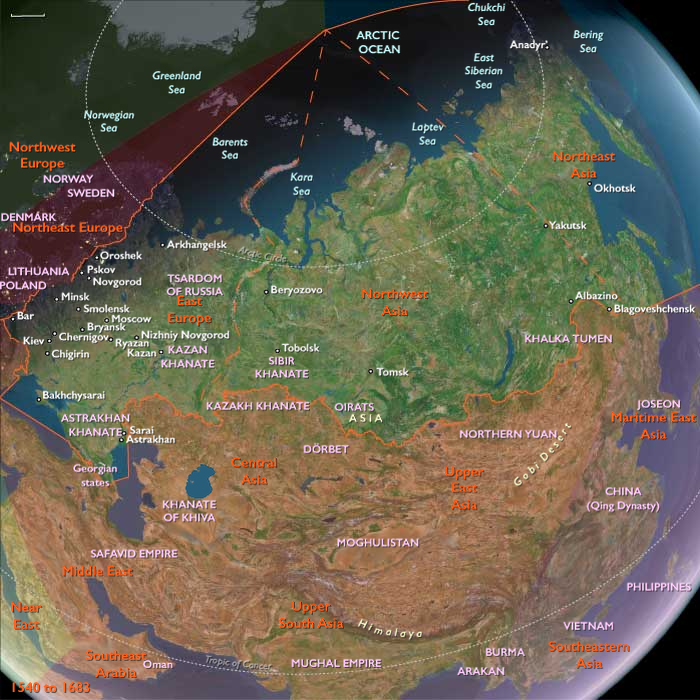
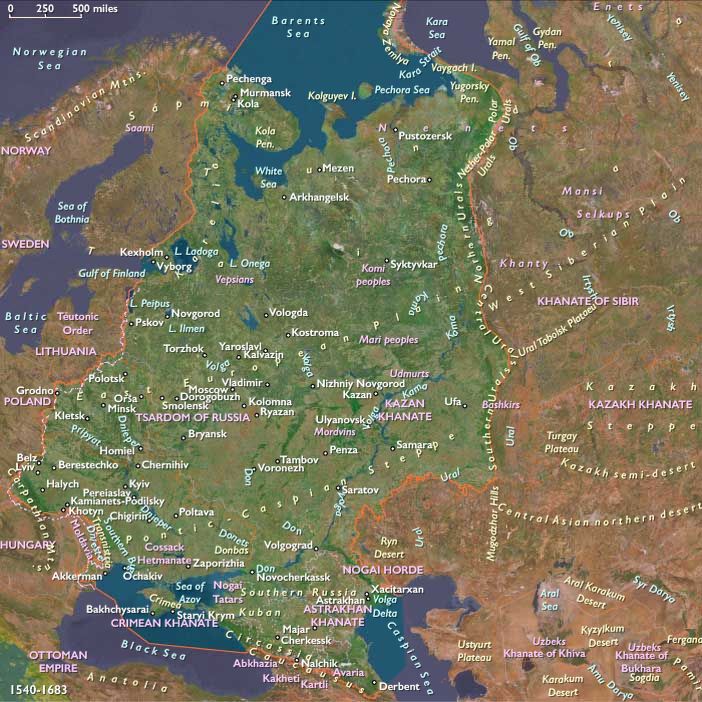
The use and making of icons had entered Kievan Rus' following its conversion to Orthodox Christianity in 988.
As a general rule, these icons strictly followed models and formulas hallowed by Byzantine art, led from the capital in Constantinople.
As time passed, the Russians—notably Andrei Rublev and Dionisius—had widened the vocabulary of types and styles far beyond anything found elsewhere in the Orthodox world.
A Russian church council, in response, in 1551 prescribes adherence to consecrated models, sparking a decline in icon painting that is to last until the seventeenth century.
Locations
Groups
Topics
Subjects
Regions
Subregions
Related Events
Filter results
Showing 9 events out of 9 total
The year 1744 has opened bleakly for the Spaniards in Italy.
To the south the Austrians are steadily driving back General Montemar's army.
Naples is threatened.
Britain, boasting naval superiority in the Mediterranean, has intervened on the side of Austria, and the Royal Navy everywhere harasses Spain's allies and frustrates Spanish war shipping.
Genoa is blocked off by a British squadron, and Switzerland keeps her borders closed to the passage of troops.
The Infante Philip, marching overland through allied France, had easily conquered Savoy, but, starved of supplies, has been unable to advance against the Sardinians in the Alps.
The retreat of Admiral Matthews' fleet has left the sea lanes temporarily under French and Spanish control.
Supplies pour into Philip's camp.
Twenty thousand Frenchmen under Louis François I, Prince of Conti, are now dispatched to combine with Philip's twenty thousand Spaniards, their goal being to force a passage into Lombardy and to unite with the Spanish army in the south.
The allies had crossed the Var on April 1 and advanced into Nice, which had fallen without a fight.
The fortified camp of Villafranca now lie before them.
The Sardinians, led by Vittorio Francesco Filippo di Savoia, Marquis of Susa, the brother of the King Charles Emmanuel III, entrench themselves along the heights of Villafranca.
Their natural defenses are formidable: the attackers, hemmed in by cliffs and precipices, face a difficult climb up over rocks and boulders, in plain sight of Sardinian guns.
The fortified camp is equipped with more than eighty guns of all calibers, landed from English ships stationed in the harbor, which are arranged in eleven batteries.
Sardinian forces count fourteen battalions of infantry.
Admiral Matthews, meanwhile, has returned to the area and landed a contingent of British regulars, marines, and artillery specialists to bolster the Sardinian defense.
This force joins the Sardinians on the heights, their guns bearing down on the French against whom they had only recently declared war (Britain had been fighting a war against Spain since 1739).
Voltaire will later quip, "even in the Alps we could still find Englishmen to fight us."
Conti's first attack, launched on April 14, is suspended because of a storm.
Conti finally assaults Villafranca on the night of April 19 to 20, 1744.
In the early stages of the battle, the French and the Spaniards are able to immediately gain the position of the collet de Villefranche, capturing or destroying five Sardinian battalions.
Even the commander in chief, the Marquis of Susa, is taken prisoner and he has to be replaced by the Knight of Cinzano.
The French and Spanish forces move to conquer the positions of Mont Gros, Mont Rouge and Mont Leuze, the keys of the defensive perimeter of Villafranca.
However, led by their new commander, the defenders are able to contain the attack.
In particular, the regiment Kalbermatten, a Swiss unit in Sardinian service, is able to develop a magnificent defensive action to hold the position of Mont Leuze.
The situation is restored at four in the afternoon, and Conti has now exhausted all the forces at his disposal.
The Cinzano has the opportunity to launch an assault on the collective Villefranche and reoccupy the position, which is crucial as it allows the transit of the road to Nice.
This operation, conducted principally by companies of grenadiers, achieves complete success.
In the evening, the Sardinians are again deployed on the positions of the morning.
The defenders have suffered heavy losses.
There are over one thousand dead and wounded and fifteen hundred prisoners, compared to less than three thousand losses of Spaniards and French, who count among their ranks four hundred and thirty-three men held captive.
The Cinzano, with only five thousand men fit to fight, prefers to abandon the fortified camp of Villafranca with the help of the British navy.
On the evening of April 21, in the dock of Villafranca, the garrison is shipped aboard thirty-three ships escorted by four British warships.
The fleet leaves the port at dawn of the 22nd.
The fort of Montalbano has been abandoned, but Cinzano has in the Citadel of Villafranco a garrison of three hundred and forty soldiers, who surrender on April 27.

Spain wishes for an advance along the coast of Italy through Genoa to occupy the lands around Parma, which it already has been decided are going to be the future realm of Infante Philip, the third son of King Philip V of Spain and his wife, Elisabeth Farnese.
France's chief aim is to humble Piedmont-Sardinia and to force her to detach herself from Austria, or better yet, force her to drop out of the war entirely.
The French commander, the Prince of Conti, will not accept the Spanish plan of attack because he thinks it unsound, while the Spanish queen will brook no opposition to what she believes should be the key thrust of the joint Bourbon armies.
A compromise is negotiated: Spain's plan is not to be followed until after the humbling of Piedmont-Sardinia, after which the joint armies will march into Lombardy to secure the Infante Philip his new realm.
The principal plan for invading Piedmont is devised by Lieutenant General Pierre-Joseph Bourcet, who is France's leading expert in alpine warfare.
The main problem for any army invading Piedmont is the problem of surmounting the alpine passes that guard its approaches.
Even a small number of defenders can effectively block an advance.
Bourcet's reasoning is that with a numerical superiority of thirty-three thousand to twenty-five thousand, the best result would be obtained by separating the attacking force into several columns, which would then attack outlying outposts in a multi-pronged advance.
Using infiltration tactics, it would be easy to envelop the Piedmontese positions, allowing attacks to be launched where most unexpected.
Finally, by putting pressure along the whole front it is reasoned that the Piedmontese defense perimeter will crack at some point, and then the columns can re-unite and push through the gap.
The Franco-Spanish army with this in mind begins in June to regroup in the Dauphiné region.
Once concentrated, the attacking columns lie on a front between Briançon and St. Etienne.
The Prince de Conti realizes that the conquest of the Ligurian Riviera will cost several months of combat.
He then prefers to attack the Alps in July, an action that allows the breakthrough of the Italian front and the siege of the city of Cuneo.
The Franco-Spanish army breaks camp on July 5 and heads in nine separate columns towards the heart of Piedmont.
Despite bickering between Conti and La Mina, the Franco-Spanish army experiences several early triumphs.
Entering the Stura valley, the route passes through a six mile defile known as the Barricades.
Following Bourcet's advice, troops to the north and south of the position emerge throughout the mountains onto the rear of the Piedmont position, and rather than being caught in a trap the Piedmontese evacuate the valley without a fight.
In accordance with instructions, the Franco-Spanish army now converges on the Stura Valley in order to take advantage of the gap in Charles Emmanuel's defenses.
The Franco-Spanish army triumphs again on July 19 when it wins the Battle of Casteldelfino.
Charles Emmanuel, aware of Frederick of Prussia's advance into Bohemia, knows that the bulk of the troops needed for the defense of Cuneo will have to come from his own domains.
With this in mind, he holds back his army of twenty-five thousand near Saluzzo to await developments.
To safeguard Cuneo, he appoints Major-General de Leutrum—who had performed well at Campo Santo—to command the garrison, and calls out the kingdom's militia, which can act as a superb guerrilla force.
The siege of Cuneo begins on the night of 12/13 September.
Conti's plan involves three armies—one to besiege, one to oppose Charles Emmanuel's Army and another to patrol the surrounding lands.
Although De Leutram shows great ingenuity—lighting the sky to illuminate the trenches for his cannon and continuously mounting sorties—Conti's army by September 28 is closing in on the fortress.
It is at this point that the King of Sardinia decides to act.
Charles Emmanuel late in September advances his army from Saluzzo towards Cuneo while Conti at the same time moves his army towards the Piedmontese.
Conti by the close of day on September 29 occupies a position between Caraglio and Madonna dell'Olmo, while Charles Emmanuel on the morning of September 30 moves his army into position opposite Conti's.
The engagement begins around noon when the Croats (on loan from Austria) in the Sardinian army charge towards Madonna dell'Olmo.
The Croat attack, however, is repulsed by the Spanish and even Charles Emmanuel's grenadiers can make no headway.
The French on the opposite flank cannot get to grips with the Piedmontese because of a ditch and some barricades barring the way.
Conti in the center, however, makes excellent use of his artillery, which provide cover for a French infantry attack.
The battle for the center lies in the balance until Charles Emmanuel, realizing that he will not be able to capture Madonna dell'Olmo, calls for an orderly retreat.
The two armies by nightfall have disengaged.
Out of a total number of twenty-five thousand, the King of Sardinia has lost four thousand four men, while the Bourbon losses are a little over half that of their enemies, at twenty-seven hundred men killed or wounded.
Furthermore, Conti still has his army intact.
Victory had gone to the Franco-Spanish army, but it had become apparent on the evening of September 30 that Charles Emmanuel's brilliantly conceived plan had fulfilled most of its objectives.
Although the Bourbon outposts around Cuneo are intact, the siege works have been destroyed, the garrison re-supplied and reinforced, and Conti's communications have been cut.
Further problems follow when it begins to rain on the first of October; the trenches flood and roads are wiped out.
It is decided at a council of war on October 11 that with winter approaching and the Franco-Spanish Army even further from their goal, the army should retreat before the winter snows close the passes behind them.
The Franco-Spanish army has recrossed the Alps by the 19th of November.
It begins to snow on the 20th.