The Uralic-speaking peoples living in the central …
Years: 496 - 507
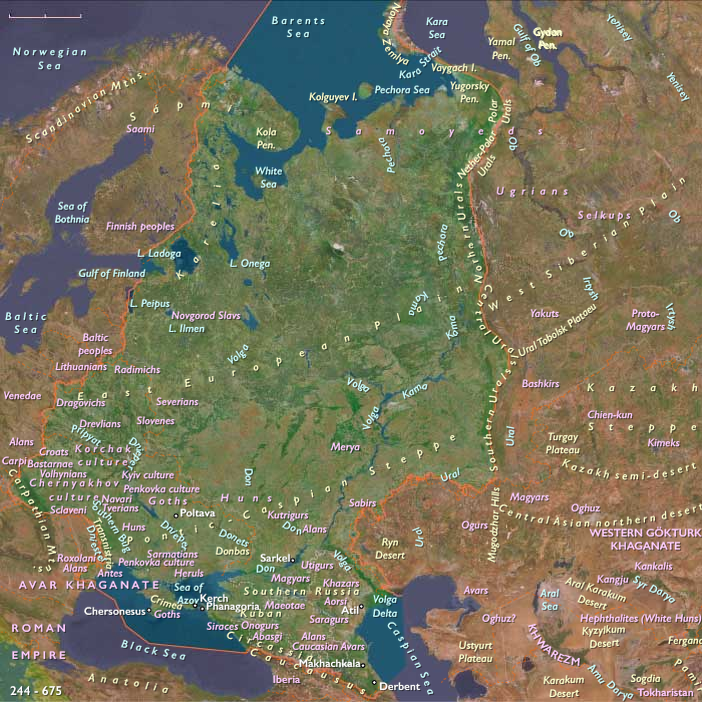
The Uralic-speaking peoples living in the central and southern regions of the Urals had split up during the fourth millennium BCE.
Some had dispersed towards the west and northwest and came into contact with Iranian speakers who were spreading northwards.
The Ugrian speakers became distinguished from the rest of the Uralic community from at least 2000 BCE onward.
Judging by evidence from burial mounds and settlement sites, they interacted with the Andronovo Culture.
Furthermore, the type of Hungarians of the Conquest period shows related features to that of the Andronovo people.
In the fourth and fifth centuries CE, the Magyars moved to the west of the Ural Mountains to the area between the southern Ural Mountains and the Volga River known as Bashkiria (Bashkortostan) and Perm Krai.
The Magyars of northeastern Europe, have, by 500, mixed with various Turkish tribes and accepted their equestrian culture.
Locations
Groups
Topics
Commodoties
Subjects
Regions
Subregions
Related Events
Filter results
Showing 10 events out of 58385 total
The so-called Old Bering Sea tradition in coastal Alaska and Siberia, focused on seal and walrus hunting, gradually begins to give way to a tradition based on whale hunting.
East Central Europe (496–507 CE): Gepid Dominance, Lombard Expansion, and Rugian Decline
Between 496 and 507 CE, East Central Europe—including Poland, Czechia, Slovakia, Hungary, and those portions of Germany and Austria lying east of 10°E and north of a line stretching from roughly 48.2°N at 10°E southeastward to the Austro-Slovenian border near 46.7°N, 15.4°E—experienced further geopolitical transformation driven by strengthened Gepid control and the growing influence of the migrating Lombards (Langobardi). This era also saw the collapse of Rugian autonomy following their conflict with Odoacer and subsequent regional instability. Moreover, in 496 CE, the Roman provincial administration in Pannonia Valeria ceased entirely, marking the definitive end of direct Roman governance in the region. Throughout these significant transformations, the proto-Slavic communities maintained notable cultural resilience and social cohesion.
Political and Military Developments
End of Roman Pannonia Valeria (496 CE)
-
In 496 CE, Roman administrative control in Pannonia Valeria effectively ended, marking the final dissolution of Roman provincial governance in East Central Europe. The province's territories became fully absorbed into the domains of tribal powers, notably the Gepids, reflecting the broader transition from Roman to Germanic authority in the region.
Consolidation of Gepid Authority
-
Gepid dominance solidified further, particularly across the Hungarian Plain and the eastern Carpathian Basin, as their rulers secured firm territorial control. Their political strength enabled a stable regional environment, reinforcing Gepid centrality within East Central Europe.
Lombard Migration and Rising Influence
-
The Lombards (Langobardi), migrating southward from territories north of the Danube, steadily increased their presence and influence within East Central Europe. Their movements and growing power introduced a significant new element into regional politics, positioning them as potential rivals to Gepid authority.
Rugian Conflict with Odoacer and Decline
-
The previously stable Rugii suffered a significant decline in autonomy and stability following their conflict with Odoacer, ruler of Italy (476–493 CE), and later, with his successors. The Rugian kingdom on the upper Tisza disintegrated rapidly around the turn of the century (circa 500 CE), marking the end of their sustained political independence.
Economic and Technological Developments
Stabilized Local Economies under Gepid Control
-
Gepid consolidation provided relative economic stability, allowing localized trade networks to expand modestly, especially along strategic trade routes linking regional centers such as Augusta Vindelicorum (Augsburg) and former Roman frontier towns.
Continued Maintenance of Infrastructure
-
Essential infrastructure, notably roads and fortifications, was maintained sufficiently to ensure secure trade routes and communication, though major infrastructure projects remained limited.
Cultural and Artistic Developments
Flourishing Gepid Artistic Traditions
-
Gepid material culture reached new levels of sophistication, reflected in jewelry, pottery, weaponry, and metalwork. Their artifacts demonstrated distinctively Gepid styles blended with Lombard and residual Roman elements.
Proto-Slavic Cultural Continuity
-
Proto-Slavic communities continued preserving their distinctive cultural traditions, maintaining traditional craftsmanship, social structures, and religious practices despite external geopolitical turbulence.
Settlement and Urban Development
Continuing Importance of Key Urban Centers
-
Major settlements like Augusta Vindelicorum (Augsburg) maintained their regional significance, acting as hubs for trade, communication, and local administration, benefiting from stable Gepid rule.
-
Former Roman towns, including Carnuntum, Vindobona, and Aquincum, remained as fortified centers and administrative points within Gepid-controlled territories, though now entirely detached from Roman governance.
Decline of Rugian Settlements
-
Rugian settlements along the upper Tisza entered a phase of decline and disintegration following their defeat and destabilization after conflicts involving Odoacer, significantly diminishing their previously influential role.
Social and Religious Developments
Gepid and Lombard Social Organization
-
Gepid and emerging Lombard societies solidified around powerful warrior elites, emphasizing strong leadership structures and traditional Germanic rituals to reinforce their legitimacy and social cohesion.
Rugian Social Collapse
-
Rugian social and political structures faced rapid dissolution as a consequence of their military defeats and the loss of autonomy, ending their role as a stabilizing regional power.
Proto-Slavic Social Resilience
-
Proto-Slavic populations preserved their internal social structures and communal cohesion, adapting pragmatically to changing regional realities while preserving their cultural and religious traditions.
Long-Term Consequences and Historical Significance
The era 496–507 CE was pivotal for East Central Europe, marking the definitive consolidation of Gepid dominance, the emergence of the Lombards as a significant new power, and the dramatic decline of Rugian autonomy. The termination of Roman provincial administration in Pannonia Valeria in 496 CE signaled the conclusive withdrawal of Roman authority from the region. These developments significantly reshaped the regional balance of power, establishing geopolitical patterns that would profoundly influence subsequent regional history. Concurrently, the ongoing cultural resilience of proto-Slavic communities provided crucial continuity, setting the stage for enduring regional diversity and the future historical trajectory of East Central Europe into the early medieval period.
Roman Emperor Anastasius, ruling in the East, perfects the empire's monetary system, increases its treasury, and proves himself an able administrator of domestic and foreign affairs.
The common and club bread wheats have begun to replace durum in the Mediterranean region.
Roman imperial authority has maintained its integrity in the East while the Western Empire has dissolved into a number of successor states.
Eastern Southeast Europe (496–507 CE): Stability Amid Emerging Pressures
Settlement and Migration Patterns
Continued Urban Development
Between 496 and 507 CE, Eastern Southeast Europe sustained urban growth and stability. Cities such as Constantinople, Philippopolis, and other regional centers further consolidated their infrastructure, continuing to enhance defenses and support stable populations.
Migration and Demographic Shifts
During this period, significant migratory pressures continued as Slavic tribes descended along the Dniester and Prut river valleys. By about 500 CE, these tribes, known as the Sclaveni, had settled extensively along the northern banks of the Danube River, from its mouths to its confluence with the Tisza River in present-day Vojvodina, Serbia. This new demographic presence began reshaping regional settlement patterns and social structures.
Economic and Technological Developments
Economic Stability and Growth
The regional economy maintained resilience, driven by consistent agricultural outputs and sustained trade activities. Constantinople remained a crucial economic hub, ensuring robust commercial networks and continued prosperity throughout Eastern Southeast Europe.
Advances in Military Technology
Technological advancements continued to improve defensive capabilities, with significant enhancements in fortifications, weaponry, and logistical infrastructure. These developments safeguarded regional stability and ensured economic continuity despite emerging pressures.
Cultural and Artistic Developments
Artistic Flourishing
Cultural and artistic endeavors remained vibrant, reflecting classical traditions integrated with emerging Christian symbolism. Notably, between 493 and 508 CE, the Ambrosian Iliad (Ilias Picta)—an illuminated manuscript of Homer's Iliad—was produced in Constantinople. This manuscript stands among the oldest surviving illustrated texts from antiquity, demonstrating the sophisticated artistic culture of the region.
Preservation of Intellectual Heritage
Educational institutions actively preserved classical and theological knowledge, maintaining intellectual vitality. Scholarly endeavors adapted to evolving social and political contexts, ensuring continued cultural and educational vigor.
Social and Religious Developments
Strengthened Governance Structures
Provincial administration refined its efficiency, improving local governance, civic management, and administrative coherence. These enhanced structures provided necessary stability amidst the challenges posed by new demographic shifts.
Christianity’s Continued Expansion
Christianity deepened its influence, further integrating into regional social, cultural, and political structures. The ongoing expansion of religious institutions, such as churches and monasteries, strengthened community bonds and provided essential spiritual and societal support during periods of transition.
Long-Term Consequences and Historical Significance
The era from 496 to 507 CE represented ongoing regional stability amidst significant demographic transformations, economic resilience, and cultural continuity. The settlement of Slavic tribes along the Danube established new cultural dynamics that significantly influenced Eastern Southeast Europe's historical trajectory, laying essential groundwork for future developments.

Many Slavic groups have descended the Dniester and Prut river valleys to the estuary of the Danube and moved inland, so that by about 500, Slavic tribes are settled along the northern bank of the Danube from its mouths to …
…its confluence with the Tisza River in present Vojvodina, Serbia.
These Danubian Slavs are known to contemporary writers as the Sclaveni, as distinct from the Antes who remain in the region northwest of the Black Sea.
The Ambrosian Iliad or Ilia Picta (Milan, Biblioteca Ambrosiana, Cod. F. 205 Inf.) is a fifth-century illuminated manuscript on vellum of the Iliad of Homer.
It is thought to have been produced in Constantinople during the late fifth or early sixth century CE, specifically between 493 and 508.
This time frame was developed by Ranuccio Bandinelli and is based on the abundance of green in the pictures, which happened to be the color of the faction in power at the time.
It has since been reduced to a series of miniatures cut out of the manuscript.
It is one of the oldest surviving illustrated manuscripts.
In addition, it is the only surviving portion of an illustrated copy of Homer from antiquity and, along with the Vergilius Vaticanus and the Vergilius Romanus, one of only three illustrated manuscripts of classical literature to survive from antiquity.
The Middle East: 496–507 CE
The Anastasian War and Religious Developments
The era from 496 to 507 CE is marked prominently by the Anastasian War (502–506 CE), a major military conflict between the Eastern Roman Empire and the Sassanid Persian Empire. This conflict, the first significant confrontation between these two powers since 440 CE, inaugurates a century-long series of devastating wars that will profoundly affect both empires and shape regional dynamics for decades.
Background and Causes of the Anastasian War
Tensions between Rome and Persia had been simmering for decades, exacerbated by disputes over influence in Armenia and control of strategic territories along their mutual border. Both empires sought to extend their dominance and secure vital trade routes, and these ambitions frequently brought them into direct conflict.
Military Course and Outcome
The Anastasian War begins in earnest in 502 CE when Sassanid forces under King Kavadh I launch an invasion of Roman-held territory, capturing key locations and threatening critical frontier fortresses. Fierce fighting ensues, with the Romans eventually responding effectively under Emperor Anastasius I, who mobilizes substantial resources to repel the Persian incursion.
Despite heavy losses and widespread devastation, particularly around Amida (modern-day Diyarbakır), the conflict ultimately ends in 506 CE with a tenuous peace. The Roman Empire agrees to pay substantial indemnities to the Persians, reflecting the unresolved nature of the strategic rivalry and foreshadowing future confrontations.
Religious and Philosophical Developments
In parallel with these military developments, this era witnesses significant intellectual and religious activity, notably exemplified by the mystical theological writings of an anonymous author known today as Dionysius the Pseudo-Areopagite. Around 500 CE, this influential thinker attempts to integrate Neoplatonism with Christian theology through several works, including The Celestial Hierarchy, The Ecclesiastical Hierarchy, The Divine Names, and Mystical Theology. These writings profoundly shape medieval Christian mysticism and theology, leaving an enduring legacy in the intellectual traditions of both East and West.
Thus, the period from 496 to 507 CE highlights the intertwined military, political, and religious transformations that characterize the Middle East at the onset of the sixth century, reflecting both the persistent conflict between great powers and the rich intellectual and theological developments of the era.