
The upper stratum of the Xiongnu had …
Years: 36BCE - 36BCE
The upper stratum of the Xiongnu had been in chaos caused by war after the death in 60 BCE of the former Shanyu, the title used by the rulers of the Xiongnu Luanti clan during the Qin and Han dynasties.
Hutuwusi had in 56 BCE risen against his elder brother Jihoushan or Huhanye Shanyu (the legitimate Shanyu), and the other three Shanyus by proclaiming himself as Zhizhi Guduhou Shanyu (full title) in the east.
Zhizhi Shanyu had won over most of Mongolian steppe by 54 BCE, forcing Huhanye to move south.
Huhanye, with the help of the Han Dynasty, had regained power over Mongolia and Zhizhi had in 44 BCE and fled west to Kangju with an army that numbered three thousand men by the time he arrived.
Kangju, with the help of Zhizhi, staged a successful raid against the rival Wusun tribe.
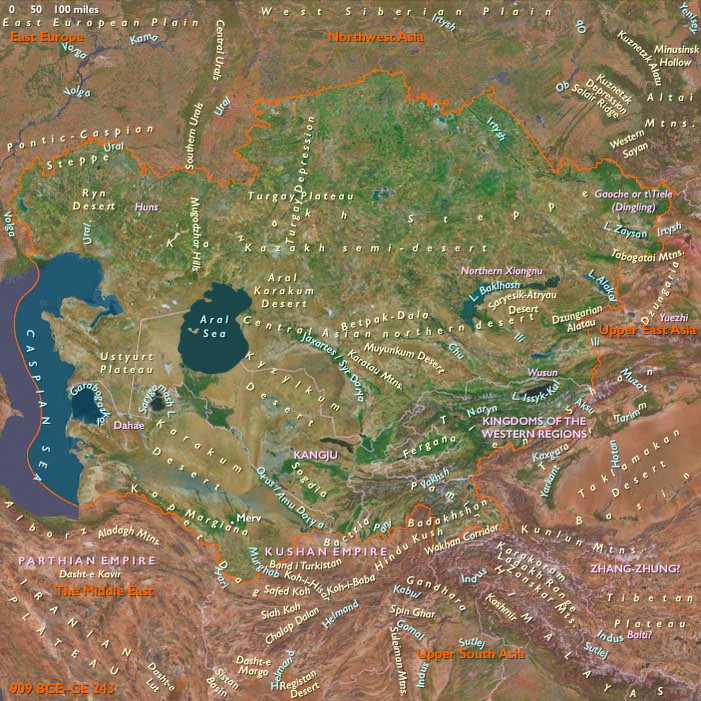
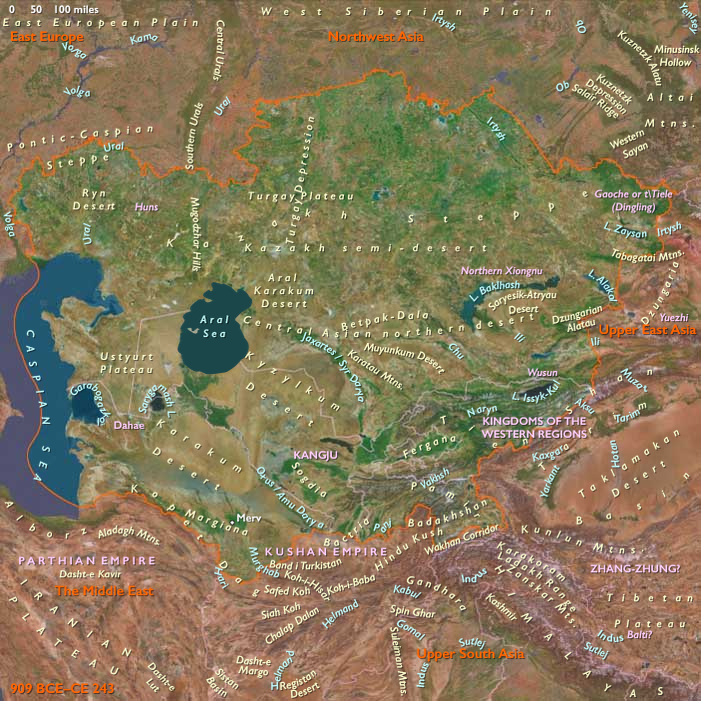
Zhizhi then compelled Kangju to build a fortress in Talas valley, near modern day Taraz, Kazakhstan, and where he had established his own state "Zhizhi," also known in European historiography as Western Xiongnu.
His conflicts with Eastern Xiongnu eventually lead the Han to launch an an expedition in 42 BCE, after Zhizhi had executed a Chinese emissary, Gu Ji, who had reached his court.
Zhizhi is killed in the Battle of Zhizhi in 36 BCE at Taraz, defending his fortress against the Han expedition led by Gan Yanshou and Chen Tang.
Zhizhi’s head is sent to Chang'an.
This action leads to what will be a half century of peace between the Han Dynasty and the Xiongnu until Wang Mang engages them in the year 10, resuming hostilities between both sides.
Locations
Groups
Topics
Commodoties
Subjects
Regions
Subregions
Related Events
Showing 4 events out of 4 total
Years: 36BCE - 36BCE
Locations
Groups
Topics
Commodoties
Subjects
Regions
Subregions