The University of Parma, its origins lying …
Years: 1117 - 1117
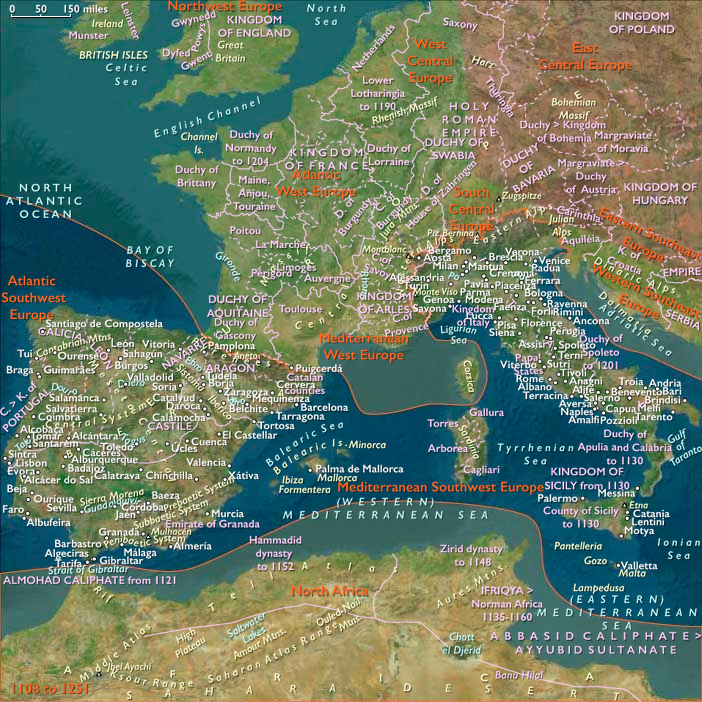
The University of Parma, its origins lying in eighth-century law and medical schools, is founded in 1117 as a center for study of the general liberal arts curriculum of the medieval period.
Locations
Groups
- Papal States (Republic of St. Peter)
- German, or Ottonian (Roman) Empire
- Italy, Kingdom of (Holy Roman Empire)
Topics
Subjects
Regions
Subregions
Related Events
Filter results
Showing 10 events out of 49424 total
Mii-dera, formally called Onjō-ji, is a Buddhist temple located at the foot of Mount Hiei, in the city of Ōtsu, in Shiga Prefecture.
It is only a short distance from both Kyoto, and Lake Biwa, Japan's largest lake.
The head temple of the Tendai Jimon sect, it is something of a sister temple to Enryaku-ji, at the top of the mountain.
Onjō-ji was founded in 672, during the early Heian period, following a dispute over Imperial succession.
Emperor Tenji had died, and his son had been killed by Tenji's brother, who was then enthroned as Emperor Temmu.
Temmu founded Onjō-ji in honor and memory of his brother.
The name "Mii-dera," literally 'Temple of Three Wells,' was given this name in the ninth century by Enchin, one of the earliest abbots of the Tendai Sect.
The name comes from the springs at the temple which were used for the ritual bathing of newborns, and in honor of Emperors Emperor Tenji and Emperor Temmu, and Empress Jitō, who contributed to the founding of the temple.
Today, the Kondo, or Main Hall, houses a spring of sacred water.
Under Enchin's guidance, from 859 to his death in 891, Mii-dera gained power and importance, eventually becoming (along with Tōdai-ji, Kōfuku-ji, and Enryaku-ji) one of the four chief temples charged with the spiritual guidance and protection of the capital.
It was during this time also that Enryaku-ji and Mii-dera split away from one another, developing two branches of the Tendai sect, called Jimon and Sammon.
For the most part, this was more a geographic rivalry than an ideological schism, but it was an intense one nonetheless, and only grew more severe after Enchin's death.
The rivalry had turned violent in the second half of the tenth century, over a series of official appointments to other temples, and similar slights.
The zasu of Enryaku-ji in 970 formed the first permanent standing army to be recruited by a religious body.
Mii-dera can be assumed to have established one very soon afterwards.
In 989, a former abbot of Mii-dera by the name of Yokei was to become abbot of Enryaku-ji; but none of the monks of Enryaku-ji would perform services under his direction.
He soon resigned.
But in 993, the monks of Mii-dera took revenge, destroying a temple where Ennin, founder of Enryaku-ji's Sammon sect, had once lived.
The monks from Enryaku-ji retaliated, destroying more than forty places associated with Enchin.
In the end, over one thousand monks of Enchin's Jimon sect fled permanently to Mii-dera, cementing the split between the two sects.
Over the course of the tenth, eleventh and twelfth centuries, there will continue to be similar incidents, over the appointment of abbots (zasu), involving many sōhei, or warrior monks.
Mii-dera had been burned to the ground by the sōhei of Enryaku-ji four times in the eleventh century alone.
There are, however, times that the two unite against a common enemy, including an attack on the Kōfuku-ji in Nara in 1081 (avenging the burning of the Mii-dera by Kōfuku-ji monks that same year), and a united attack on Nara once more in 1117.

Mstislav, the eldest son of Vladimir II Monomakh by Gytha of Wessex, figures prominently in the Norse Sagas under the name Harald, taken to allude to his grandfather, Harold II of England, slain in 1066 at the Batttle of Hastings.
According to Saxo Grammaticus, two of Harold's sons and a daughter escaped the Norman Conquest to the court of their uncle, king Sweyn Estridsson of Denmark.
They were treated by Sweyn with hospitality, while their sister was married to Waldemar, king of Ruthenia, i.e.
Vladimir II Monomakh.
(The pateric of St. Pantaleon Cloister in Cologne says that "Gytha the Queen" died as a nun on March 10.
It is assumed that she followed Godfrey of Bouillon in the first Crusade and died in Palestine, most likely in 1098, as a year later Vladimir Monomakh married a noblewoman of Constantinople, by whom he had Yuri Dolgoruki, the future founder of Moscow, and two daughters: Eufemia, who married King Coloman of Hungary, and Maria, married to the pretender to the throne of Constantinople who called himself Leon Diogenes.)
As his father's future successor, Mstislav has reigned in Novgorod from 1088-93 and (after a brief stint at Rostov) from 1095-1117, building numerous churches in Novgorod, of which St. Nicholas Cathedral (1113) and the cathedral of St. Anthony Cloister (1117) survive to the present day.
Mstislav's life thus far has been spent in constant warfare with Cumans (1093, 1107, 1111) and Estonians (1111, 1113, 1116).
In 1096, he had defeated his uncle Oleg of Chernigov on the Koloksha River, thereby laying the foundation for the centuries of enmity between his and Oleg's descendants.
(Mstislav will be the last ruler of united Rus, and upon his death, as the chronicler put it, "the land of Rus was torn apart".)
Mstislav is from 1118 Monomakh's co-ruler in Belgorod-on-the-Dnieper; he is to inherit the Kievan throne after his death.
Bohemia’s ducal siblings are reconciled in 1117, when Vladislav I formally abdicates in favor of Borivoj II, but retains much of the actual power.
The acceptance by the Seljuqs of Rüm of a truce with Constantinople permits the empire to reclaim all the coastal areas by 1117.
Imperial prestige is higher than it has been for many years, but the empire can barely afford to sustain the part of a great power.
Alexios has reconstituted the army and recreated the fleet, but only by means of stabilizing the gold coinage at one-third of its original value and by imposing a number of supplementary taxes.
It has become normal practice for taxes to be farmed out, which means that the collectors recoup their outlay on their own terms.
People in the provinces have the added burden of providing materials and labor for defense, communications, and provisions for the army, which now includes very large numbers of foreigners.
The supply of native soldiers has virtually ceased with the disappearance or absorption of their military holdings.
Alexios promotes an alternative source of native manpower by extending the system of granting estates in pronoia (by favor of the emperor) and tying the grant to the military obligation.
The recipient of a pronoia is entitled to all the revenues of his estate and to the taxes payable by his tenants (paroikoi), on condition of equipping himself as a mounted cavalryman with a varying number of troops.
He is in absolute possession of his property until it reverts to the crown upon his death.
Similarly, Alexios tries to promote more profitable development of the estates of the church by granting them to the management of laymen as charistikia or benefices.
As an expedient, the pronoia system has advantages both for the state and for the military aristocracy who are its main beneficiaries, but in the long term, it will hasten the fragmentation of the empire among the landed families and the breakdown of centralized government that the tenth-century emperors had labored to avert.
The Cumans initially had managed to defeat the Great Prince Vladimir Monomakh of Kievan Rus in the twelfth century (at the Battle of the Stugna River), but they are later defeated by the combined forces of Russian principalities led by Monomakh and forced out of the Rus borders to Caucasus.
Many Cumans at this time resettle in Georgia, where they achieve prominent positions and help Georgians to stop the advance of Seljuq Turks.
The death of Mas'ud III in 1115 had begun a heated contest for the Ghaznavid throne.
In 1116, Arslan ibn Mas'ud had overthrown his older brother Shahrzad bin Mas'ud, taken the throne, and blinded or imprisoned his remaining brothers, except Bahram who was in Zamin-Dawar.
After being initially defeated by Arslan at Tiginabad, Bahram flees to the Seljuq court in Khorasan.
he appeals to Sultan Ahmad Sanjar, whose sister, 'Iraq Jauhar Khatun, is greatly offended at the conduct of her eldest son, Arslan, towards his brothers.
Incited by her and perhaps by his own ambitious views, Sanjar calls on Arslan to release his brothers and on his refusal marches against him with an army of thirty thousand cavalry and fifty thousand infantry.
Arslan is defeated in a skirmish and flees to Ghazna.
Here, on the plain of Shahrabad outside Ghanza, Arslan is decisively defeated and flees to Bamian.
Ghazna is now subjected to forty days of pillage, which culminates in Bahram's installment as ruler and vassal of Sanjar.
However, as soon as Sanjar has withdrawn his army, Arslan returns, chases out Bahram ibn Mas'ud, who has been left in possession of throne as a vassal.
This obliges Sanjar to take the field again in a struggle that will prove to be Arslan’s last.
The Chennakeshava Temple, built on the banks of the Yagachi River in Belur, an early Hoysala capital, is commissioned by King Vishnuvardhana in 1117.
Scholars are divided about the reasons for the construction of the temple.
The military successes of Vishnuvardhana is considered a probable reason.
Some scholars believe Vishnuvardhana commissioned the temple to surpass his overlord, King Vikramaditya VI of the Western Chalukya Empire (who rules from Basavakalyan), after his initial military victories against the Chalukyas.
According to another theory, Vishnuvardhana was celebrating his famous victory against the Chola dynasty of Tamil country in the battle of Talakad (1116), which resulted in the annexation of Gangavadi (modern southern Karnataka) by the Hoysalas.
Another theory points to Vishnuvardhana's conversion from Jainism to Vaishnavism (a sect of Hinduism) after coming under the influence of saint Ramanujacharya, considering this is a predominantly Vaishnava temple in sculptural iconography.
Baldwin builds the castle of Scandalion in 1117 near Tyre, which is still in Muslim hands.
At this point the army in the Kingdom of Jerusalem consists of only six thousand men, including one thousand knights, but it is augmented with five thousand turcopoles, the locally recruited mounted archers.
The turcopoles employed by the crusader states are not necessarily Turkish or mixed-race mercenaries, but many are probably recruited from Christianized Seljuqs, or from Syrian Eastern Orthodox Christians under crusader rule.
The turcopoles are more lightly armored than the knights and sergeants (mounted men at arms), being armed with lances and bows to help combat the more mobile Muslim forces.
The turcopoles serve as light cavalry providing skirmishers, scouts, and mounted archers, and sometimes ride as a second line in a charge, to back up the Frankish knights and sergeants.
Turcopoles have lighter and faster horses than the western mounted troops and wear much lighter armor.
Usually this comprises only a quilted aketon or jerkin and a conical steel helmet.
Ramon Berenguer III (”the Great”), the count of Barcelona, Girona, and Osona from 1082 (jointly with Berenguer Ramon II and solely from 1097), Besalú from 1111, Cerdanya from 1117, and Provence, in the Holy Roman Empire, ends local dynastic lordship over Provence when he marries its heiress, Douce, in 1112.
His dominions now stretch as far east as Nice; his rule heralds an era of sparkling Provençal literature and culture.
Years: 1117 - 1117
Locations
Groups
- Papal States (Republic of St. Peter)
- German, or Ottonian (Roman) Empire
- Italy, Kingdom of (Holy Roman Empire)