The University of Montpellier is considerably older …
Years: 1289 - 1289
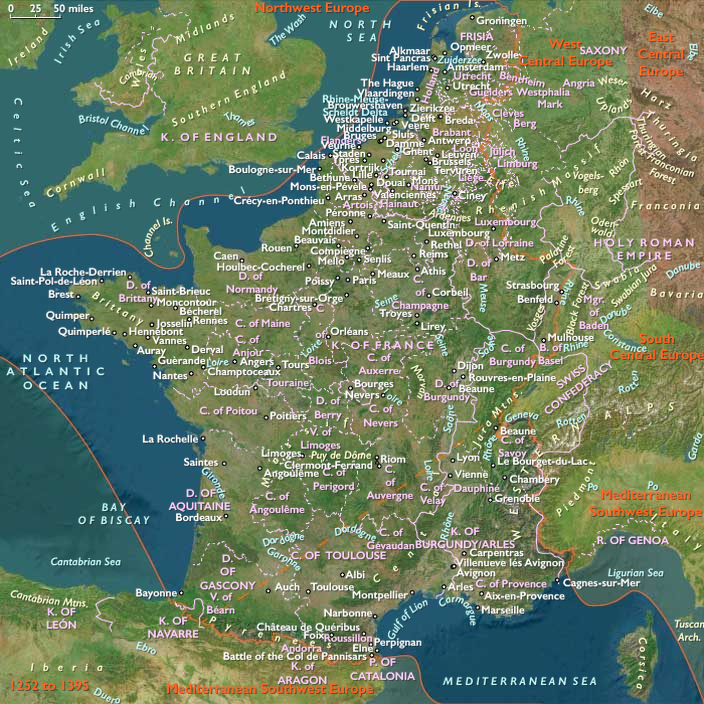
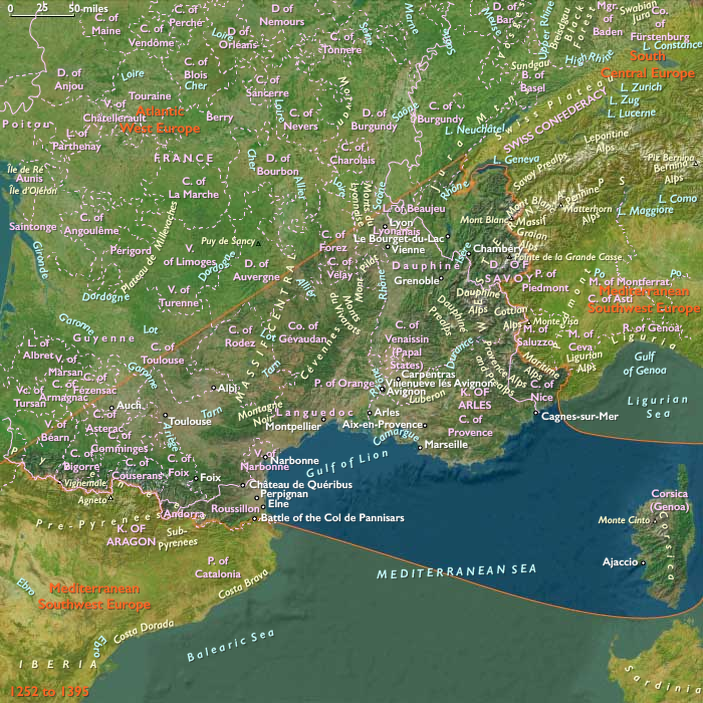
The University of Montpellier is considerably older than its formal founding date, associated with a bull issued by Pope Nicholas IV in 1289, combining all the long-existing schools into a university.
Locations
People
Groups
Subjects
Regions
Subregions
Related Events
Filter results
Showing 10 events out of 45333 total
The temples built in eastern Java during the ascendancy of the Singhasari kingdom are considered great examples of Hindu-Javanese arts; they mark the gradual transformation of Hindu architecture into Javanese forms and also reflect the increasing syncretism of Hinduism and Buddhism, which culminates in King Kertanagara's Siva-Buddha cult.
Kertanegara, the fifth ruler of Singasari and the son of the previous king, Wisnuwardhana, has effectively held power from 1254 and officially succeeded his father when the latter died in 1268.
The Singasari dynasty had come to power in Java following the overthrow of the previous Kingdom of Kediri by Ken Arok, the first Singhasari ruler in 1222.
Kertanegara is a follower of a mystical Tantric syncretism of Hinduism and Buddhism, and presented himself as the divine god-king incarnation of Siwa and Buddha.
Kertanegara celebrates many religious festivals and has commissioned sculptures and metal plaques during his reign.
Singhasari has reached the height of its power during Kertanegara's rule, which has seen the dramatic expansion of Javanese power in Maritime Southeast Asia.
He has extended Javanese involvement in the lucrative spice trade with the Moluccas.
He had also put down rebellions in Java by Cayaraja in 1270 and Mahisa in 1280.
Kertanegara is the first Javanese ruler with territorial ambitions that extended beyond the island of Java.
In 1284, he had subjected nearby Bali to vassalage.
Kertanagara has managed to form an alliance with Champa, another dominant state in Southeast Asia.
Late in his reign, the Pamalayu expedition succeeds in gaining control of the Melayu Kingdom in eastern Sumatra, and possibly also gains control over the Sunda kingdom and hegemony over the Strait of Malacca.
Other areas in Madura and Borneo also offer their submission to Kertanegara.
After the Singhasari kingdom had driven Srivijaya out of Java altogether, the rising power of Singhasari comes to the attention of Kublai Khan in China and he sends emissaries demanding tribute in 1289.
Kertanegara takes grave offense to the request and arrests the envoys.
He brands their faces, cuts their ears and sends them back to China with disfigured faces.
Indravarman III, a ruler of the Khmer Empire from 1295 to 1308, rises to power after the abdication of his father in law Jayavarman VIII.
A follower of Theravada Buddhism, Inravarman makes it the state religion upon his ascension to power.
The Tower of Kamianiec, today often called by the misnomer the White Tower (Belarusian: Bielaya Vieža or Belaya Vezha), has been erected from 1271–1289 by the architect Oleksa as a frontier stronghold on the northern border of the principality of Volhynia.
It is the only such tower remaining to this day in the area.
The name Bielaja Vieža (Belaya Vezha), which literally means White Tower or White Fortress in Belarusian, presumably derives from the tower's proximity to the Belavezhskaya Pushcha Forest, but not from its color, which has been brick-red through the ages, never white.
The first record in the chronicles about the foundation of the tower dates from 1276.
It was erected in the 1270s.
The castle has been built as an enclosed community.
Like many European castles, it has a great round tower, on the raised mound (motte), enclosed by a moat and the river on the northern side, and an adjoining enclosure (bailey).
This type of the motte-and-bailey castle had appeared in the tenth and eleventh centuries between the Rhine and Loire rivers and eventually spread to most of western Europe and even to the area of the present Belarus.
The red-brick tower with service and residential rooms on five levels inside is actually a donjon or a keep, that will be quite common in France and England until the sixteenth century.
It is thirty meters (ninety-eight feet) high; the red brick walls are about 2.5 m (8.2 ft) thick, with a pitched roof at the top.
The tower is entirely built of brick, which makes it unique, as brick construction will rarely be used in this part of Europe until the close of the Middle Ages, as brick production is costly: until the sixteenth century, mostly rubbleworks will prevail in fortifications and churches and monasteries; only some parts of exteriors being built of brick.
The tower traces the influence of Western Europe, where brickwork is used extensively in the late thirteenth—early fourteenth century.
Unlike the narrow loopholes on lower levels, the pointed big lancet windows and niches on the upper floor are excellent examples of early Gothic architecture in Belarus.
The openings of the windows and niches are plastered and whitewashed.
The windows are designed to permit the entry of light into the apartments, where the nobility would live during sieges.
Glass windows are another contribution to Gothic architecture; the residents were apparently eager to make themselves at home in the keep.
The upper part of the tower is furnished with battlements and a pattern of surface modeling of the brickwork, several ring dog-tooth courses running below the battlements.
The brickwork features a peculiar Baltic bond: a course consists of two stretchers and one header.

Tripoli, rebuilt by Crusaders and made a bishopric, is captured in 1289 by Mamluks under Sultan Qalawun.
Driving the crusaders from Tripoli, he destroys the harbor to prevent his enemies from landing there again.
John of Montecorvino was born at Montecorvino Rovella, in what is now Campania.
As a member of a Roman Catholic religious order which at this time is chiefly concerned with the conversion of unbelievers, he had been commissioned in 1272 by the East Roman emperor Michael VIII Palaiologos to Pope Gregory X, to negotiate for the reunion of the 'Greek' (Orthodox) and Latin churches.
Commissioned by Pope Nicholas IV to preach Christianity in the Nearer and Middle East, especially to the Asiatic hordes then threatening the West, he had devoted himself incessantly from 1275 to 1289 to the Eastern missions, first that of Persia.
In 1286 Arghun, the Ilkhan who rules this kingdom, had sent a request to the pope through the Nestorian monk, Rabban Bar Sauma, to send Catholic missionaries to the Court of the Great Khan (Mongol emperor) of China, Kúblaí Khan (1260–94), who is well disposed towards Christianity.
About that time John of Montecorvino had come to Rome with similar promising news, and Pope Nicholas had entrusted him with the important mission to Farther China, where about this time Marco Polo, the celebrated Venetian lay traveler, still lingers.
John had revisited the Papal Court in 1289 and had been sent out as Roman legate to the Great Khan, the Ilkhan of Persia, and other leading personages of the Mongol Empire, as well as to the Emperor of Ethiopia.
He started on his journey in 1289, provided with letters to the Khan Argun, to the great Emperor Kublai Khan, to Kaidu, Prince of the Tatars, to the King of Armenia and to the Patriarch of the Jacobites.
His companions are the Dominican Nicholas of Pistoia and the merchant Peter of Lucalongo.
He reaches Tabriz (in Iranian Azerbeijan), at this time the chief city of Mongol Persia, if not of all Western Asia.
Abaqa Khan was the leader of the Ilkhanate at the time of the birth of his grandson, Ghazan, whose father Arghun was viceroy (crown prince) in Khorasan for Abaqa.
Ghazan was the eldest son of Arghun, and Qutlugh of the Dorben clan, though he was raised in the Ordo (nomadic palace-tent) of his grandfather Abaqa's favorite wife, Buluqhan Khatun, who herself was childless.
Ghazan had been baptized and raised a Christian, as was his brother Oljeitu.
The Mongols are traditionally tolerant of multiple religions, and during Ghazan's youth, he had been educated by a Chinese monk, who taught him Buddhism, as well as the Mongolian and Uighur scripts.
After Abaqa's death in 1282, Ghazan's father Arghun had been crowned as Ilkhan, the eleven-year-old Ghazan became Viceroy, and he moved to the capital of Khorasan with the others of Bulughan's Ordo.
Conflict with other Mongols ensues in 1289 when a revolt is led against Arghun by Nawruz, a young noble of the Oirat clan, whose father had been governor of Persia before the arrival of Hulagu.
When Nawruz is defeated, he flees the Ilkhanate and joined the alliance of Kaidu, another descendant of Genghis Khan who is the ruler of both the House of Ögedei and the neighboring Chagatai Khanate.
Ghazan will spend the next ten years defending the frontier of the Ilkhanate against incursions by the Chagatai Mongols of Central Asia.
The Italian Guelph and Ghibelline factions fight in the Battle of Campaldino on June 11, 1289; the Guelph victory secures their position of power in Florence, though internecine fighting among the Whites and Blacks among the Florentine Guelphs will result in civic disturbances and the exile of many, including notable medieval Italian poet Dante Alighieri (a member of the Whites, the faction more opposed to papal power).
Twenty three partners, including five members of the Bonsignori family, recreate Siena’s Gran Tavola, formerly the most successful European bank, which had ceased its operations after the death of its creator and manager Orlando Bonsignori in 1273.
An earthquake with its epicenter in present Ningcheng County, Inner Mongolia, takes an estimated one hundred thousand lives.
The earthquake destroys four hundred and eighty storehouses and countless houses in Ningcheng.
Changping, Hejian, Renqiu, Xiongxian, Baoding, Baixiang, and ...
…Yixia are also affected.
It severely damages the Fengguo Temple in Yixian.