The United States, after occupying the Philippine …
Years: 1898 - 1898
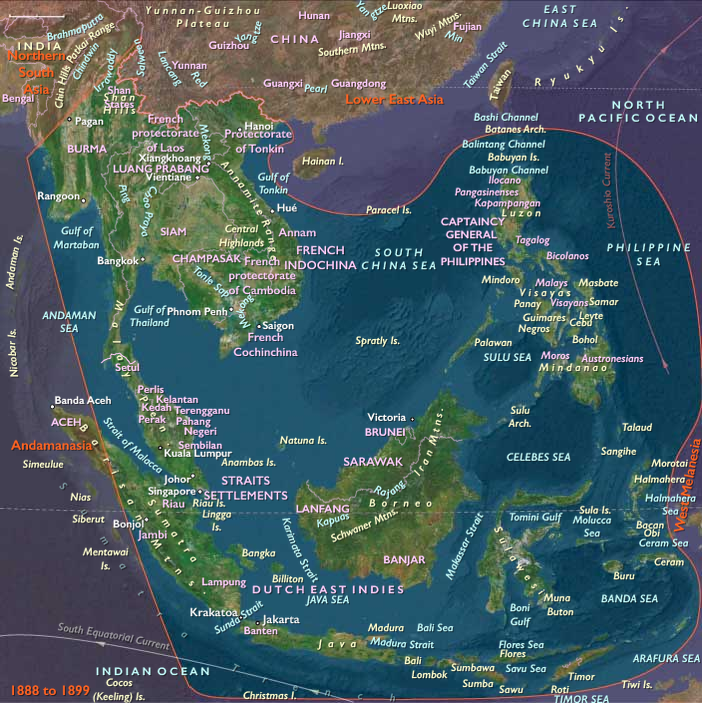
The United States, after occupying the Philippine Islands in 1898, discovers that Manila has one hundred and ninety dens retailing a total of one hundred and thirty tons of opium.
Locations
Groups
- Spanish East Indies
- United States of America (US, USA) (Washington DC)
- Spain, Bourbon Kingdom (second restoration) of
- Philippines, American colony of the
Topics
Commodoties
Subjects
Regions
Subregions
Related Events
Filter results
Showing 10 events out of 9205 total
Americans had rushed to the gold strike in the Yukon Territory’s Klondike region in 1897.
Gold had been discovered there by local miners on August 16, 1896, and, when news reaches Seattle and San Francisco the following year, it triggers a stampede of prospectors.
Some will become wealthy, but the majority will go in vain.
The Klondike Gold Rush will be immortalized in popular culture, e.g., in artifacts, films, games, literature, and photographs.
To reach the gold fields, most prospectors take the route through the ports of Dyea and Skagway, in Southeast Alaska.
Here, the Klondikers can follow either the Chilkoot or the White Pass trails to the Yukon River, and sail down to the Klondike.
The Canadian authorities require each of them to bring a year's supply of food, in order to prevent starvation.
In all, the Klondikers' equipment weighs close to a ton, which most carry themselves, in stages.
Performing this task, and contending with the mountainous terrain and cold climate, means those who persist do not arrive until summer 1898.
Once there, they find few opportunities, and many leave disappointed.
Mining is challenging, as the ore is distributed unevenly, and permafrost makes digging slow.
Consequently, some miners choose to buy and sell claims, build up huge investments, and let others do the work.
To accommodate the prospectors, boom towns spring up along the routes.
At their terminus, Dawson City is founded at the confluence of the Klondike and the Yukon Rivers.
From a population of five hundred in 1896, the town grows to house approximately thirty thousand people by summer 1898.
Built of wood, isolated, and unsanitary, Dawson suffers from fires, high prices, and epidemics.

Gauguin turns forty in Papeete, Tahiti, where he continues to live in self-imposed exile, still seeking to achieve a "primitive" expression of spiritual and emotional states in his work.
He had arrived in September 1895 and was to spend the next six years living, for the most part, an apparently comfortable life as an artist-colon near, or at times in, Papeete.
During this time he is able to support himself with an increasingly steady stream of sales and the support of friends and well-wishers, though he feels compelled in 1898–1899 to take a desk job in Papeete, of which there is not much record.
He has built a spacious reed and thatch house at Punaauia in an affluent area ten miles east of Papeete, settled by wealthy families, in which he has installed a large studio, sparing no expense.
Jules Agostini, an acquaintance of Gauguin's and an accomplished amateur photographer, photographed the house in 1896.
New Zealand’s liberal government introduces state-funded Old Age Pensions in 1898.
In 1894, New Zealand had pioneered the adoption of compulsory arbitration between employers and unions.
The United States sends its Asiatic fleet under Commodore George Dewey to the Philippines with secret orders signed by Assistant Secretary of the Navy Theodore Roosevelt.
The moment the fleet receives news of the U.S. declaration of war against Spain, Dewey’s fleet sinks the ten ships of Spain’s navy in Manila Bay.
General Aguinaldo and other Filipino nationalists declare independence in June.
The U.S. responds, in December, by establishing a protectorate over the formerly Spanish Philippines, ceded illegally by Spain in the Treaty of Paris for twenty million U.S. dollars.
Aguinaldo and his associates at Malolos quickly establish the First Philippine Republic, Asia’s first republican government.
The Cuban rebellion leads to the Spanish-American War of 1898, in which the sinking of the battleship Maine in Havana Harbor ignites an expansionist war against Spain, gaining Puerto Rico and the Philippines for the United States.
The Spanish-American war gains Puerto Rico and the Philippines for the United States.
China’s Guangxu emperor adopts Kang Youwei’s program in 1898 and issues edicts covering the creation of a public education system, construction of a manufacturing and transportation infrastructure, centralization and reorganization of the military and modernization of the bureaucracy in the so-called “Hundred Days of Reform”.
Cixi, China’s Dowager Empress, leads a conservative faction in imprisoning the emperor and abruptly curtailing the Hundred Days.
The abortive reform movement strengthens the growing anti-Manchu sentiment.
Ivan Pavlov begins his study of conditioned reflex in dogs in 1898.
It is at the Institute of Experimental Medicine that Pavlov carries out his classical experiments on the digestive glands.
Thais is how he will eventually win a Nobel prize.
Pavlov investigates the gastric function of dogs, and later, children, by externalizing a salivary gland so he can collect, measure, and analyze the saliva and what response it has to food under different conditions.
He notices that the dogs tend to salivate before food is actually delivered to their mouths, and sets out to investigate this "psychic secretion", as he calls it.
Pavlov's laboratory houses a full-scale kennel for the experimental animals.
Pavlov is interested in observing their long-term physiological processes.
This requires keeping them alive and healthy in order to conduct chronic experiments, as he calls them.
These are experiments over time, designed to understand the normal functions of animals.
This is a new kind of study, because previously experiments had been “acute,” meaning that the dog went through vivisection which ultimately killed the animal in the process.
The Russian Social Democratic Labor Party is founded in 1898 upon Marxist principles.
The RSDLP was not the first Russian Marxist group as the Emancipation of Labor group had been formed in 1883.
The RSDLP is created to oppose the Narodniks revolutionary populism, which will later be represented by the Socialist Revolutionary Party (SRs).
The RSDLP program is based on the theories of Karl Marx and Friedrich Engels, namely that despite Russia's agrarian nature, the true revolutionary potential lies with the industrial working class.
The RSDLP is illegal for most of its existence as at the end of the 1st Party Congress in March 1898 all nine delegates are arrested by the Imperial Russian Police.
At this time, there are three million Russian industrial workers, just three percent of the population.
Years: 1898 - 1898
Locations
Groups
- Spanish East Indies
- United States of America (US, USA) (Washington DC)
- Spain, Bourbon Kingdom (second restoration) of
- Philippines, American colony of the