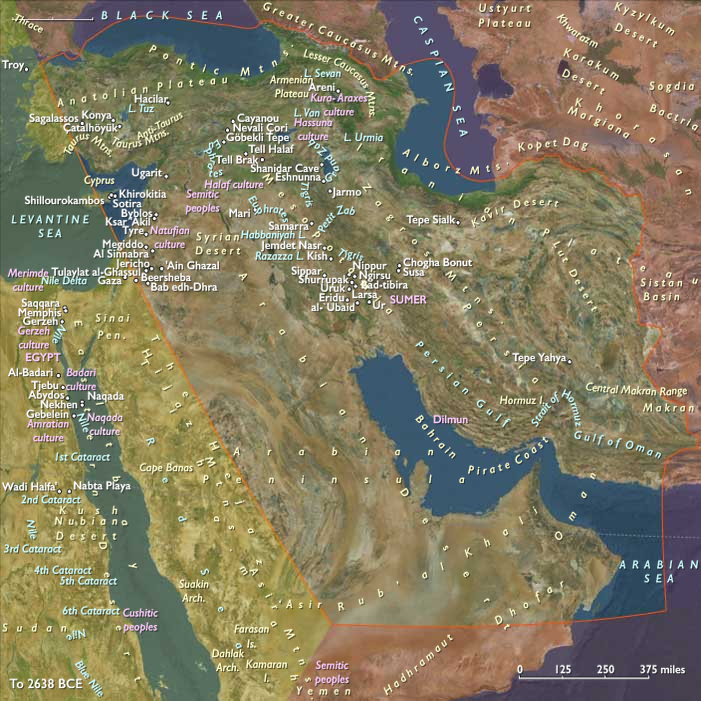
The Middle East (4077–3934 BCE): Ubaid Urbanization and Cultural Innovations
Ubaid 3/4 Culture and Urbanization
Between 4077 and 3934 BCE, the Ubaid 3/4 culture, sometimes termed Ubaid I and Ubaid II, underwent a period of intense and rapid urbanization. This transformative era saw the culture expanding significantly into northern Mesopotamia, effectively replacing the earlier Halaf culture after a brief hiatus. The growth in urban settlements was marked by the emergence of large village communities, characterized by multi-roomed rectangular mud-brick houses and the first significant examples of public temple architecture in Mesopotamia.
Settlement Patterns and Architecture
The urban expansion of the Ubaid period resulted in a hierarchical settlement pattern, with major centralized sites exceeding ten hectares, supported by numerous smaller village settlements under one hectare. These urban centers displayed enhanced social organization, infrastructural complexity, and sophisticated architectural planning.
Pottery and Technological Developments
The period is distinguished by distinctive pottery craftsmanship featuring fine-quality buff or greenish-colored ceramics intricately decorated with geometric motifs in brown or black paint. Tools, including sickles, frequently crafted from hard-fired clay in southern Mesopotamia, transitioned to stone and occasionally metal implements further north, demonstrating significant technological variation across the region.
Susa and Mesopotamian Influence
The region around Susa in southwestern modern Iran, located adjacent to lower Mesopotamia, experienced substantial cultural influence from this expanding Mesopotamian civilization starting in the fifth millennium BCE. Although strongly influenced, Susa maintained its unique cultural characteristics. By the latter half of the fourth millennium BCE, the area could be considered part of the broader Uruk culture, suggesting a complex relationship of either gradual acculturation or possible conquest.
Winemaking and Early Bronze Age Innovations in Armenia
Significant cultural insights emerged from the discovery at the cave site Areni 1, in the modern village of Areni in Armenia's Vayots Dzor Province, excavated in 2007. Excavations revealed evidence of a sophisticated winemaking enterprise, as well as culturally diverse pottery and an extensive collection of Copper Age artifacts dating between 6200 and 5900 years ago. These discoveries, including metal knives, seeds from various fruits, cereal grains, ropes, cloth, straw, grass, reeds, dried grapes, and prunes, suggest advanced agricultural and domestic practices.
In January 2011, archaeologists announced the discovery of the Areni-1 winery, dating back over six thousand years, equipped with a wine press, fermentation vats, jars, and cups, along with grape seeds and vines of the species Vitis vinifera. Notably, the cave also contained the world’s oldest known leather shoe, the Areni-1 shoe. Patrick McGovern, a biomolecular anthropologist at the University of Pennsylvania, highlighted the significance of these finds, stating, "The fact that winemaking was already so well developed in 4000 BCE suggests that the technology probably goes back much earlier."
This era underscores remarkable urbanization, cultural integration, technological innovation, and complex agricultural practices, setting crucial foundations for the development of subsequent civilizations in the ancient Middle East.