
Omai had traveled to Europe on Adventure …
Years: 1776 - 1776
Omai had traveled to Europe on Adventure, arriving at London in October 1774 where he had been introduced into British society by the naturalist Sir Joseph Banks (whom he had also met during Cook's first voyage).
During his two-year stay in England, Omai has become much admired within London high society.
Renowned for his charm, quick wit and exotic good looks, he had quickly become a favorite of the aristocratic elite.
Banks has regularly invited Omai to dine with the Royal Society and arranged meetings with notable celebrities of the time, including Lord Sandwich, Dr. Samuel Johnson, Frances Burney, and Anna Seward, among others.
Richard Holmes, a British author and academic best known for his biographical studies of major figures of British and French Romanticism, remarks that Omai's idiosyncratic behavior and distinctive bow were widely celebrated.
Indeed, during one famed meeting with King George III at Kew, Omai is said to have delivered his bow then grasped the King's hand, declaring, "How do, King Tosh!"
His portrait was painted by Sir Joshua Reynolds among others, and his journey to England and subsequent return to Tahiti with Cook on his third voyage in 1776 will become the subject of a theatrical production, written and directed by the dramatist John O'Keefe, entitled Omai – A Voyage ‘round the World that will be performed during the 1785 Christmas season at London’s Theatre Royal in Covent Garden.
During his two-year stay in England, Omai has become much admired within London high society.
Renowned for his charm, quick wit and exotic good looks, he had quickly become a favorite of the aristocratic elite.
Banks has regularly invited Omai to dine with the Royal Society and arranged meetings with notable celebrities of the time, including Lord Sandwich, Dr. Samuel Johnson, Frances Burney, and Anna Seward, among others.
Richard Holmes, a British author and academic best known for his biographical studies of major figures of British and French Romanticism, remarks that Omai's idiosyncratic behavior and distinctive bow were widely celebrated.
Indeed, during one famed meeting with King George III at Kew, Omai is said to have delivered his bow then grasped the King's hand, declaring, "How do, King Tosh!"
His portrait was painted by Sir Joshua Reynolds among others, and his journey to England and subsequent return to Tahiti with Cook on his third voyage in 1776 will become the subject of a theatrical production, written and directed by the dramatist John O'Keefe, entitled Omai – A Voyage ‘round the World that will be performed during the 1785 Christmas season at London’s Theatre Royal in Covent Garden.
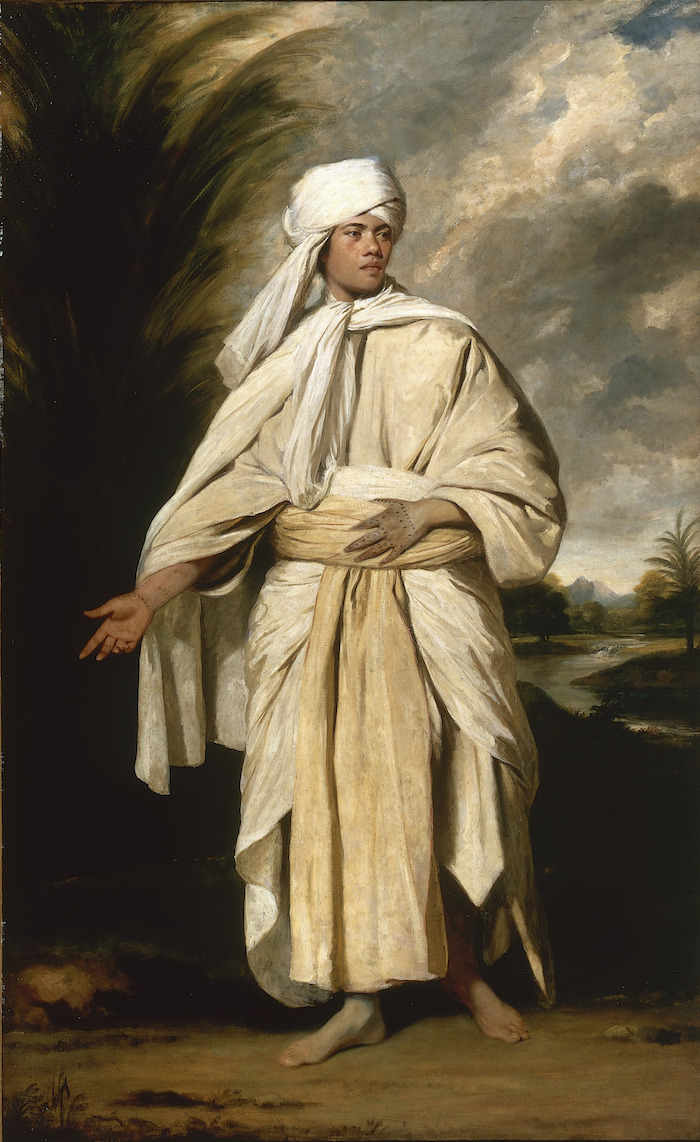
Joshua Reynolds: Portrait of Omai, a South Sea Islander who travelled to England with the second expedition of Captain Cook (circa 1776). Oil on canvas; 236 × 145.5 cm (92.9 × 57.3 in); collection of John Magnier; on loan since about 2007 at the National Gallery of Ireland.
Locations
People
- Anna Seward
- Frances Burney
- George III of Great Britain
- James Cook
- John Montagu, 4th Earl of Sandwich
- John O'Keeffe
- Joseph Banks
- Omai
- Samuel Johnson
Groups
Topics
- Exploration of Oceania, European
- Voyages of scientific exploration, European and American
- Cook, Second Voyage of James
Subjects
Regions
Subregions
Related Events
Showing 10 events out of 25581 total
Years: 1776 - 1776
Joshua Reynolds: Portrait of Omai, a South Sea Islander who travelled to England with the second expedition of Captain Cook (circa 1776). Oil on canvas; 236 × 145.5 cm (92.9 × 57.3 in); collection of John Magnier; on loan since about 2007 at the National Gallery of Ireland.
Locations
People
- Anna Seward
- Frances Burney
- George III of Great Britain
- James Cook
- John Montagu, 4th Earl of Sandwich
- John O'Keeffe
- Joseph Banks
- Omai
- Samuel Johnson
Groups
Topics
- Exploration of Oceania, European
- Voyages of scientific exploration, European and American
- Cook, Second Voyage of James
Subjects
Regions
Subregions